298 CHAPTER 12. SERIES AND TRANSFORMS
(a) f (x) = X[−1,1] (x). Thus f (x) = 1 on [−1,1] and is 0 elsewhere. Show that
limR→∞
2π
∫ R
0cos(tx)
(1t
sin t)
dt =
1 if x ∈ (−1,1)1/2 if |x|= 10 if |x|> 1
Isn’t this an amazing result?
(b) f (x) = cos(x) on(−π
2 ,π
2
)and 0 if |x|> π
2 .
(c) f (x) = sin(x) on (−2π,2π) and 0 if |x|> 2π.
(d) f (x) = cos(x) on (−π,π) and 0 if |x|> π.
(e) f (x) = e−x if x > 0,−e−|x| if x < 0.
6. Find limR→∞
∫ 1−1
sin(πt)sin(Rt)t2 dt. Hint: Consider the following steps. Using the ver-
sion of Fubini’s theorem from Theorem 9.9.4 on Page 214∫ 1
−1
sin(πt)sin(Rt)t2 = 2
∫ 1
0
sin(πt)sin(Rt)t2 dt
= 2∫ 1
0
sin(πt)t
∫ R
0cos(yt)dydt = 2
∫ R
0
∫ 1
0
sin(πt)t
cos(yt)dtdy
Now the Fourier cosine transform for the even function x→ sin(πx)x X[−1,1] ≡ f (x) is
limR→∞
2π
∫ R
0cos(xy)
∫ 1
0
sin(πt)t
cos(yt)dtdy = f (x)
This equals the value of this function at x. It looks like what this problem is askingis π f (0) . What is f (0)?
7. Do something similar to the above problem in order to compute
limR→∞
∫ 1
0
sin(Rx)√x
dx
Hint:∫ 1
0sin(Ry)√
y dy =∫ 1
0√
y∫ R
0 cos(ty)dtdy =∫ R
0∫ 1
0√
ycos(ty)dydt. Isn’t this a case
of the Fourier cosine transform for the even function x→√|x|?
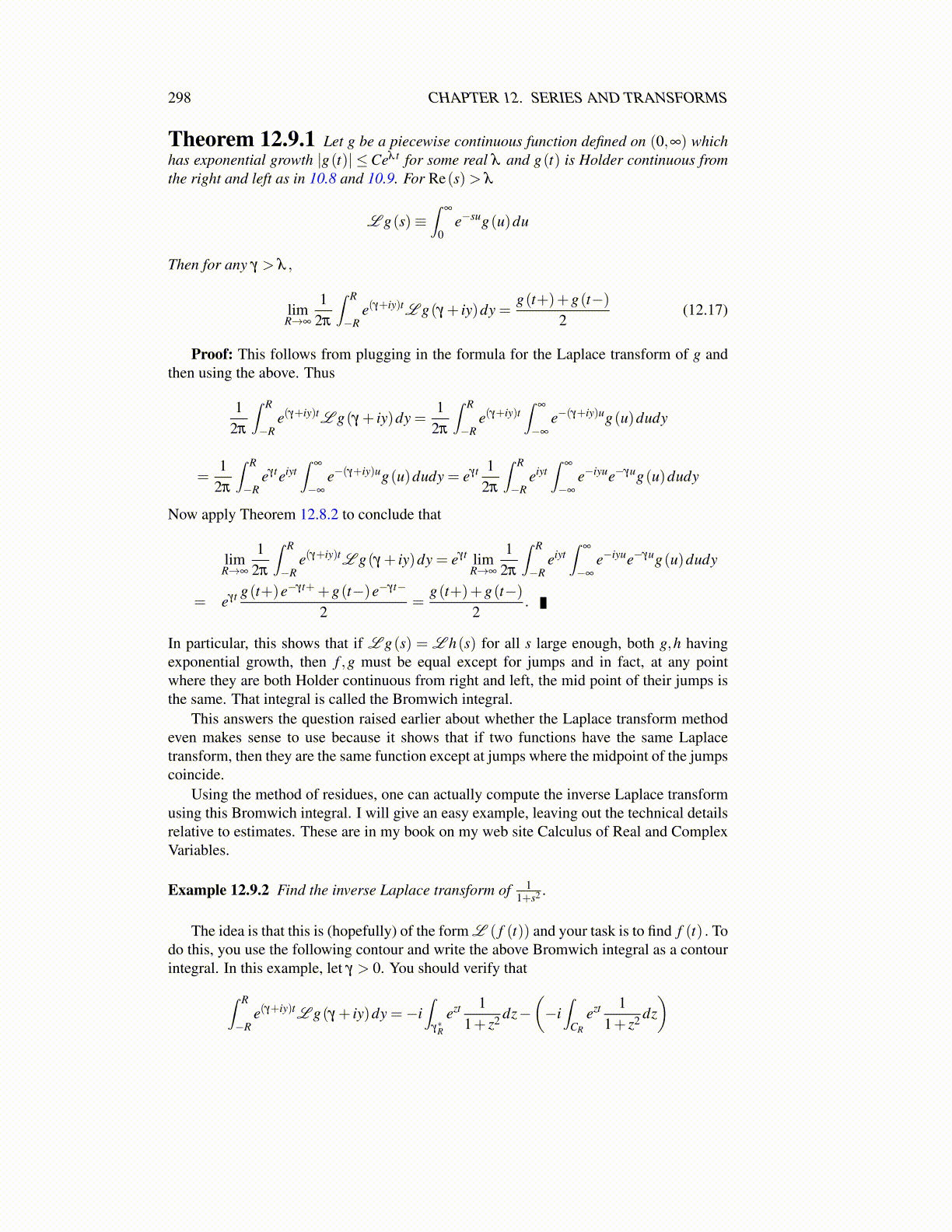
8. In example 12.9.2, verify the details. In particular, show that the contour integralover the circular part of the contour converges to 0 as R→ ∞. Explain why γ couldbe any positive number in this case. In general, you just need γ to be large enoughso that the contour encloses all the poles and the function for which you are trying tofind the inverse Laplace transform, needs to be dominated by C/ |z|α for some α > 0for all |z| large enough. Try to show this. It is a little technical but only involveselementary considerations. Thus verify Procedure 12.9.3 is valid by showing thatthe part of the contour integral over the circular part converges to 0 if the assumedestimate holds.
9. Find inverse Laplace transforms using the method of residues in Procedure 12.9.3for b
(s−a)2+b2 , s−a(s−a)2+b2 , and the other entries of the table in Problem 8 on Page 246.