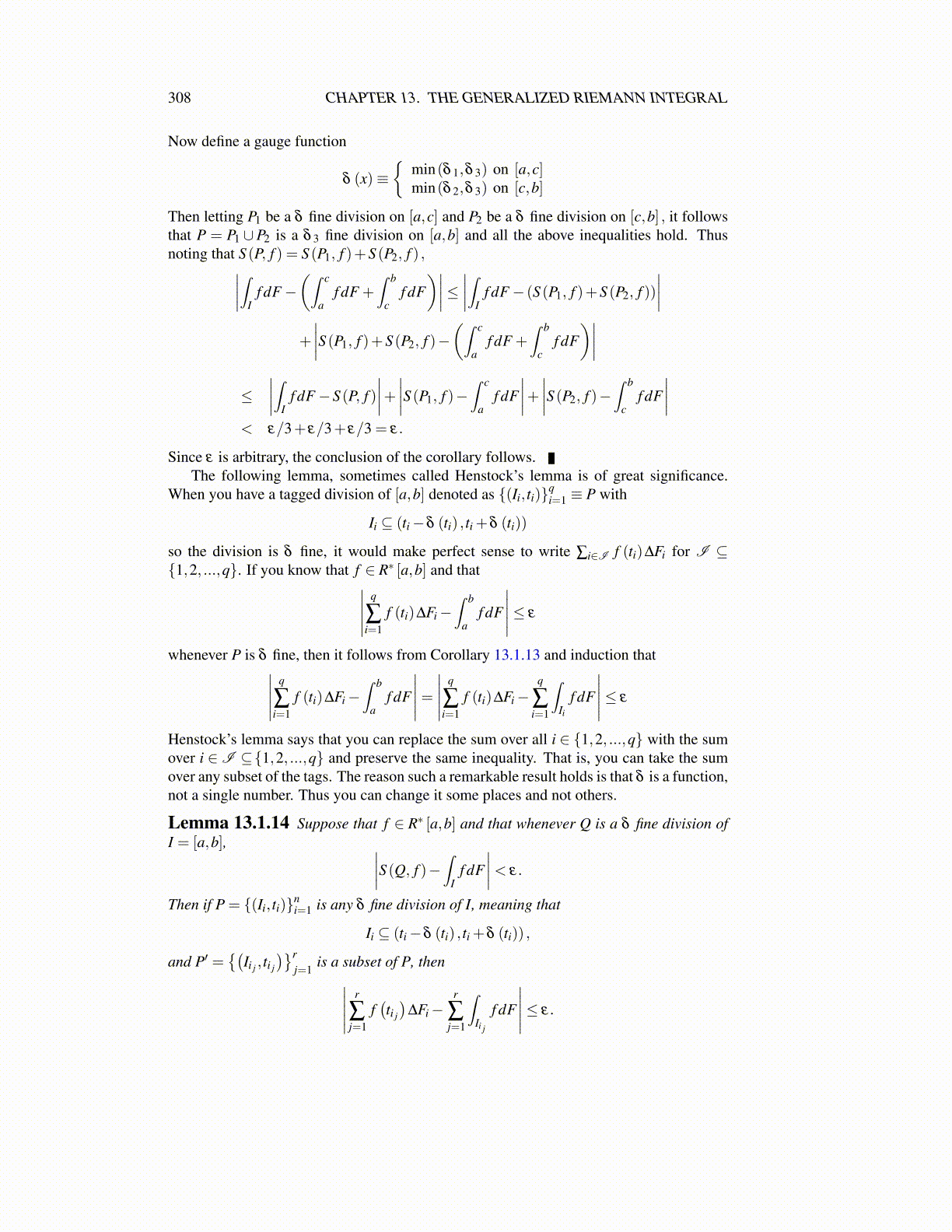
308 CHAPTER 13. THE GENERALIZED RIEMANN INTEGRAL
Corollary 13.1.16 Suppose f ∈ R∗ [a,b] has values in R and that∣∣∣∣S (P, f )−∫
If dF
∣∣∣∣≤ ε
for all P which is δ fine. Then if P = {(Ii, ti)}ni=1 is δ fine,
n
∑i=1
∣∣∣∣ f (ti)∆Fi−∫
Iif dF
∣∣∣∣≤ 2ε. (13.1)
Proof: Let I ≡{
i : f (ti)∆Fi ≥∫
Ii f dF}
and let I C ≡ {1, · · · ,n}\I . Then by Hen-stock’s lemma ∣∣∣∣∣∑i∈I f (ti)∆Fi− ∑
i∈I
∫Ii
f dF
∣∣∣∣∣= ∑i∈I
∣∣∣∣ f (ti)∆Fi−∫
Iif dF
∣∣∣∣≤ ε
and ∣∣∣∣∣ ∑i∈I C
f (ti)∆Fi− ∑i∈I C
∫Ii
f dF
∣∣∣∣∣= ∑i∈I C
∣∣∣∣ f (ti)∆Fi−∫
Iif dF
∣∣∣∣≤ ε
so adding these together yields 13.1.This generalizes immediately to the following.
Corollary 13.1.17 Suppose f ∈ R∗ [a,b] has values in C and that∣∣∣∣S (P, f )−∫
If dF
∣∣∣∣≤ ε (13.2)
for all P which is δ fine. Then if P = {(Ii, ti)}ni=1 is δ fine,
n
∑i=1
∣∣∣∣ f (ti)∆Fi−∫
Iif dF
∣∣∣∣≤ 4ε. (13.3)
Proof: It is clear that if 13.2 holds, then |S (P,Re f )−Re∫
I f dF | ≤ ε, which showsthat Re
∫I f dF =
∫I Re f dF . Similarly Im
∫I f dF =
∫I Im f dF . Therefore, using Corollary
13.1.16, ∑ni=1
∣∣∣Re f (ti)∆Fi−∫
Ii Re f dF∣∣∣ ≤ 2ε and ∑
ni=1
∣∣∣i Im f (ti)∆Fi−∫
Ii i Im f dF∣∣∣ ≤ 2ε.
Adding and using the triangle inequality, yields 13.3.
13.2 Monotone Convergence TheoremThere is nothing like the following theorem in the context of Riemann integration.
Example 13.2.1 Let {rn}∞
m=1 be the rational numbers in [0,1]. Let fn (x) be 1 if x ∈{r1, · · · ,rn} and 0 elsewhere and F (x) = x. Then fn is Riemann integrable and convergespointwise to the function f (x) which is 1 on all rationals in [0,1] and zero elsewhere. How-ever, f is not Riemann integrable. Indeed, there is a gap between the upper and lowersums. See Theorem 9.3.10 on Page 198.
In contrast to this example, here is the monotone convergence theorem.