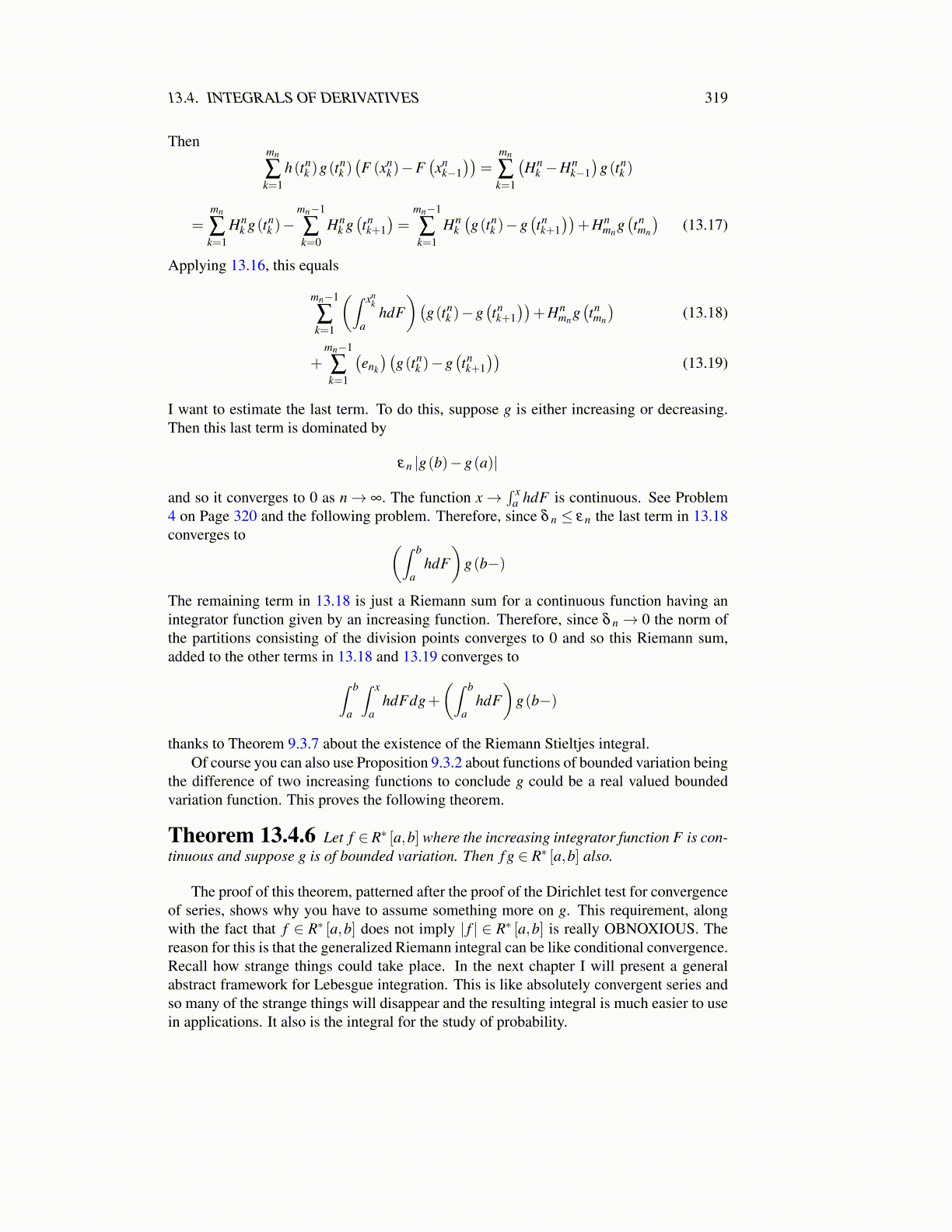
13.5. EXERCISES 319
Is this formula even valid for ordinary Riemann or Darboux integrals? Hint: It isfine if you assume f n+1 is continuous.
11. The ordinary Riemann integral is only applicable to bounded functions. However,the Generalized Riemann integral has no such restriction. Let f (x) = x−1/2 for x > 0and 0 for x = 0. Find
∫ 10 x−1/2dx. Hint: Let fn (x) = 0 for x ∈ [0,1/n] and x−1/2 for
x > 1/n. Now consider each of these functions and use the monotone convergencetheorem.
12. Do the above problem directly from the definition without involving the monotoneconvergence theorem. This involves choosing an auspicious gauge function. Definethe function to equal 0 at 0. It is undefined at this point so make it 0 there.
13. Can you establish a version of the monotone convergence theorem which has a de-creasing sequence of functions, { fk} rather than an increasing sequence?
14. For E a subset of R and F an increasing integrator function, define E to be “measur-able” if XE∩[a,b] ∈ R∗ [a,b] for each interval [a,b] and in this case, let
µ (E)≡ sup{∫ n
−nXE (t)dF : n ∈ N
}Show that if each Ek is measurable and the Ek are disjoint, then so is ∪∞
k=1Ek and if Eis measurable, then so is R\E. Show that intervals are all “measurable”. Hint: Thiswill involve the monotone convergence theorem. Thus the collection of measurablesets is closed with respect to countable disjoint unions and complements.
15. Nothing was said about the function being bounded in the presentation of the gen-eralized Riemann integral. In Problem 51 on Page 225, it was shown that you needto have the function bounded if you are going to have the definition holding for aRiemann integral to exist. However, in the case of the generalized Riemann integral,this is not necessary. Suppose F (x) = x so you have the usual Riemann type integraland let
f (x) ={
1/√
x if x ∈ (0,1]0 if x = 0
Letting ε > 0, consider δ (x) = min(|x| ,ε) for x ̸= 0 and δ (0) = ε . If you have a > 0then
∫ ba
1√x dx = 1√
t (b−a) for some t ∈ (a,b) thanks to the mean value theorem forintegrals. This t could be a tag for the interval [a,b] or it might be close enough toa tag γ that
∣∣∣ 1√t −
1√γ
∣∣∣ is small. Modify δ on [ε,1] a compact set on which 1/√
x is
continuous. Compare the Riemann sums with the tags and∫ 1
ε1/√
xdx. When youdo this, it really looks a lot like the standard method of finding an improper Riemannintegral.
16. Let F be an increasing integrator function. In Proposition 13.3.4 an argument wasgiven which showed that if I is an interval contained on the interior of an interval(a,b) , then XI was in R∗ [a,b]. However, this was not computed. In this problem wedo this. Let a < α < β < b. For x /∈ {α,β} , let
δ (x)≡min(|x−α| , |x−β |)