8.8. EXERCISES 217
(a) By Lemma 8.2.10, there exists a sequence { fn} ⊆ Cc (Ω) which converges tof off a set N of measure zero. Use Eggoroff’s theorem to enlarge N to N̂ suchthat µ
(N̂)< ε
2 and convergence is uniform off N̂.
(b) Next use outer regularity to obtain open V ⊇ N̂ having measure less than ε .Thus { fn} converges uniformly on VC. Therefore, that which it converges to iscontinuous on VC a closed set. Now use the Tietze extension theorem.
25. Let A :Rn→Rn be continuous and let f∈Rn. Also let (·, ·) denote the standard innerproduct in Rn. Letting K be a closed and bounded and convex set, show that thereexists x ∈ K such that for all y ∈ K,(f−Ax,y−x) ≤ 0. Hint: Show that this is thesame as saying P(f−Ax+x) = x for some x∈K where here P is the projection mapdiscussed above in the problems beginning with Problem 22 on Page 77. Now usethe Brouwer fixed point theorem. This little observation is called Browder’s lemma.It is a fundamental result in nonlinear analysis.
26. ↑In the above problem, suppose that you have a coercivity result which is
lim∥x∥→∞
(Ax,x)∥x∥
= ∞.
Show that if you have this, then you don’t need to assume the convex closed set isbounded. In case K = Rn, and this coercivity holds, show that A maps onto Rn.
27. Suppose f : Rn→ Rn is one to one and continuous. Suppose
lim∥x∥→∞
∥f(x)∥= ∞.
Show that f must also be onto. Hint: By invariance of domain, f(Rn) is open. Showthat Rn \ f(Rn) is also open. Since f(Rn) is connected (by theorems on connectedsets), one of these open sets is empty.
28. Explain why, if J is a simple closed curve, it has empty interior. Hint: If J containsa ball, then would some point of J fail to be a limit point of the components of JC?
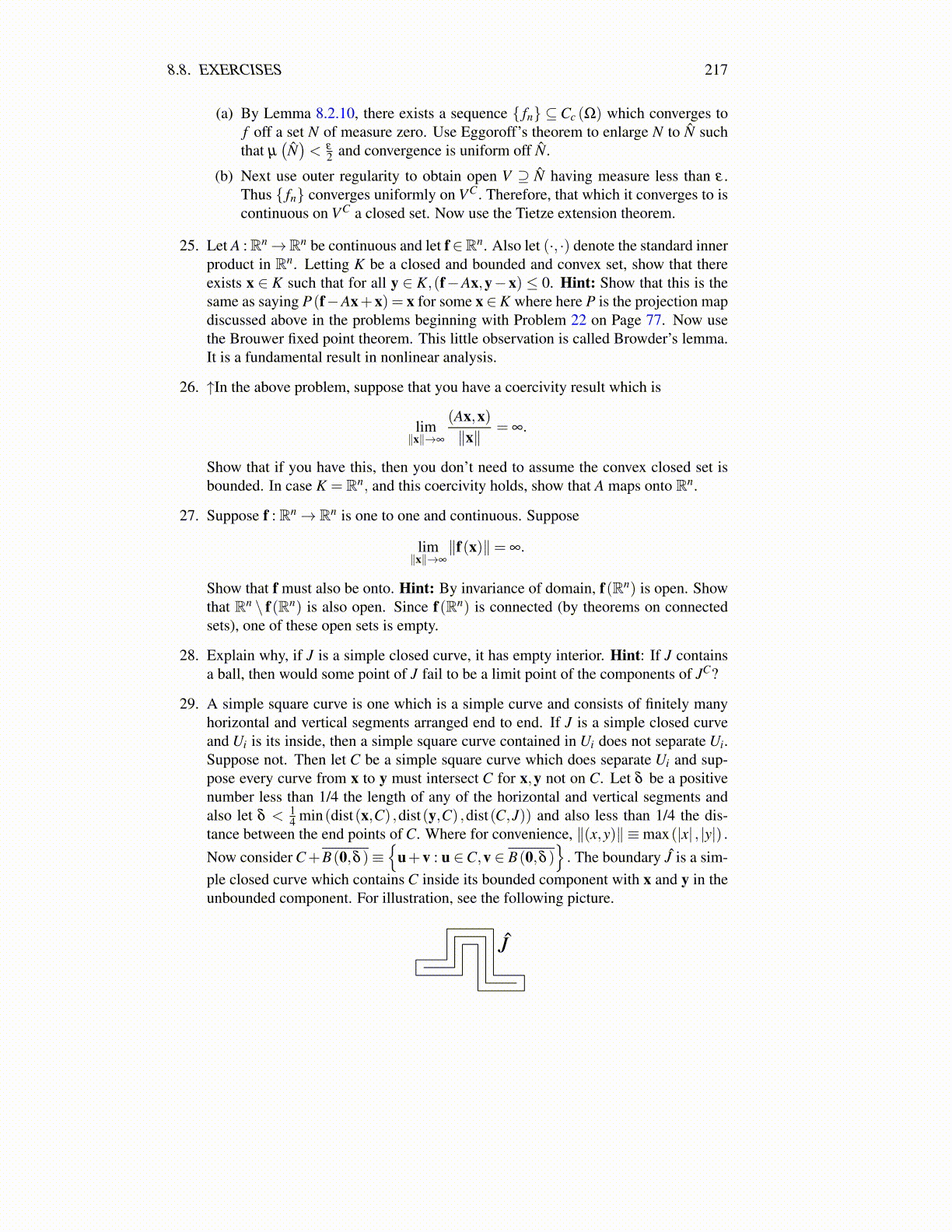
29. A simple square curve is one which is a simple curve and consists of finitely manyhorizontal and vertical segments arranged end to end. If J is a simple closed curveand Ui is its inside, then a simple square curve contained in Ui does not separate Ui.Suppose not. Then let C be a simple square curve which does separate Ui and sup-pose every curve from x to y must intersect C for x,y not on C. Let δ be a positivenumber less than 1/4 the length of any of the horizontal and vertical segments andalso let δ < 1
4 min(dist(x,C) ,dist(y,C) ,dist(C,J)) and also less than 1/4 the dis-tance between the end points of C. Where for convenience, ∥(x,y)∥ ≡max(|x| , |y|) .Now consider C+B(0,δ )≡
{u+v : u ∈C,v ∈ B(0,δ )
}. The boundary Ĵ is a sim-
ple closed curve which contains C inside its bounded component with x and y in theunbounded component. For illustration, see the following picture.
Ĵ