220 CHAPTER 9. BASIC FUNCTION SPACES
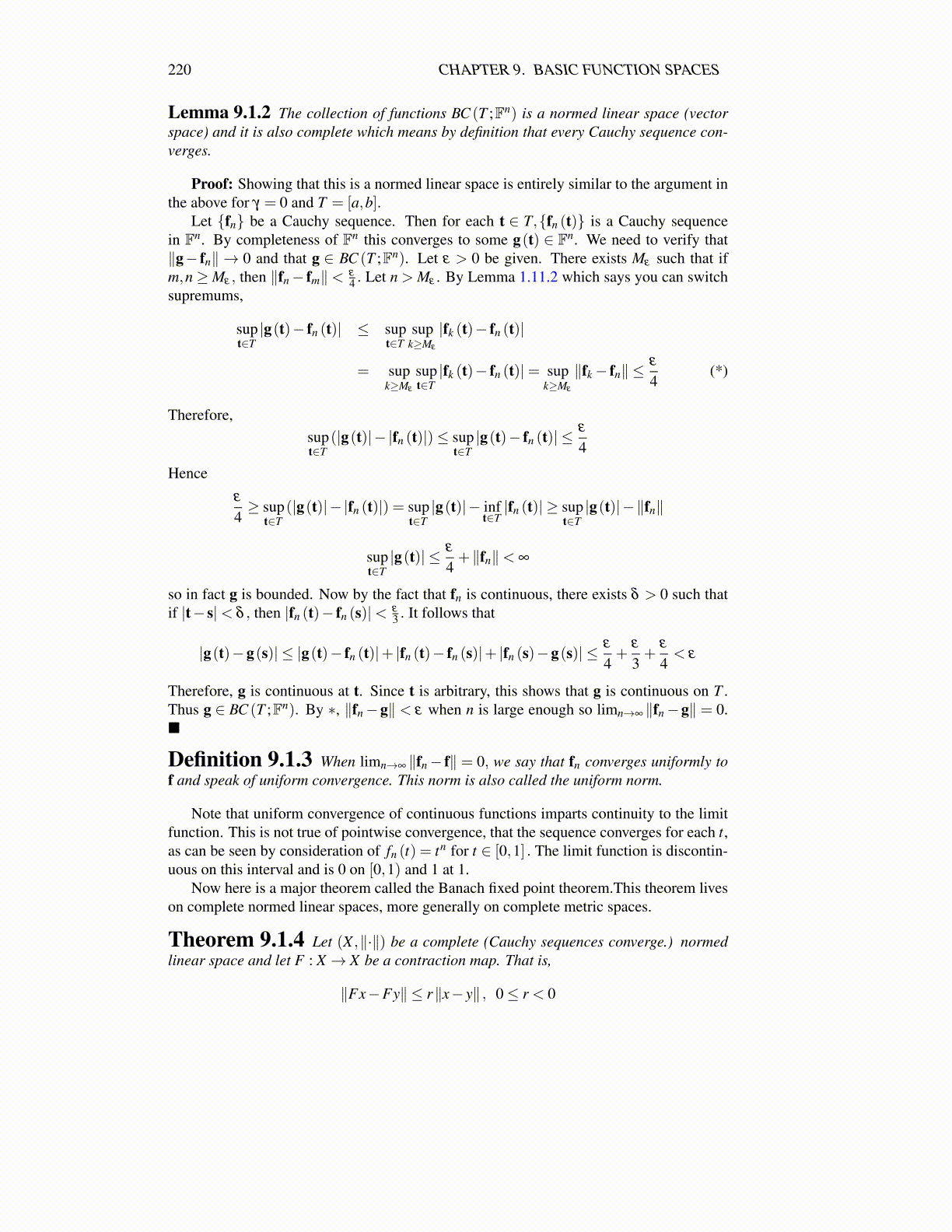
Lemma 9.1.2 The collection of functions BC (T ;Fn) is a normed linear space (vectorspace) and it is also complete which means by definition that every Cauchy sequence con-verges.
Proof: Showing that this is a normed linear space is entirely similar to the argument inthe above for γ = 0 and T = [a,b].
Let {fn} be a Cauchy sequence. Then for each t ∈ T,{fn (t)} is a Cauchy sequencein Fn. By completeness of Fn this converges to some g(t) ∈ Fn. We need to verify that∥g− fn∥ → 0 and that g ∈ BC (T ;Fn). Let ε > 0 be given. There exists Mε such that ifm,n≥Mε , then ∥fn− fm∥< ε
4 . Let n > Mε . By Lemma 1.11.2 which says you can switchsupremums,
supt∈T|g(t)− fn (t)| ≤ sup
t∈Tsup
k≥Mε
|fk (t)− fn (t)|
= supk≥Mε
supt∈T|fk (t)− fn (t)|= sup
k≥Mε
∥fk− fn∥ ≤ε
4(*)
Therefore,supt∈T
(|g(t)|− |fn (t)|)≤ supt∈T|g(t)− fn (t)| ≤
ε
4
Henceε
4≥ sup
t∈T(|g(t)|− |fn (t)|) = sup
t∈T|g(t)|− inf
t∈T|fn (t)| ≥ sup
t∈T|g(t)|−∥fn∥
supt∈T|g(t)| ≤ ε
4+∥fn∥< ∞
so in fact g is bounded. Now by the fact that fn is continuous, there exists δ > 0 such thatif |t− s|< δ , then |fn (t)− fn (s)|< ε
3 . It follows that
|g(t)−g(s)| ≤ |g(t)− fn (t)|+ |fn (t)− fn (s)|+ |fn (s)−g(s)| ≤ ε
4+
ε
3+
ε
4< ε
Therefore, g is continuous at t. Since t is arbitrary, this shows that g is continuous on T .Thus g ∈ BC (T ;Fn). By ∗, ∥fn−g∥ < ε when n is large enough so limn→∞ ∥fn−g∥ = 0.■
Definition 9.1.3 When limn→∞ ∥fn− f∥ = 0, we say that fn converges uniformly tof and speak of uniform convergence. This norm is also called the uniform norm.
Note that uniform convergence of continuous functions imparts continuity to the limitfunction. This is not true of pointwise convergence, that the sequence converges for each t,as can be seen by consideration of fn (t) = tn for t ∈ [0,1] . The limit function is discontin-uous on this interval and is 0 on [0,1) and 1 at 1.
Now here is a major theorem called the Banach fixed point theorem.This theorem liveson complete normed linear spaces, more generally on complete metric spaces.
Theorem 9.1.4 Let (X ,∥·∥) be a complete (Cauchy sequences converge.) normedlinear space and let F : X → X be a contraction map. That is,
∥Fx−Fy∥ ≤ r∥x− y∥ , 0≤ r < 0