9.2. COMPACTNESS IN C (K,Rn) 223
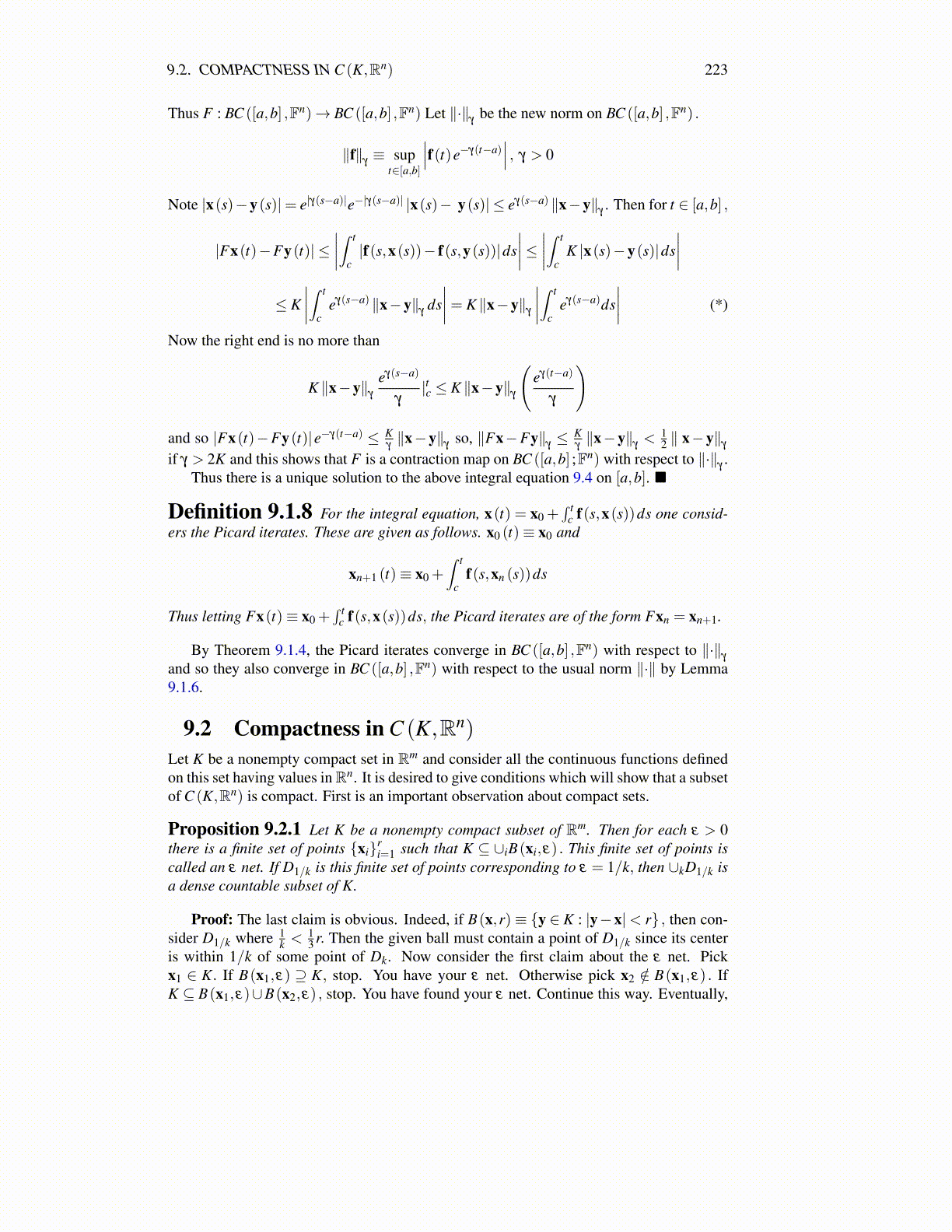
Thus F : BC ([a,b] ,Fn)→ BC ([a,b] ,Fn) Let ∥·∥γ
be the new norm on BC ([a,b] ,Fn) .
∥f∥γ≡ sup
t∈[a,b]
∣∣∣f(t)e−γ(t−a)∣∣∣ , γ > 0
Note |x(s)−y(s)|= e|γ(s−a)|e−|γ(s−a)| |x(s)− y(s)| ≤ eγ(s−a) ∥x−y∥γ. Then for t ∈ [a,b] ,
|Fx(t)−Fy(t)| ≤∣∣∣∣∫ t
c|f(s,x(s))− f(s,y(s))|ds
∣∣∣∣≤ ∣∣∣∣∫ t
cK |x(s)−y(s)|ds
∣∣∣∣≤ K
∣∣∣∣∫ t
ceγ(s−a) ∥x−y∥
γds∣∣∣∣= K ∥x−y∥
γ
∣∣∣∣∫ t
ceγ(s−a)ds
∣∣∣∣ (*)
Now the right end is no more than
K ∥x−y∥γ
eγ(s−a)
γ|tc ≤ K ∥x−y∥
γ
(eγ(t−a)
γ
)
and so |Fx(t)−Fy(t)|e−γ(t−a) ≤ Kγ∥x−y∥
γso, ∥Fx−Fy∥
γ≤ K
γ∥x−y∥
γ< 1
2 ∥ x−y∥γ
if γ > 2K and this shows that F is a contraction map on BC ([a,b] ;Fn) with respect to ∥·∥γ.
Thus there is a unique solution to the above integral equation 9.4 on [a,b]. ■
Definition 9.1.8 For the integral equation, x(t) = x0 +∫ t
c f(s,x(s))ds one consid-ers the Picard iterates. These are given as follows. x0 (t)≡ x0 and
xn+1 (t)≡ x0 +∫ t
cf(s,xn (s))ds
Thus letting Fx(t)≡ x0 +∫ t
c f(s,x(s))ds, the Picard iterates are of the form Fxn = xn+1.
By Theorem 9.1.4, the Picard iterates converge in BC ([a,b] ,Fn) with respect to ∥·∥γ
and so they also converge in BC ([a,b] ,Fn) with respect to the usual norm ∥·∥ by Lemma9.1.6.
9.2 Compactness in C (K,Rn)
Let K be a nonempty compact set in Rm and consider all the continuous functions definedon this set having values inRn. It is desired to give conditions which will show that a subsetof C (K,Rn) is compact. First is an important observation about compact sets.
Proposition 9.2.1 Let K be a nonempty compact subset of Rm. Then for each ε > 0there is a finite set of points {xi}r
i=1 such that K ⊆ ∪iB(xi,ε) . This finite set of points iscalled an ε net. If D1/k is this finite set of points corresponding to ε = 1/k, then ∪kD1/k isa dense countable subset of K.
Proof: The last claim is obvious. Indeed, if B(x,r) ≡ {y ∈ K : |y−x|< r} , then con-sider D1/k where 1
k < 13 r. Then the given ball must contain a point of D1/k since its center
is within 1/k of some point of Dk. Now consider the first claim about the ε net. Pickx1 ∈ K. If B(x1,ε) ⊇ K, stop. You have your ε net. Otherwise pick x2 /∈ B(x1,ε) . IfK ⊆ B(x1,ε)∪B(x2,ε) , stop. You have found your ε net. Continue this way. Eventually,