228 CHAPTER 9. BASIC FUNCTION SPACES
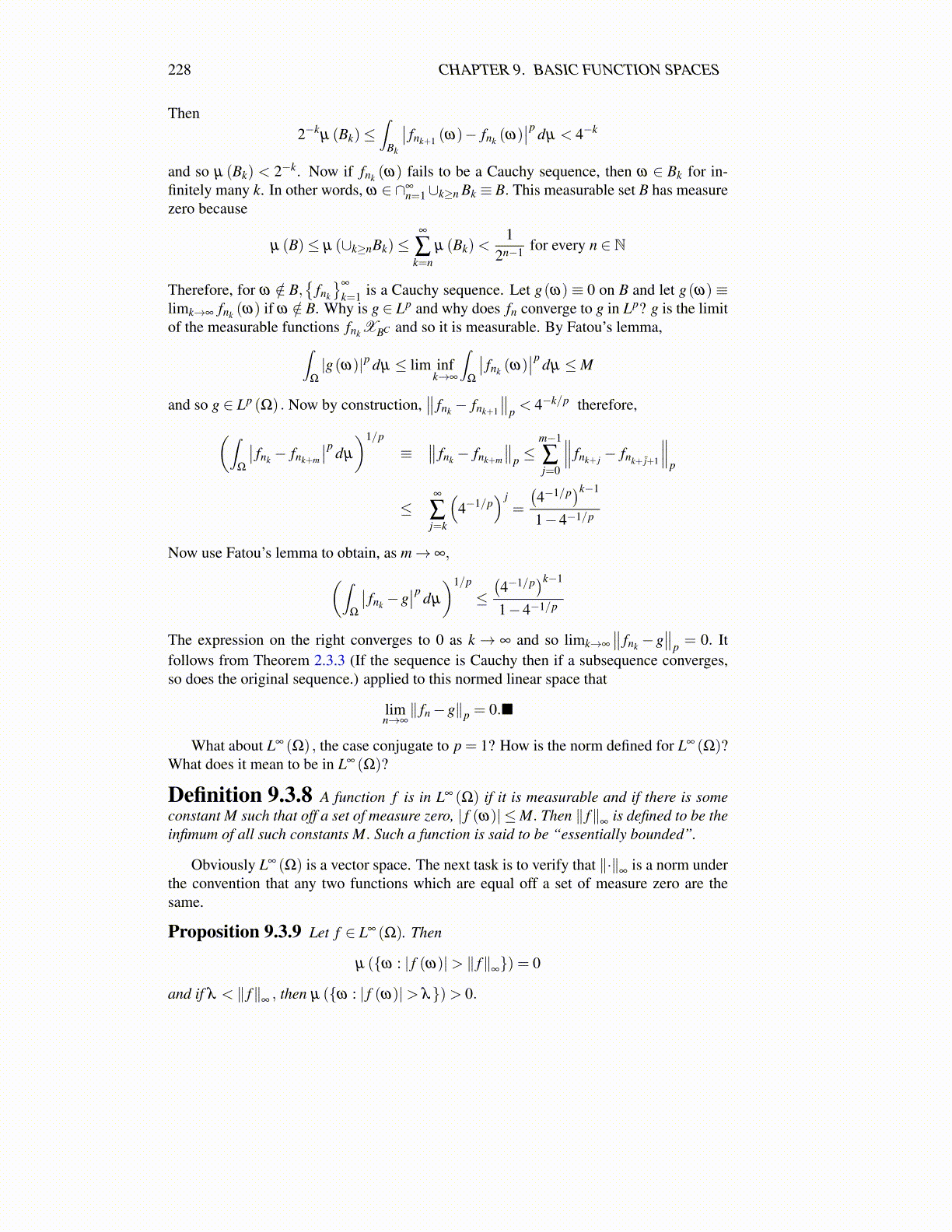
Then2−k
µ (Bk)≤∫
Bk
∣∣ fnk+1 (ω)− fnk (ω)∣∣p dµ < 4−k
and so µ (Bk) < 2−k. Now if fnk (ω) fails to be a Cauchy sequence, then ω ∈ Bk for in-finitely many k. In other words, ω ∈ ∩∞
n=1∪k≥n Bk ≡ B. This measurable set B has measurezero because
µ (B)≤ µ (∪k≥nBk)≤∞
∑k=n
µ (Bk)<1
2n−1 for every n ∈ N
Therefore, for ω /∈ B,{
fnk
}∞
k=1 is a Cauchy sequence. Let g(ω)≡ 0 on B and let g(ω)≡limk→∞ fnk (ω) if ω /∈ B. Why is g ∈ Lp and why does fn converge to g in Lp? g is the limitof the measurable functions fnkXBC and so it is measurable. By Fatou’s lemma,∫
Ω
|g(ω)|p dµ ≤ lim infk→∞
∫Ω
∣∣ fnk (ω)∣∣p dµ ≤M
and so g ∈ Lp (Ω) . Now by construction,∥∥ fnk − fnk+1
∥∥p < 4−k/p therefore,(∫
Ω
∣∣ fnk − fnk+m
∣∣p dµ
)1/p
≡∥∥ fnk − fnk+m
∥∥p ≤
m−1
∑j=0
∥∥∥ fnk+ j − fnk+ j̄+1
∥∥∥p
≤∞
∑j=k
(4−1/p
) j=
(4−1/p
)k−1
1−4−1/p
Now use Fatou’s lemma to obtain, as m→ ∞,(∫Ω
∣∣ fnk −g∣∣p dµ
)1/p
≤(4−1/p
)k−1
1−4−1/p
The expression on the right converges to 0 as k → ∞ and so limk→∞
∥∥ fnk −g∥∥
p = 0. Itfollows from Theorem 2.3.3 (If the sequence is Cauchy then if a subsequence converges,so does the original sequence.) applied to this normed linear space that
limn→∞∥ fn−g∥p = 0.■
What about L∞ (Ω) , the case conjugate to p = 1? How is the norm defined for L∞ (Ω)?What does it mean to be in L∞ (Ω)?
Definition 9.3.8 A function f is in L∞ (Ω) if it is measurable and if there is someconstant M such that off a set of measure zero, | f (ω)| ≤M. Then ∥ f∥
∞is defined to be the
infimum of all such constants M. Such a function is said to be “essentially bounded”.
Obviously L∞ (Ω) is a vector space. The next task is to verify that ∥·∥∞
is a norm underthe convention that any two functions which are equal off a set of measure zero are thesame.
Proposition 9.3.9 Let f ∈ L∞ (Ω). Then
µ ({ω : | f (ω)|> ∥ f∥∞}) = 0
and if λ < ∥ f∥∞, then µ ({ω : | f (ω)|> λ})> 0.