234 CHAPTER 9. BASIC FUNCTION SPACES
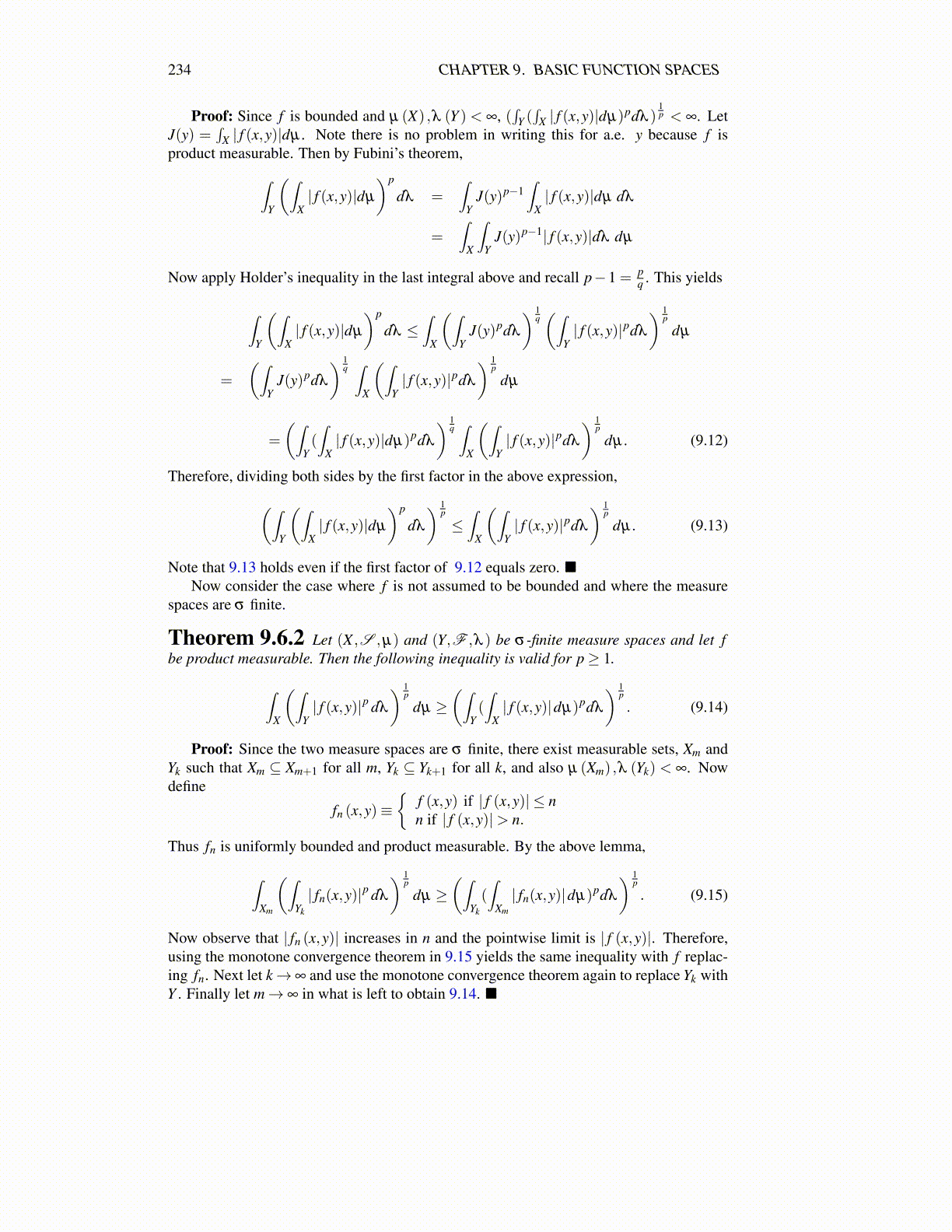
Proof: Since f is bounded and µ (X) ,λ (Y ) < ∞, (∫
Y (∫
X | f (x,y)|dµ)pdλ )1p < ∞. Let
J(y) =∫
X | f (x,y)|dµ . Note there is no problem in writing this for a.e. y because f isproduct measurable. Then by Fubini’s theorem,∫
Y
(∫X| f (x,y)|dµ
)p
dλ =∫
YJ(y)p−1
∫X| f (x,y)|dµ dλ
=∫
X
∫Y
J(y)p−1| f (x,y)|dλ dµ
Now apply Holder’s inequality in the last integral above and recall p−1 = pq . This yields
∫Y
(∫X| f (x,y)|dµ
)p
dλ ≤∫
X
(∫Y
J(y)pdλ
) 1q(∫
Y| f (x,y)|pdλ
) 1p
dµ
=
(∫Y
J(y)pdλ
) 1q ∫
X
(∫Y| f (x,y)|pdλ
) 1p
dµ
=
(∫Y(∫
X| f (x,y)|dµ)pdλ
) 1q ∫
X
(∫Y| f (x,y)|pdλ
) 1p
dµ . (9.12)
Therefore, dividing both sides by the first factor in the above expression,(∫Y
(∫X| f (x,y)|dµ
)p
dλ
) 1p
≤∫
X
(∫Y| f (x,y)|pdλ
) 1p
dµ . (9.13)
Note that 9.13 holds even if the first factor of 9.12 equals zero. ■Now consider the case where f is not assumed to be bounded and where the measure
spaces are σ finite.
Theorem 9.6.2 Let (X ,S ,µ) and (Y,F ,λ ) be σ -finite measure spaces and let fbe product measurable. Then the following inequality is valid for p≥ 1.
∫X
(∫Y| f (x,y)|p dλ
) 1p
dµ ≥(∫
Y(∫
X| f (x,y)|dµ)pdλ
) 1p
. (9.14)
Proof: Since the two measure spaces are σ finite, there exist measurable sets, Xm andYk such that Xm ⊆ Xm+1 for all m, Yk ⊆ Yk+1 for all k, and also µ (Xm) ,λ (Yk) < ∞. Nowdefine
fn (x,y)≡{
f (x,y) if | f (x,y)| ≤ nn if | f (x,y)|> n.
Thus fn is uniformly bounded and product measurable. By the above lemma,
∫Xm
(∫Yk
| fn(x,y)|p dλ
) 1p
dµ ≥(∫
Yk
(∫
Xm
| fn(x,y)|dµ)pdλ
) 1p
. (9.15)
Now observe that | fn (x,y)| increases in n and the pointwise limit is | f (x,y)|. Therefore,using the monotone convergence theorem in 9.15 yields the same inequality with f replac-ing fn. Next let k→∞ and use the monotone convergence theorem again to replace Yk withY . Finally let m→ ∞ in what is left to obtain 9.14. ■