10.2. CHANGE OF VARIABLES NONLINEAR MAPS 243
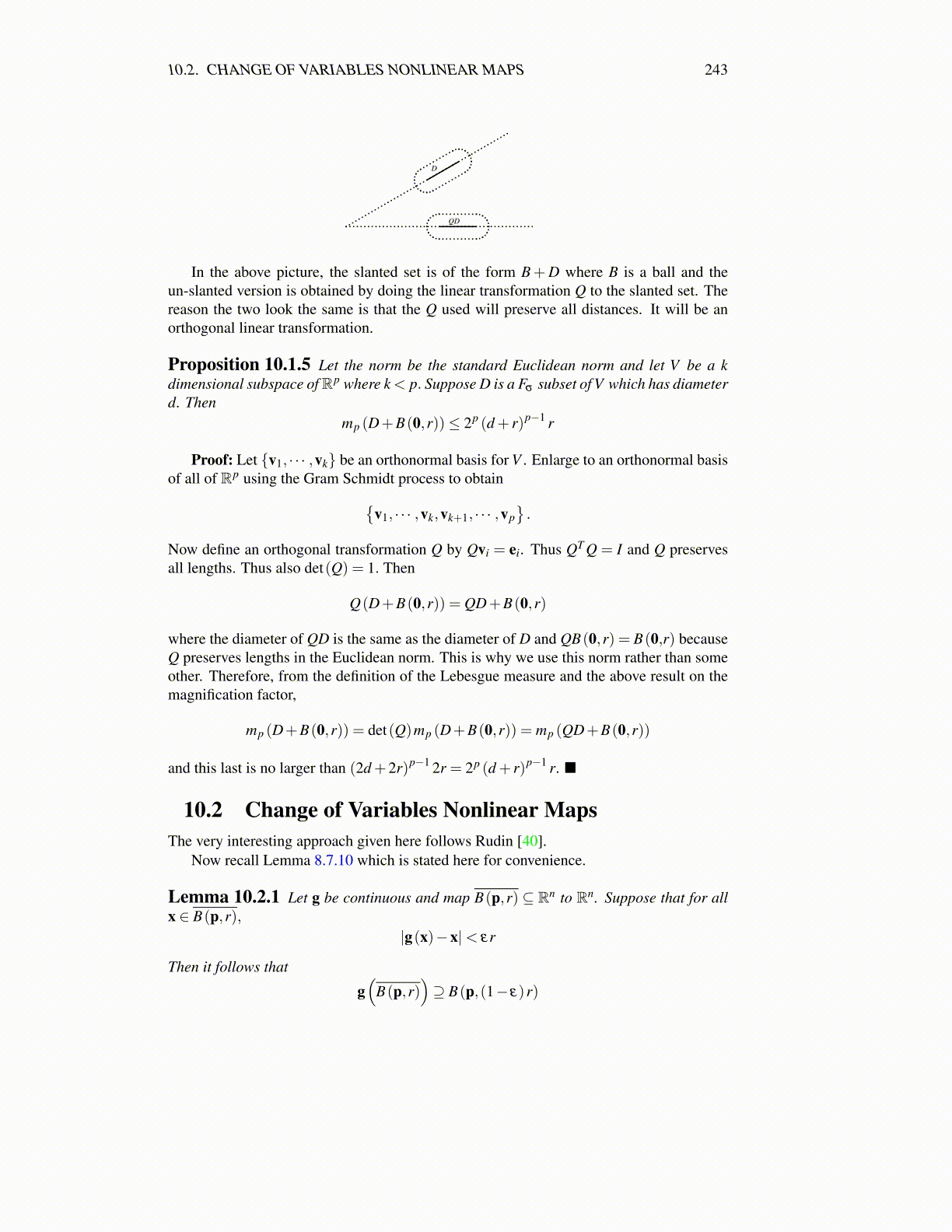
D
QD
In the above picture, the slanted set is of the form B+D where B is a ball and theun-slanted version is obtained by doing the linear transformation Q to the slanted set. Thereason the two look the same is that the Q used will preserve all distances. It will be anorthogonal linear transformation.
Proposition 10.1.5 Let the norm be the standard Euclidean norm and let V be a kdimensional subspace ofRp where k < p. Suppose D is a Fσ subset of V which has diameterd. Then
mp (D+B(0,r))≤ 2p (d + r)p−1 r
Proof: Let {v1, · · · ,vk} be an orthonormal basis for V . Enlarge to an orthonormal basisof all of Rp using the Gram Schmidt process to obtain{
v1, · · · ,vk,vk+1, · · · ,vp}.
Now define an orthogonal transformation Q by Qvi = ei. Thus QT Q = I and Q preservesall lengths. Thus also det(Q) = 1. Then
Q(D+B(0,r)) = QD+B(0,r)
where the diameter of QD is the same as the diameter of D and QB(0,r) = B(0,r) becauseQ preserves lengths in the Euclidean norm. This is why we use this norm rather than someother. Therefore, from the definition of the Lebesgue measure and the above result on themagnification factor,
mp (D+B(0,r)) = det(Q)mp (D+B(0,r)) = mp (QD+B(0,r))
and this last is no larger than (2d +2r)p−1 2r = 2p (d + r)p−1 r. ■
10.2 Change of Variables Nonlinear MapsThe very interesting approach given here follows Rudin [40].
Now recall Lemma 8.7.10 which is stated here for convenience.
Lemma 10.2.1 Let g be continuous and map B(p,r) ⊆ Rn to Rn. Suppose that for allx ∈ B(p,r),
|g(x)−x|< εr
Then it follows that
g(
B(p,r))⊇ B(p,(1− ε)r)