254 CHAPTER 10. CHANGE OF VARIABLES
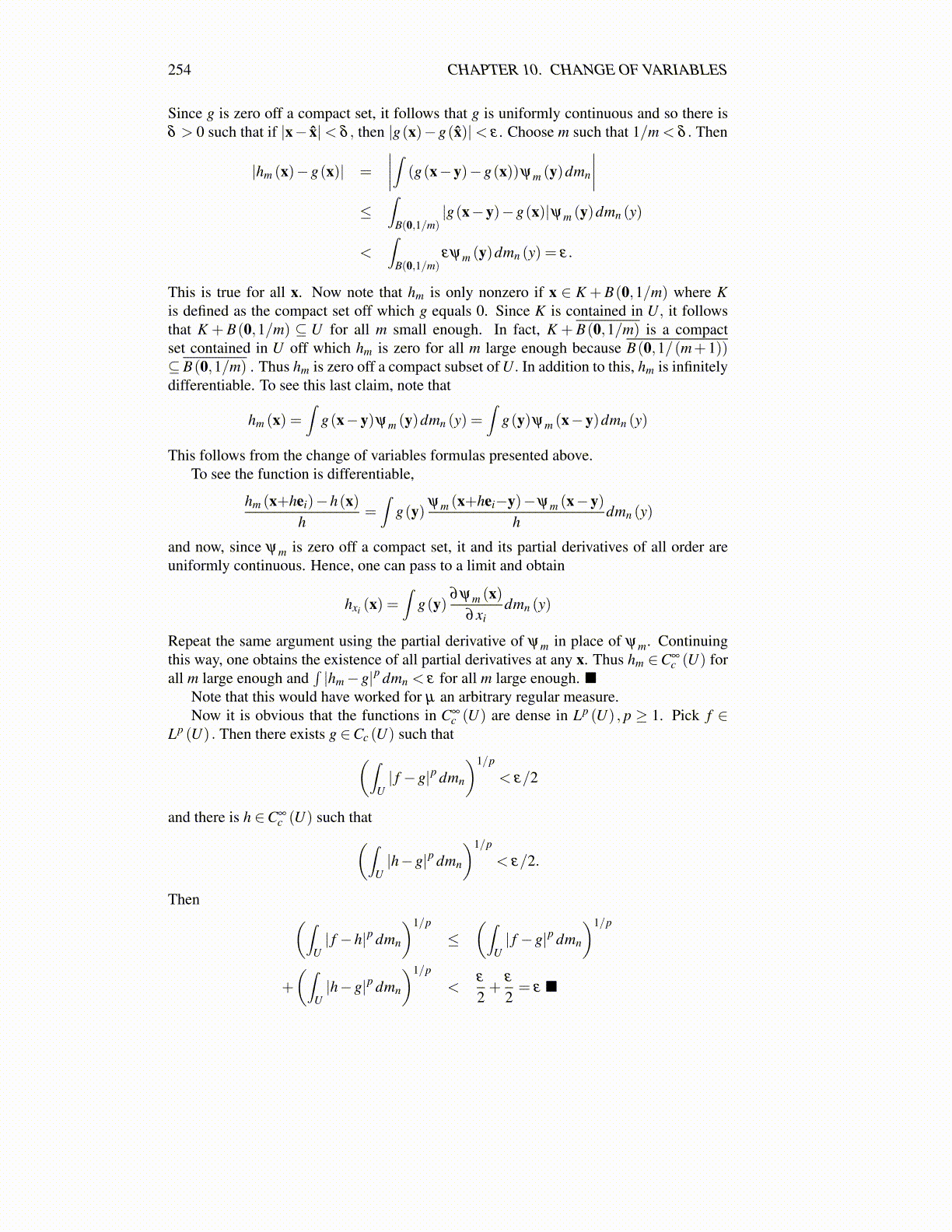
Since g is zero off a compact set, it follows that g is uniformly continuous and so there isδ > 0 such that if |x− x̂|< δ , then |g(x)−g(x̂)|< ε . Choose m such that 1/m < δ . Then
|hm (x)−g(x)| =
∣∣∣∣∫ (g(x−y)−g(x))ψm (y)dmn
∣∣∣∣≤
∫B(0,1/m)
|g(x−y)−g(x)|ψm (y)dmn (y)
<∫
B(0,1/m)εψm (y)dmn (y) = ε.
This is true for all x. Now note that hm is only nonzero if x ∈ K +B(0,1/m) where Kis defined as the compact set off which g equals 0. Since K is contained in U, it followsthat K + B(0,1/m) ⊆ U for all m small enough. In fact, K + B(0,1/m) is a compactset contained in U off which hm is zero for all m large enough because B(0,1/(m+1))⊆ B(0,1/m) . Thus hm is zero off a compact subset of U. In addition to this, hm is infinitelydifferentiable. To see this last claim, note that
hm (x) =∫
g(x−y)ψm (y)dmn (y) =∫
g(y)ψm (x−y)dmn (y)
This follows from the change of variables formulas presented above.To see the function is differentiable,
hm (x+hei)−h(x)h
=∫
g(y)ψm (x+hei−y)−ψm (x−y)
hdmn (y)
and now, since ψm is zero off a compact set, it and its partial derivatives of all order areuniformly continuous. Hence, one can pass to a limit and obtain
hxi (x) =∫
g(y)∂ψm (x)
∂xidmn (y)
Repeat the same argument using the partial derivative of ψm in place of ψm. Continuingthis way, one obtains the existence of all partial derivatives at any x. Thus hm ∈C∞
c (U) forall m large enough and
∫|hm−g|p dmn < ε for all m large enough. ■
Note that this would have worked for µ an arbitrary regular measure.Now it is obvious that the functions in C∞
c (U) are dense in Lp (U) , p ≥ 1. Pick f ∈Lp (U) . Then there exists g ∈Cc (U) such that(∫
U| f −g|p dmn
)1/p
< ε/2
and there is h ∈C∞c (U) such that(∫
U|h−g|p dmn
)1/p
< ε/2.
Then (∫U| f −h|p dmn
)1/p
≤(∫
U| f −g|p dmn
)1/p
+
(∫U|h−g|p dmn
)1/p
<ε
2+
ε
2= ε ■