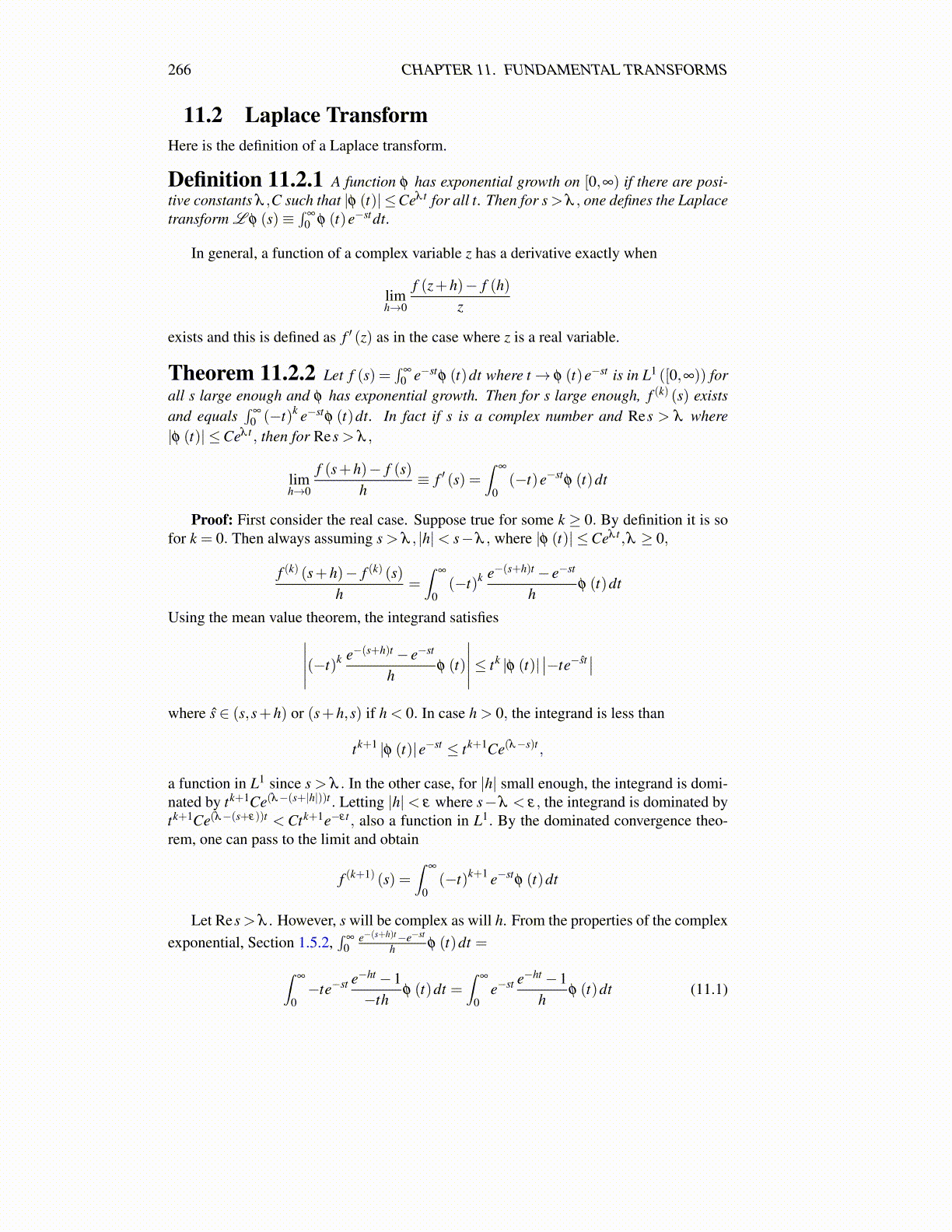
266 CHAPTER 11. FUNDAMENTAL TRANSFORMS
11.2 Laplace TransformHere is the definition of a Laplace transform.
Definition 11.2.1 A function φ has exponential growth on [0,∞) if there are posi-tive constants λ ,C such that |φ (t)| ≤Ceλ t for all t. Then for s > λ , one defines the Laplacetransform L φ (s)≡
∫∞
0 φ (t)e−stdt.
In general, a function of a complex variable z has a derivative exactly when
limh→0
f (z+h)− f (h)z
exists and this is defined as f ′ (z) as in the case where z is a real variable.
Theorem 11.2.2 Let f (s) =∫
∞
0 e−stφ (t)dt where t→ φ (t)e−st is in L1 ([0,∞)) forall s large enough and φ has exponential growth. Then for s large enough, f (k) (s) existsand equals
∫∞
0 (−t)k e−stφ (t)dt. In fact if s is a complex number and Res > λ where|φ (t)| ≤Ceλ t , then for Res > λ ,
limh→0
f (s+h)− f (s)h
≡ f ′ (s) =∫
∞
0(−t)e−st
φ (t)dt
Proof: First consider the real case. Suppose true for some k ≥ 0. By definition it is sofor k = 0. Then always assuming s > λ , |h|< s−λ , where |φ (t)| ≤Ceλ t ,λ ≥ 0,
f (k) (s+h)− f (k) (s)h
=∫
∞
0(−t)k e−(s+h)t − e−st
hφ (t)dt
Using the mean value theorem, the integrand satisfies∣∣∣∣∣(−t)k e−(s+h)t − e−st
hφ (t)
∣∣∣∣∣≤ tk |φ (t)|∣∣−te−ŝt ∣∣
where ŝ ∈ (s,s+h) or (s+h,s) if h < 0. In case h > 0, the integrand is less than
tk+1 |φ (t)|e−st ≤ tk+1Ce(λ−s)t ,
a function in L1 since s > λ . In the other case, for |h| small enough, the integrand is domi-nated by tk+1Ce(λ−(s+|h|))t . Letting |h|< ε where s−λ < ε, the integrand is dominated bytk+1Ce(λ−(s+ε))t < Ctk+1e−εt , also a function in L1. By the dominated convergence theo-rem, one can pass to the limit and obtain
f (k+1) (s) =∫
∞
0(−t)k+1 e−st
φ (t)dt
Let Res > λ . However, s will be complex as will h. From the properties of the complexexponential, Section 1.5.2,
∫∞
0e−(s+h)t−e−st
h φ (t)dt =
∫∞
0−te−st e−ht −1
−thφ (t)dt =
∫∞
0e−st e−ht −1
hφ (t)dt (11.1)