11.6. FOURIER TRANSFORMS OF JUST ABOUT ANYTHING 287
Also note that if f ∈S, then p◦ f ∈S for any polynomial p with p(0) = 0 and that
S⊆ Lp(Rn)∩L∞(Rn)
for any p ≥ 1. To see this assertion about the p( f ), it suffices to consider the case of theproduct of two elements of the Schwartz class. If f ,g ∈S, then Dα ( f g) is a finite sum ofderivatives of f times derivatives of g. Therefore, ρN ( f g)< ∞ for all N. You may wonderabout examples of things in S. Clearly any function in C∞
c (Rn) is in S. However there areother functions in S. For example e−|x|
2is in S as you can verify for yourself and so is any
function from G . Note also that the density of Cc (Rn) in Lp (Rn) shows that S is dense inLp (Rn) for every p.
Recall the Fourier transform of a function in L1 (Rn) is given by
F f (t)≡ (2π)−n/2∫Rn
e−it·x f (x)dx.
Therefore, this gives the Fourier transform for f ∈ S. The nice property which S has incommon with G is that the Fourier transform and its inverse map S one to one onto S.This means I could have presented the whole of the above theory in terms of S rather thanin terms of G . However, it is more technical.
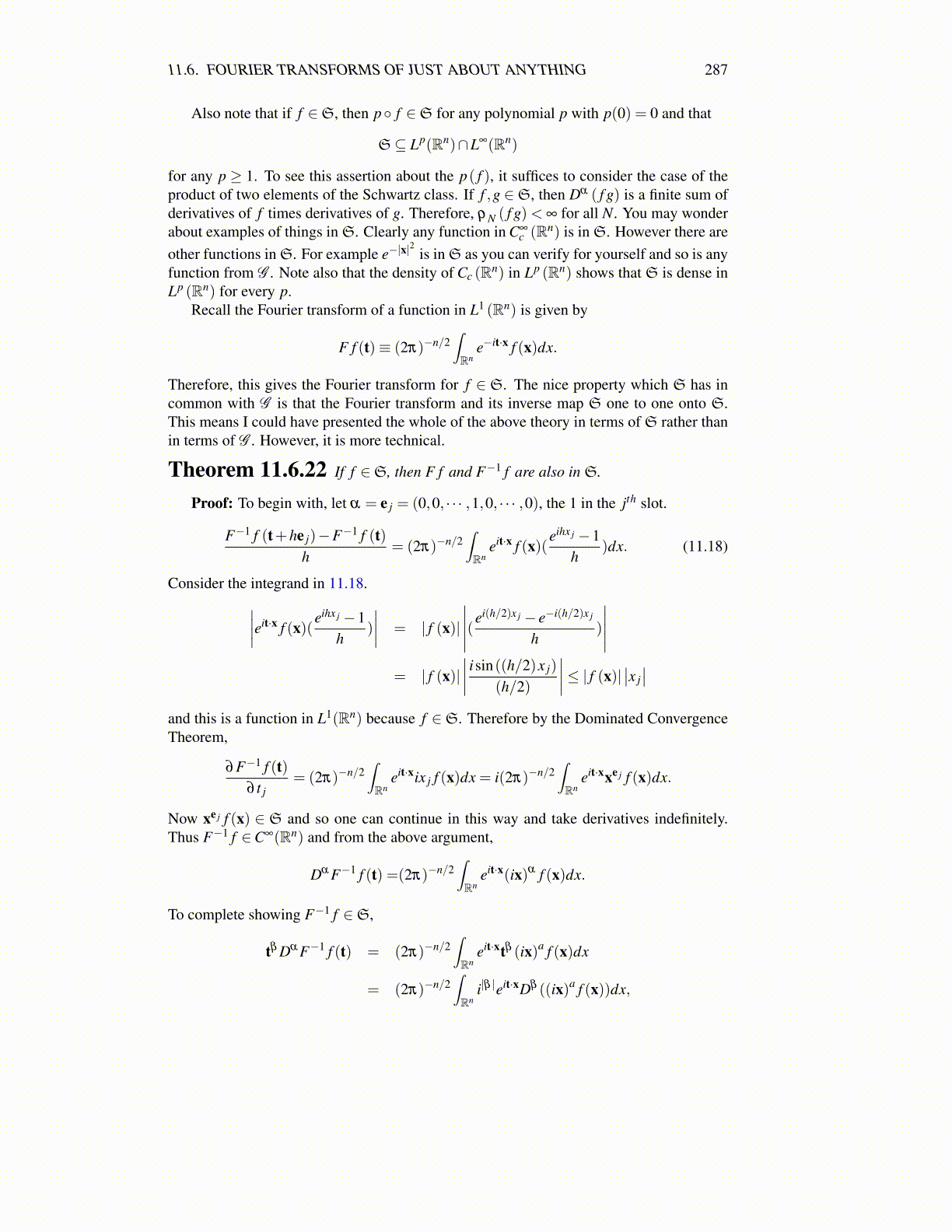
Theorem 11.6.22 If f ∈S, then F f and F−1 f are also in S.
Proof: To begin with, let α = e j = (0,0, · · · ,1,0, · · · ,0), the 1 in the jth slot.
F−1 f (t+he j)−F−1 f (t)h
= (2π)−n/2∫Rn
eit·x f (x)(eihx j −1
h)dx. (11.18)
Consider the integrand in 11.18.∣∣∣∣eit·x f (x)(eihx j −1
h)
∣∣∣∣ = | f (x)|
∣∣∣∣∣(ei(h/2)x j − e−i(h/2)x j
h)
∣∣∣∣∣= | f (x)|
∣∣∣∣ isin((h/2)x j)
(h/2)
∣∣∣∣≤ | f (x)| ∣∣x j∣∣
and this is a function in L1(Rn) because f ∈S. Therefore by the Dominated ConvergenceTheorem,
∂F−1 f (t)∂ t j
= (2π)−n/2∫Rn
eit·xix j f (x)dx = i(2π)−n/2∫Rn
eit·xxe j f (x)dx.
Now xe j f (x) ∈ S and so one can continue in this way and take derivatives indefinitely.Thus F−1 f ∈C∞(Rn) and from the above argument,
Dα F−1 f (t) =(2π)−n/2∫Rn
eit·x(ix)α f (x)dx.
To complete showing F−1 f ∈S,
tβ Dα F−1 f (t) = (2π)−n/2∫Rn
eit·xtβ (ix)a f (x)dx
= (2π)−n/2∫Rn
i|β |eit·xDβ ((ix)a f (x))dx,