298 CHAPTER 12. BANACH SPACES
by L f ≡∫R f (x)dx and for a norm on V,∥ f∥ ≡ max{| f (x)| : x ∈ R} . Of course V is not
complete, but it is a normed linear space. Recall that∫∞
−∞
e−x2dx =
∫∞
−∞
1n
e−(x2/n2) =√
π
where here n ∈ N. Consider the sequence of functions fn (x) ≡ 1n e−(x2/n2). Its maximum
value is 1/n and so ∥ fn∥ → 0 but L fn fails to converge to the 0 function. Thus L is notcontinuous although it is linear.
12.1.1 Bair Category TheoremThe following remarkable result is called the Baire category theorem. To get an idea of itsmeaning, imagine you draw a line in the plane. The complement of this line is an open setand is dense because every point, even those on the line, are limit points of this open set.Now draw another line. The complement of the two lines is still open and dense. Keepdrawing lines and looking at the complements of the union of these lines. You always havean open set which is dense. Now what if there were countably many lines? The Bairecategory theorem implies the complement of the union of these lines is dense. In particularit is nonempty. Thus you cannot write the plane as a countable union of lines. This is arather rough description of this very important theorem. The precise statement and prooffollow. These theorems work more generally for a complete metric space so I am statingthem for this case.
Theorem 12.1.5 Let X be a complete metric space and let {Un}∞n=1 be a sequence
of open subsets of X satisfying Un = X (Un is dense). Then D ≡ ∩∞n=1Un is a dense subset
of X.
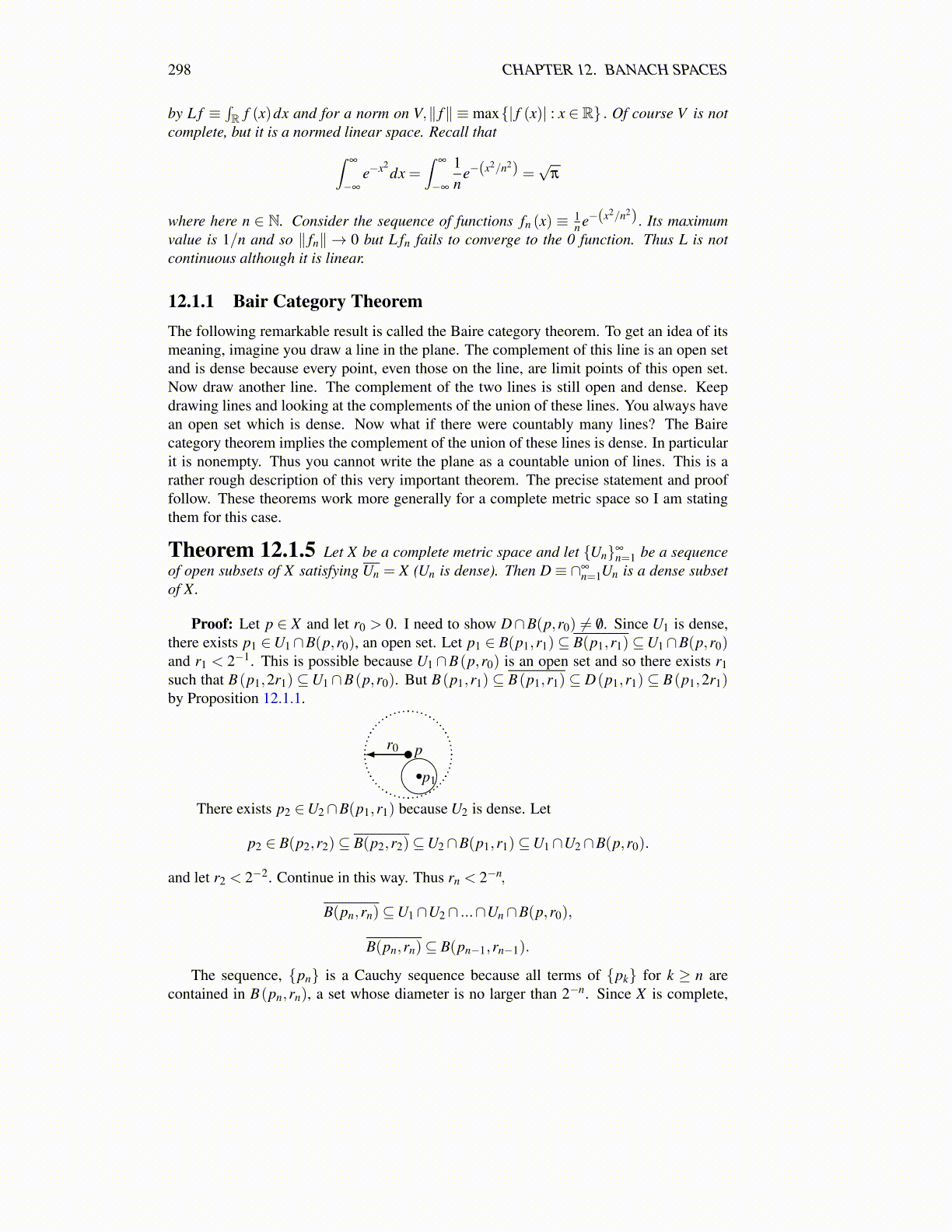
Proof: Let p ∈ X and let r0 > 0. I need to show D∩B(p,r0) ̸= /0. Since U1 is dense,there exists p1 ∈U1∩B(p,r0), an open set. Let p1 ∈ B(p1,r1)⊆ B(p1,r1)⊆U1∩B(p,r0)and r1 < 2−1. This is possible because U1 ∩B(p,r0) is an open set and so there exists r1such that B(p1,2r1) ⊆U1∩B(p,r0). But B(p1,r1) ⊆ B(p1,r1) ⊆ D(p1,r1) ⊆ B(p1,2r1)by Proposition 12.1.1.
r0 p
p1
There exists p2 ∈U2∩B(p1,r1) because U2 is dense. Let
p2 ∈ B(p2,r2)⊆ B(p2,r2)⊆U2∩B(p1,r1)⊆U1∩U2∩B(p,r0).
and let r2 < 2−2. Continue in this way. Thus rn < 2−n,
B(pn,rn)⊆U1∩U2∩ ...∩Un∩B(p,r0),
B(pn,rn)⊆ B(pn−1,rn−1).
The sequence, {pn} is a Cauchy sequence because all terms of {pk} for k ≥ n arecontained in B(pn,rn), a set whose diameter is no larger than 2−n. Since X is complete,