526 CHAPTER 28. THE MATHEMATICAL THEORY OF DETERMINANTS∗
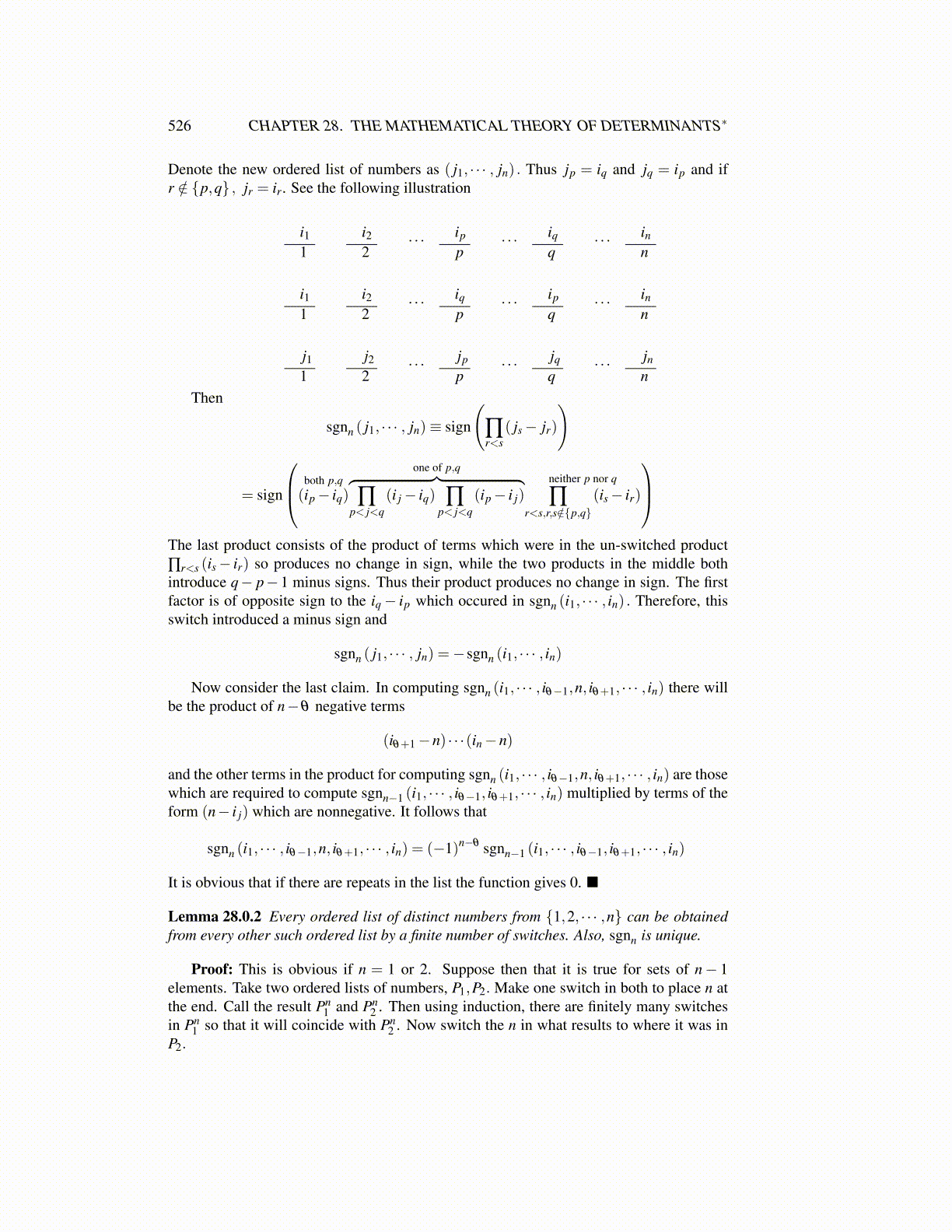
Denote the new ordered list of numbers as ( j1, · · · , jn) . Thus jp = iq and jq = ip and ifr /∈ {p,q} , jr = ir. See the following illustration
i11
i22
· · · ip
p· · · iq
q· · · in
n
i11
i22
· · · iqp
· · · ip
q· · · in
n
j11
j22
· · · jp
p· · · jq
q· · · jn
nThen
sgnn ( j1, · · · , jn)≡ sign
(∏r<s
( js− jr)
)
= sign
both p,q(ip− iq)
one of p,q︷ ︸︸ ︷∏
p< j<q(i j− iq) ∏
p< j<q(ip− i j)
neither p nor q
∏r<s,r,s/∈{p,q}
(is− ir)
The last product consists of the product of terms which were in the un-switched product∏r<s (is− ir) so produces no change in sign, while the two products in the middle bothintroduce q− p−1 minus signs. Thus their product produces no change in sign. The firstfactor is of opposite sign to the iq− ip which occured in sgnn (i1, · · · , in) . Therefore, thisswitch introduced a minus sign and
sgnn ( j1, · · · , jn) =−sgnn (i1, · · · , in)
Now consider the last claim. In computing sgnn (i1, · · · , iθ−1,n, iθ+1, · · · , in) there willbe the product of n−θ negative terms
(iθ+1−n) · · ·(in−n)
and the other terms in the product for computing sgnn (i1, · · · , iθ−1,n, iθ+1, · · · , in) are thosewhich are required to compute sgnn−1 (i1, · · · , iθ−1, iθ+1, · · · , in) multiplied by terms of theform (n− i j) which are nonnegative. It follows that
sgnn (i1, · · · , iθ−1,n, iθ+1, · · · , in) = (−1)n−θ sgnn−1 (i1, · · · , iθ−1, iθ+1, · · · , in)
It is obvious that if there are repeats in the list the function gives 0. ■
Lemma 28.0.2 Every ordered list of distinct numbers from {1,2, · · · ,n} can be obtainedfrom every other such ordered list by a finite number of switches. Also, sgnn is unique.
Proof: This is obvious if n = 1 or 2. Suppose then that it is true for sets of n− 1elements. Take two ordered lists of numbers, P1,P2. Make one switch in both to place n atthe end. Call the result Pn
1 and Pn2 . Then using induction, there are finitely many switches
in Pn1 so that it will coincide with Pn
2 . Now switch the n in what results to where it was inP2.