28.4. THE PROPER VALUE OF β (n) 1005
and so
Γ
(12
)= 2
∫∞
0e−u2
du =√
π
This proves the lemma.Next let n be a positive integer.
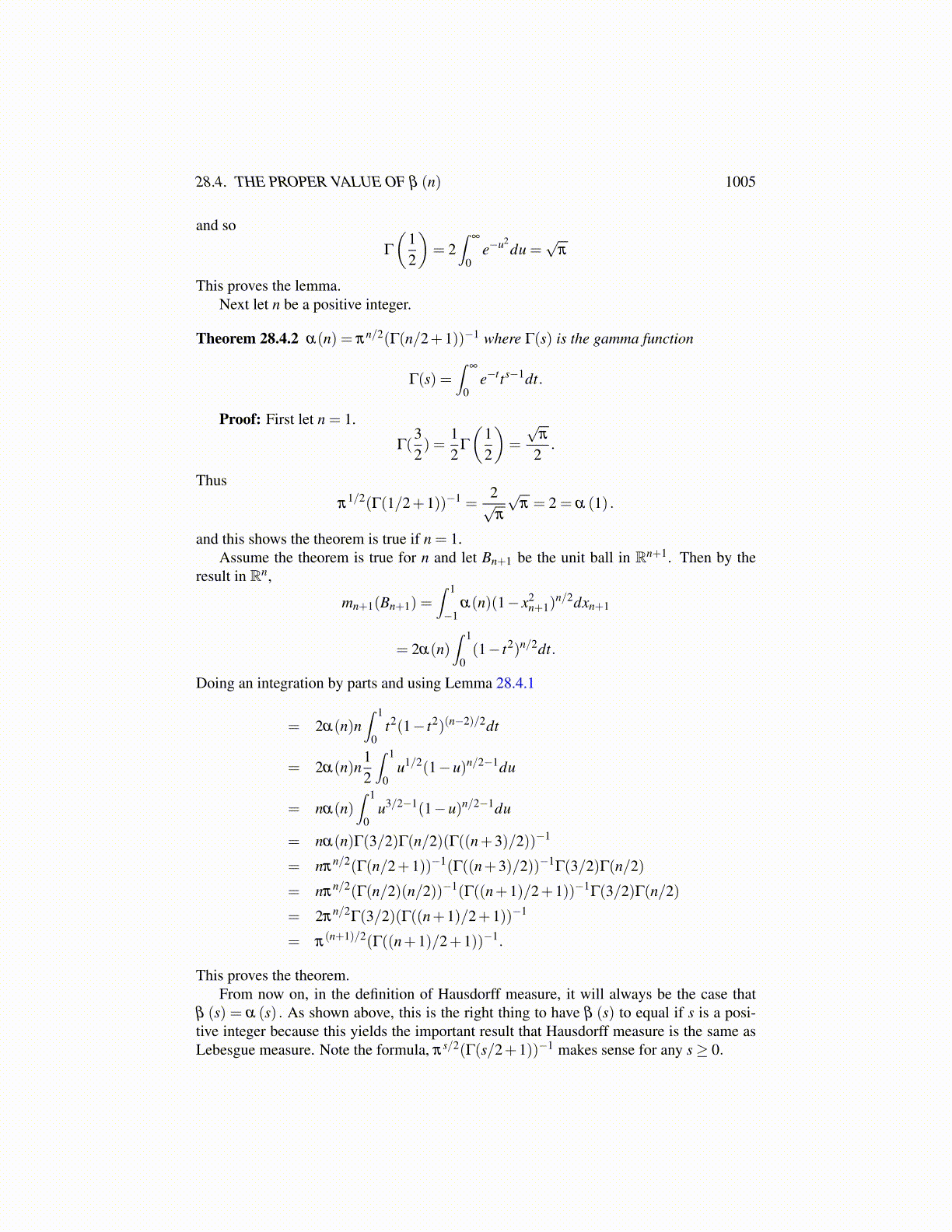
Theorem 28.4.2 α(n) = πn/2(Γ(n/2+1))−1 where Γ(s) is the gamma function
Γ(s) =∫
∞
0e−tts−1dt.
Proof: First let n = 1.
Γ(32) =
12
Γ
(12
)=
√π
2.
Thusπ
1/2(Γ(1/2+1))−1 =2√π
√π = 2 = α (1) .
and this shows the theorem is true if n = 1.Assume the theorem is true for n and let Bn+1 be the unit ball in Rn+1. Then by the
result in Rn,
mn+1(Bn+1) =∫ 1
−1α(n)(1− x2
n+1)n/2dxn+1
= 2α(n)∫ 1
0(1− t2)n/2dt.
Doing an integration by parts and using Lemma 28.4.1
= 2α(n)n∫ 1
0t2(1− t2)(n−2)/2dt
= 2α(n)n12
∫ 1
0u1/2(1−u)n/2−1du
= nα(n)∫ 1
0u3/2−1(1−u)n/2−1du
= nα(n)Γ(3/2)Γ(n/2)(Γ((n+3)/2))−1
= nπn/2(Γ(n/2+1))−1(Γ((n+3)/2))−1
Γ(3/2)Γ(n/2)
= nπn/2(Γ(n/2)(n/2))−1(Γ((n+1)/2+1))−1
Γ(3/2)Γ(n/2)
= 2πn/2
Γ(3/2)(Γ((n+1)/2+1))−1
= π(n+1)/2(Γ((n+1)/2+1))−1.
This proves the theorem.From now on, in the definition of Hausdorff measure, it will always be the case that
β (s) = α (s) . As shown above, this is the right thing to have β (s) to equal if s is a posi-tive integer because this yields the important result that Hausdorff measure is the same asLebesgue measure. Note the formula, πs/2(Γ(s/2+1))−1 makes sense for any s≥ 0.