1024 CHAPTER 29. THE AREA FORMULA
One more lemma will be useful. It involves approximating a continuous function uni-formly with one which is infinitely differentiable.
Lemma 29.7.5 Let V be a bounded open set and let X be the closed subspace of C(V),
the space of continuous functions defined on V , which is given by the following.
X = {u ∈C(V)
: u(x) = 0 on ∂V}.
Then C∞c (V ) is dense in X with respect to the norm given by
∥u∥= max{|u(x)| : x ∈V
}Proof: Let O ⊆ O ⊆W ⊆W ⊆ V be such that dist
(O,VC
)< η and let ψδ (·) be a
mollifier. Let u ∈ X and consider XW u∗ψδ . Let ε > 0 be given and let η be small enoughthat |u(x) |< ε/2 whenever x∈V \O. Then if δ is small enough |XW u∗ψδ (x)−u(x) |< ε
for all x ∈ O and XW u∗ψδ is in C∞c (V ). For x ∈V \O, |XW u∗ψδ (x) | ≤ ε/2 and so for
such x,|XW u∗ψδ (x)−u(x) | ≤ ε.
This proves the lemma since ε was arbitrary.
Lemma 29.7.6 Let α1, · · · ,α p be real numbers and let A(α1, · · · ,α p) be the matrix whichhas 1+α2
i in the iith slot and α iα j in the i jth slot when i ̸= j. Then
detA = 1+p
∑i=1
α2i .
Proof of the claim: The matrix, A(α1, · · · ,α p) is of the form
A(α1, · · · ,α p) =
1+α2
1 α1α2 · · · α1α pα1α2 1+α2
2 α2α p...
. . ....
α1α p α2α p · · · 1+α2p
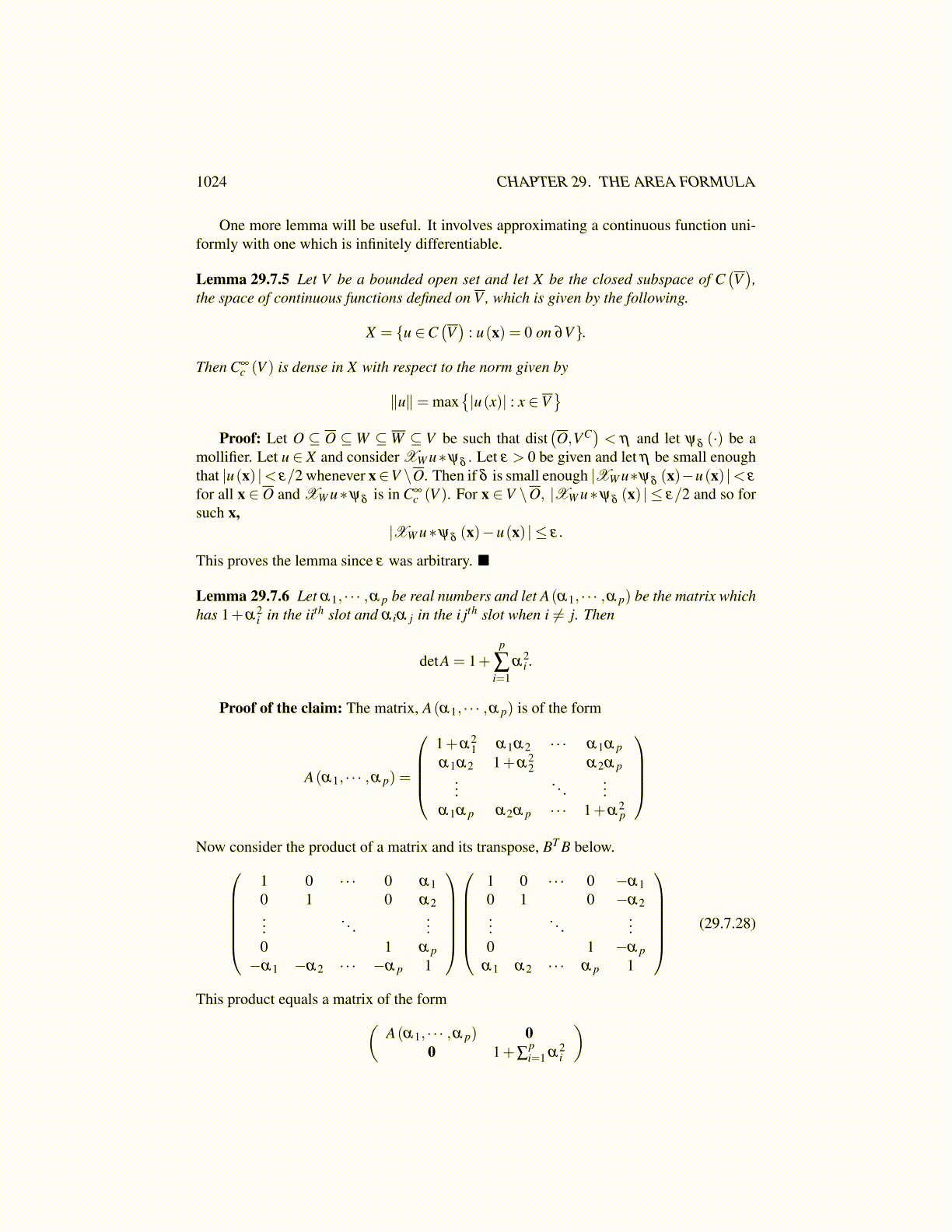
Now consider the product of a matrix and its transpose, BT B below.
1 0 · · · 0 α10 1 0 α2...
. . ....
0 1 α p−α1 −α2 · · · −α p 1
1 0 · · · 0 −α10 1 0 −α2...
. . ....
0 1 −α pα1 α2 · · · α p 1
(29.7.28)
This product equals a matrix of the form(A(α1, · · · ,α p) 0
0 1+∑pi=1 α2
i
)