1028 CHAPTER 29. THE AREA FORMULA
+∫
Ai
∫ gi(x1,··· ,xp−1)
−∞
Dp (ψ i f (x1, · · · ,xp−1,xp))wpdxpdx1 · · ·dxp−1
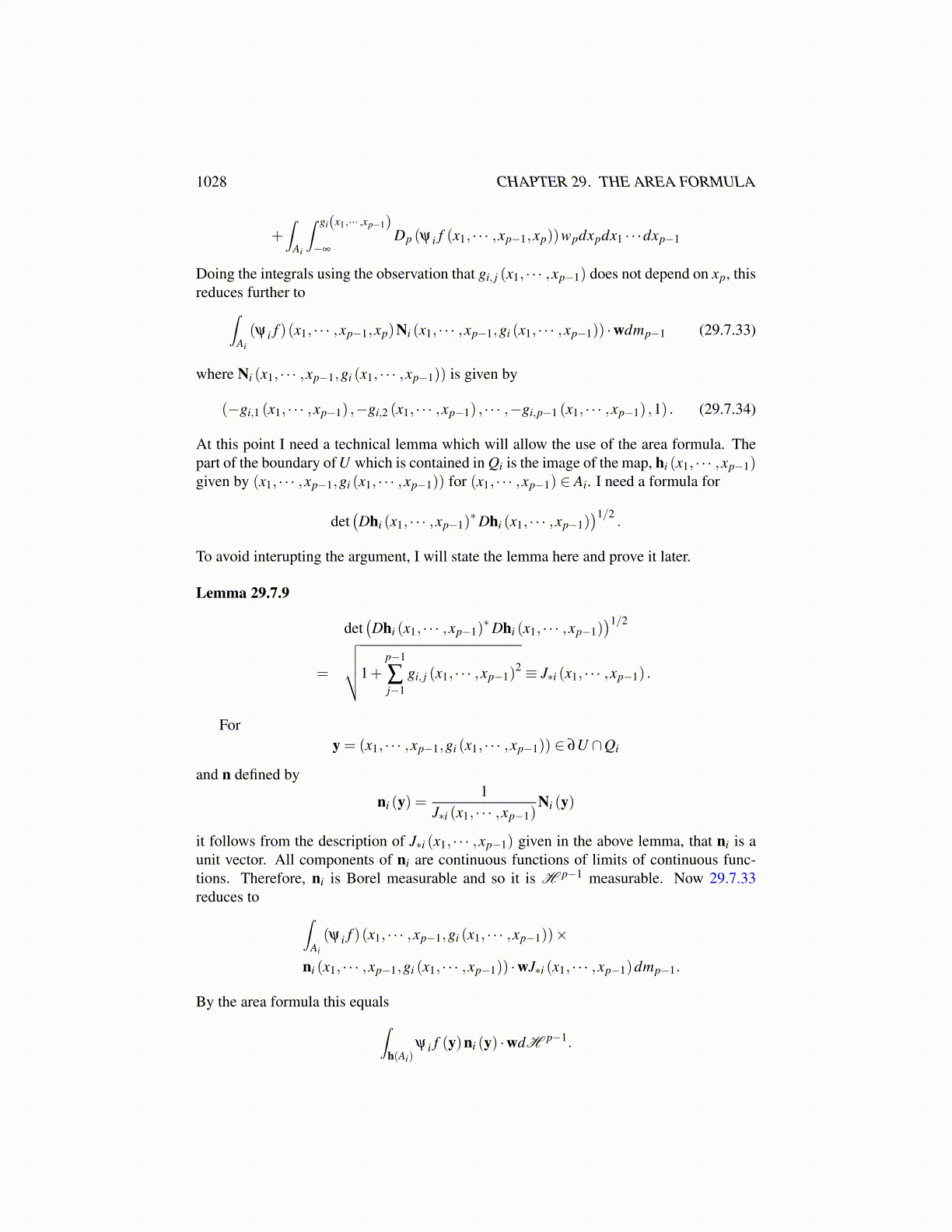
Doing the integrals using the observation that gi, j (x1, · · · ,xp−1) does not depend on xp, thisreduces further to∫
Ai
(ψ i f )(x1, · · · ,xp−1,xp)Ni (x1, · · · ,xp−1,gi (x1, · · · ,xp−1)) ·wdmp−1 (29.7.33)
where Ni (x1, · · · ,xp−1,gi (x1, · · · ,xp−1)) is given by
(−gi,1 (x1, · · · ,xp−1) ,−gi,2 (x1, · · · ,xp−1) , · · · ,−gi,p−1 (x1, · · · ,xp−1) ,1) . (29.7.34)
At this point I need a technical lemma which will allow the use of the area formula. Thepart of the boundary of U which is contained in Qi is the image of the map, hi (x1, · · · ,xp−1)given by (x1, · · · ,xp−1,gi (x1, · · · ,xp−1)) for (x1, · · · ,xp−1) ∈ Ai. I need a formula for
det(Dhi (x1, · · · ,xp−1)
∗Dhi (x1, · · · ,xp−1))1/2
.
To avoid interupting the argument, I will state the lemma here and prove it later.
Lemma 29.7.9
det(Dhi (x1, · · · ,xp−1)
∗Dhi (x1, · · · ,xp−1))1/2
=
√√√√1+p−1
∑j−1
gi, j (x1, · · · ,xp−1)2 ≡ J∗i (x1, · · · ,xp−1) .
Fory = (x1, · · · ,xp−1,gi (x1, · · · ,xp−1)) ∈ ∂U ∩Qi
and n defined by
ni (y) =1
J∗i (x1, · · · ,xp−1)Ni (y)
it follows from the description of J∗i (x1, · · · ,xp−1) given in the above lemma, that ni is aunit vector. All components of ni are continuous functions of limits of continuous func-tions. Therefore, ni is Borel measurable and so it is H p−1 measurable. Now 29.7.33reduces to ∫
Ai
(ψ i f )(x1, · · · ,xp−1,gi (x1, · · · ,xp−1))×
ni (x1, · · · ,xp−1,gi (x1, · · · ,xp−1)) ·wJ∗i (x1, · · · ,xp−1)dmp−1.
By the area formula this equals∫h(Ai)
ψ i f (y)ni (y) ·wdH p−1.