29.8. THE REYNOLDS TRANSPORT FORMULA 1033
With this lemma, it is easy to find Ddet(F) whenever F is invertible.
det(F +U) = det(F(I +F−1U
))= det(F)det
(I +F−1U
)= det(F)
(1+ trace
(F−1U
)+o(U)
)= det(F)+det(F) trace
(F−1U
)+o(U)
Therefore,det(F +U)−det(F) = det(F) trace
(F−1U
)+o(U)
This proves the following.
Proposition 29.8.5 Let F−1 exist. Then Ddet(F)(U) = det(F) trace(F−1U
).
From this, suppose F (t) is a p× p matrix and all entries are differentiable. Then thefollowing describes d
dt det(F)(t) .
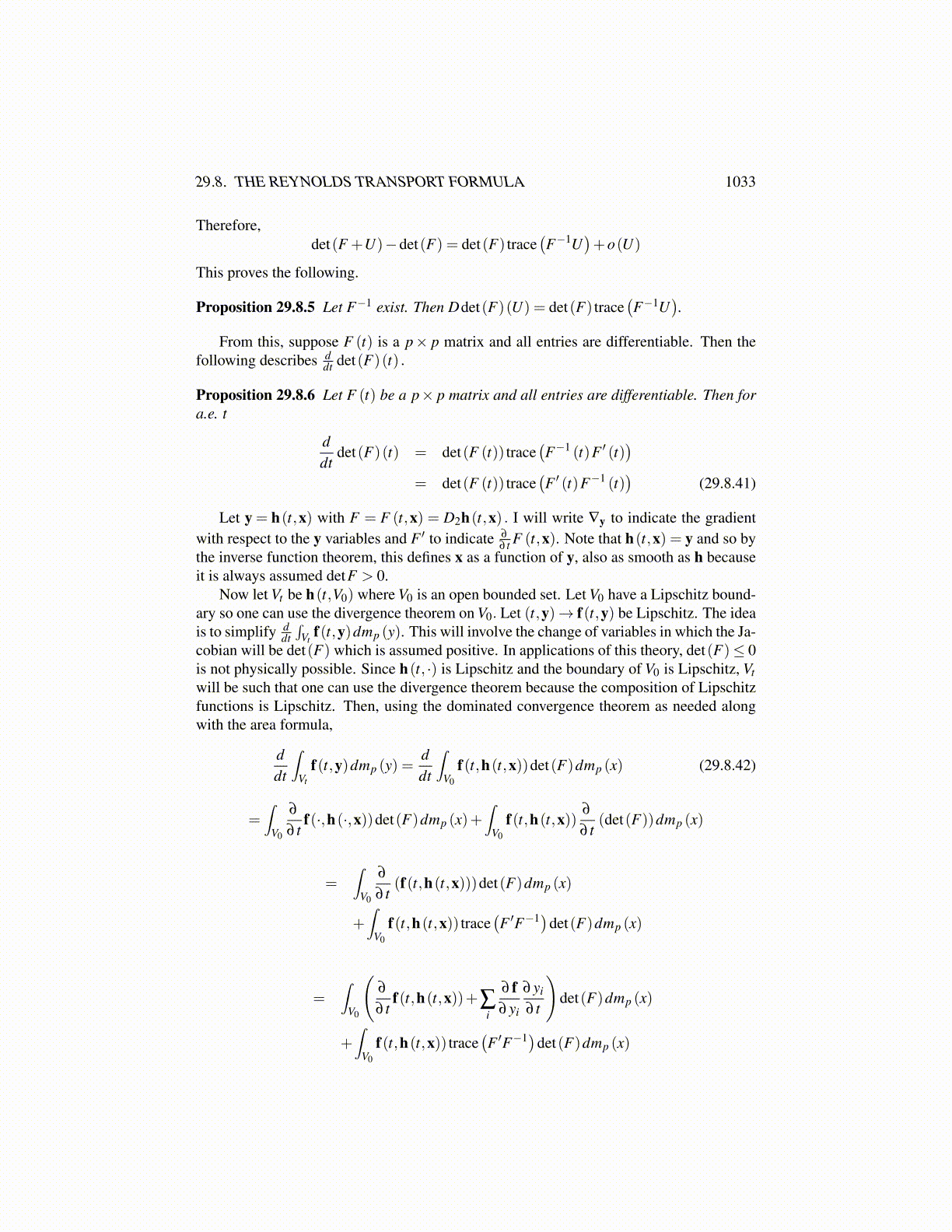
Proposition 29.8.6 Let F (t) be a p× p matrix and all entries are differentiable. Then fora.e. t
ddt
det(F)(t) = det(F (t)) trace(F−1 (t)F ′ (t)
)= det(F (t)) trace
(F ′ (t)F−1 (t)
)(29.8.41)
Let y = h(t,x) with F = F (t,x) = D2h(t,x) . I will write ∇y to indicate the gradientwith respect to the y variables and F ′ to indicate ∂
∂ t F (t,x). Note that h(t,x) = y and so bythe inverse function theorem, this defines x as a function of y, also as smooth as h becauseit is always assumed detF > 0.
Now let Vt be h(t,V0) where V0 is an open bounded set. Let V0 have a Lipschitz bound-ary so one can use the divergence theorem on V0. Let (t,y)→ f(t,y) be Lipschitz. The ideais to simplify d
dt∫
Vtf(t,y)dmp (y). This will involve the change of variables in which the Ja-
cobian will be det(F) which is assumed positive. In applications of this theory, det(F)≤ 0is not physically possible. Since h(t, ·) is Lipschitz and the boundary of V0 is Lipschitz, Vtwill be such that one can use the divergence theorem because the composition of Lipschitzfunctions is Lipschitz. Then, using the dominated convergence theorem as needed alongwith the area formula,
ddt
∫Vt
f(t,y)dmp (y) =ddt
∫V0
f(t,h(t,x))det(F)dmp (x) (29.8.42)
=∫
V0
∂
∂ tf(·,h(·,x))det(F)dmp (x)+
∫V0
f(t,h(t,x))∂
∂ t(det(F))dmp (x)
=∫
V0
∂
∂ t(f(t,h(t,x)))det(F)dmp (x)
+∫
V0
f(t,h(t,x)) trace(F ′F−1)det(F)dmp (x)