1042 CHAPTER 29. THE AREA FORMULA
=∞
∑j=1
∑i ∈Λ(n,m)
∫fi(
E ij∩A
) (det(Df(g(y))Df(g(y))∗
))1/2∣∣∣detDfi (g(y))
∣∣∣−1dy (29.9.52)
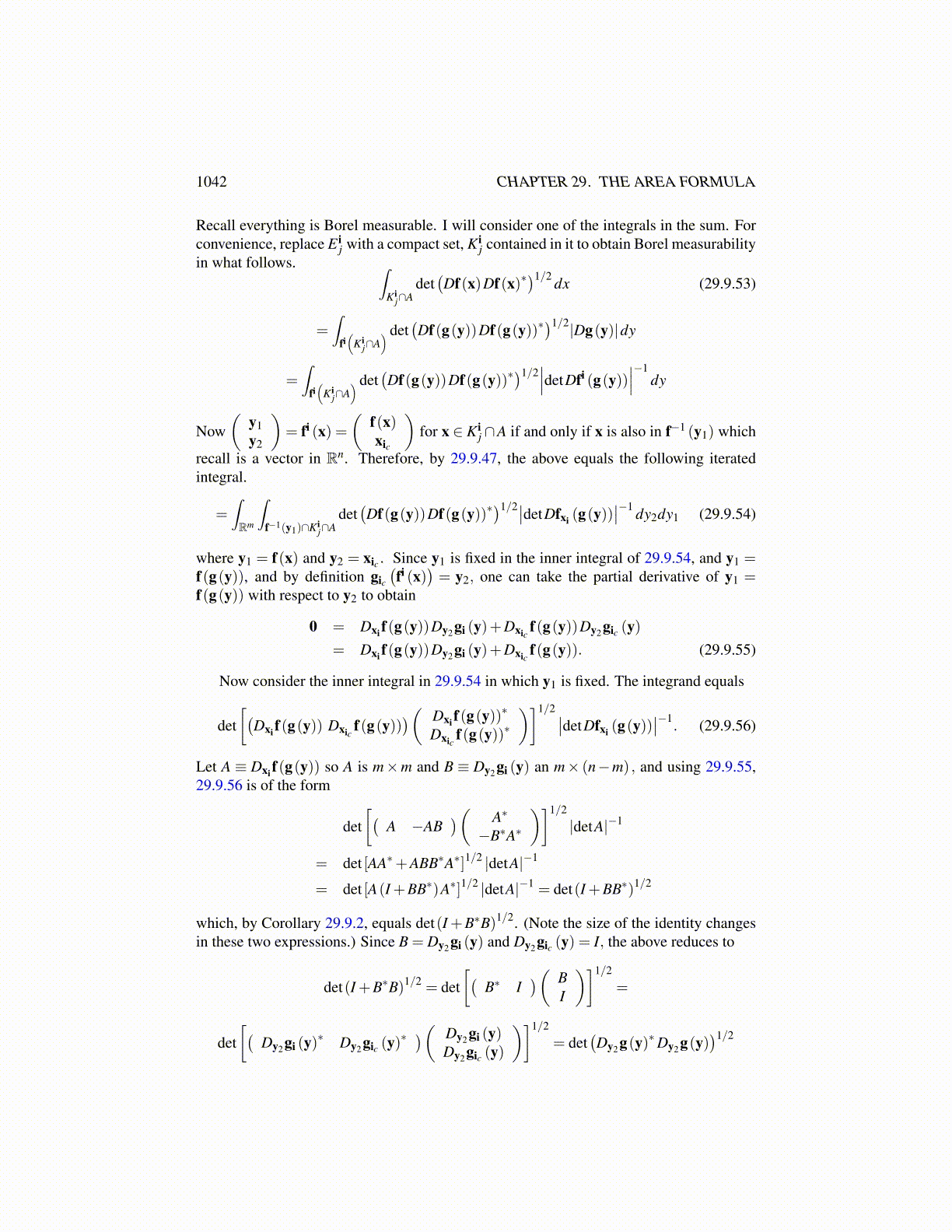
Recall everything is Borel measurable. I will consider one of the integrals in the sum. Forconvenience, replace E i
j with a compact set, Kij contained in it to obtain Borel measurability
in what follows. ∫Ki
j∩Adet(Df(x)Df(x)∗
)1/2 dx (29.9.53)
=∫
fi(
Kij∩A
) det(Df(g(y))Df(g(y))∗
)1/2|Dg(y)|dy
=∫
fi(
Kij∩A
) det(Df(g(y))Df(g(y))∗
)1/2∣∣∣detDfi (g(y))
∣∣∣−1dy
Now(
y1y2
)= fi (x) =
(f(x)xic
)for x ∈ Ki
j ∩A if and only if x is also in f−1 (y1) which
recall is a vector in Rn. Therefore, by 29.9.47, the above equals the following iteratedintegral.
=∫Rm
∫f−1(y1)∩Ki
j∩Adet(Df(g(y))Df(g(y))∗
)1/2∣∣detDfxi (g(y))∣∣−1 dy2dy1 (29.9.54)
where y1 = f(x) and y2 = xic . Since y1 is fixed in the inner integral of 29.9.54, and y1 =f(g(y)), and by definition gic
(fi (x)
)= y2, one can take the partial derivative of y1 =
f(g(y)) with respect to y2 to obtain
0 = Dxi f(g(y))Dy2gi (y)+Dxicf(g(y))Dy2gic (y)
= Dxi f(g(y))Dy2gi (y)+Dxicf(g(y)). (29.9.55)
Now consider the inner integral in 29.9.54 in which y1 is fixed. The integrand equals
det[(
Dxi f(g(y)) Dxicf(g(y))
)( Dxi f(g(y))∗
Dxicf(g(y))∗
)]1/2 ∣∣detDfxi (g(y))∣∣−1
. (29.9.56)
Let A ≡ Dxi f(g(y)) so A is m×m and B ≡ Dy2gi (y) an m× (n−m) , and using 29.9.55,29.9.56 is of the form
det[(
A −AB)( A∗
−B∗A∗
)]1/2
|detA|−1
= det [AA∗+ABB∗A∗]1/2 |detA|−1
= det [A(I +BB∗)A∗]1/2 |detA|−1 = det(I +BB∗)1/2
which, by Corollary 29.9.2, equals det(I +B∗B)1/2. (Note the size of the identity changesin these two expressions.) Since B = Dy2gi (y) and Dy2gic (y) = I, the above reduces to
det(I +B∗B)1/2 = det[(
B∗ I)( B
I
)]1/2
=