29.12. THE CASE OF W 1,p 1059
Proof: Let E be a Lebesgue measurable subset of h(Ω) . By regularity of the measure,there exist Borel sets F ⊆E ⊆G such that F and G are both Borel measurable sets containedin h(Ω) with m(G\F) = 0. Then by Theorem 29.12.6∫
Ω
|det(Dh(x))|XF (h(x))dx =∫
h(Ω)XF (y)dy
=∫
h(Ω)XE (y)dy =
∫h(Ω)
XG (y)dy
=∫
Ω
|det(Dh(x))|XG (h(x))dx (29.12.80)
which shows that
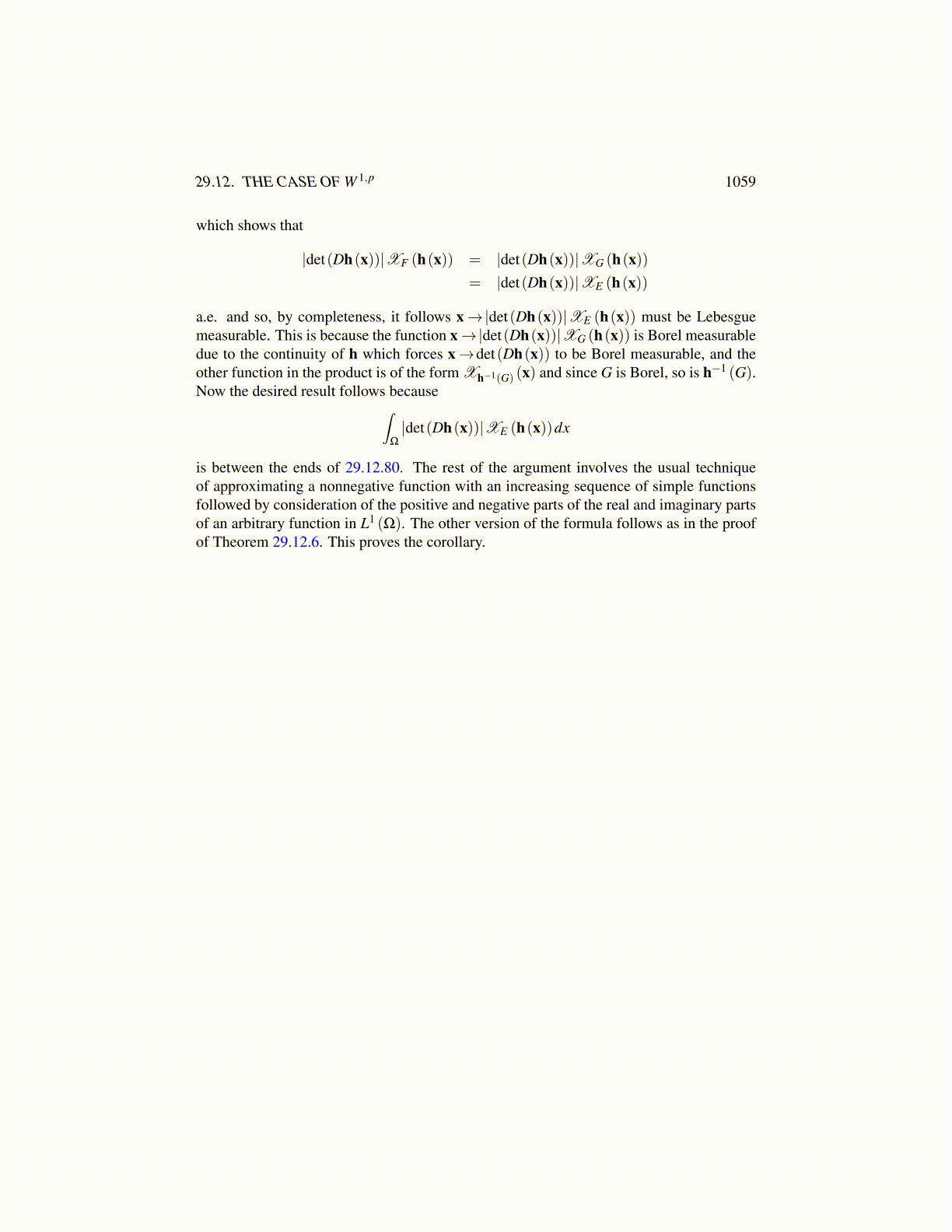
|det(Dh(x))|XF (h(x)) = |det(Dh(x))|XG (h(x))= |det(Dh(x))|XE (h(x))
a.e. and so, by completeness, it follows x→|det(Dh(x))|XE (h(x)) must be Lebesguemeasurable. This is because the function x→|det(Dh(x))|XG (h(x)) is Borel measurabledue to the continuity of h which forces x→det(Dh(x)) to be Borel measurable, and theother function in the product is of the form Xh−1(G) (x) and since G is Borel, so is h−1 (G).Now the desired result follows because∫
Ω
|det(Dh(x))|XE (h(x))dx
is between the ends of 29.12.80. The rest of the argument involves the usual techniqueof approximating a nonnegative function with an increasing sequence of simple functionsfollowed by consideration of the positive and negative parts of the real and imaginary partsof an arbitrary function in L1 (Ω). The other version of the formula follows as in the proofof Theorem 29.12.6. This proves the corollary.