30.2. THE BINET CAUCHY FORMULA 1063
the case where Ω is a Ck,k ≥ 1 manifold, it is called orientable if in addition to this thereexists an atlas, (Ur,Rr), such that whenever Ui∩U j ̸= /0,
det(D(R j ◦R−1
i))
(u)> 0 for all u ∈ Ri (Ui∩U j) (30.1.1)
The mappings, Ri ◦R−1j are called the overlap maps. In the case where k = 0, the Ri
are only assumed continuous so there is no differentiability available and in this case, themanifold is oriented if whenever A is an open connected subset of int(Ri (Ui∩U j)) whoseboundary has measure zero and separates Rn into two components,
d(y,A,R j ◦R−1
i)∈ {1,0} (30.1.2)
depending on whether y∈R j ◦R−1i (A). An atlas satisfying 30.1.1 or more generally 30.1.2
is called an oriented atlas.
It follows from Proposition 23.6.4 the degree in 30.1.2 is either undefined if y ∈ R j ◦R−1
i ∂A or it is 1, -1,or 0.The study of manifolds is really a generalization of something with which everyone
who has taken a normal calculus course is familiar. We think of a point in three dimensionalspace in two ways. There is a geometric point and there are coordinates associated withthis point. There are many different coordinate systems which describe a point. There arespherical coordinates, cylindrical coordinates and rectangular coordinates to name the threemost popular coordinate systems. These coordinates are like the vector u. The point, x islike the geometric point although it is always assumed x has rectangular coordinates in Rm
for some m. Under fairly general conditions, it can be shown there is no loss of generalityin making such an assumption. Next is some algebra.
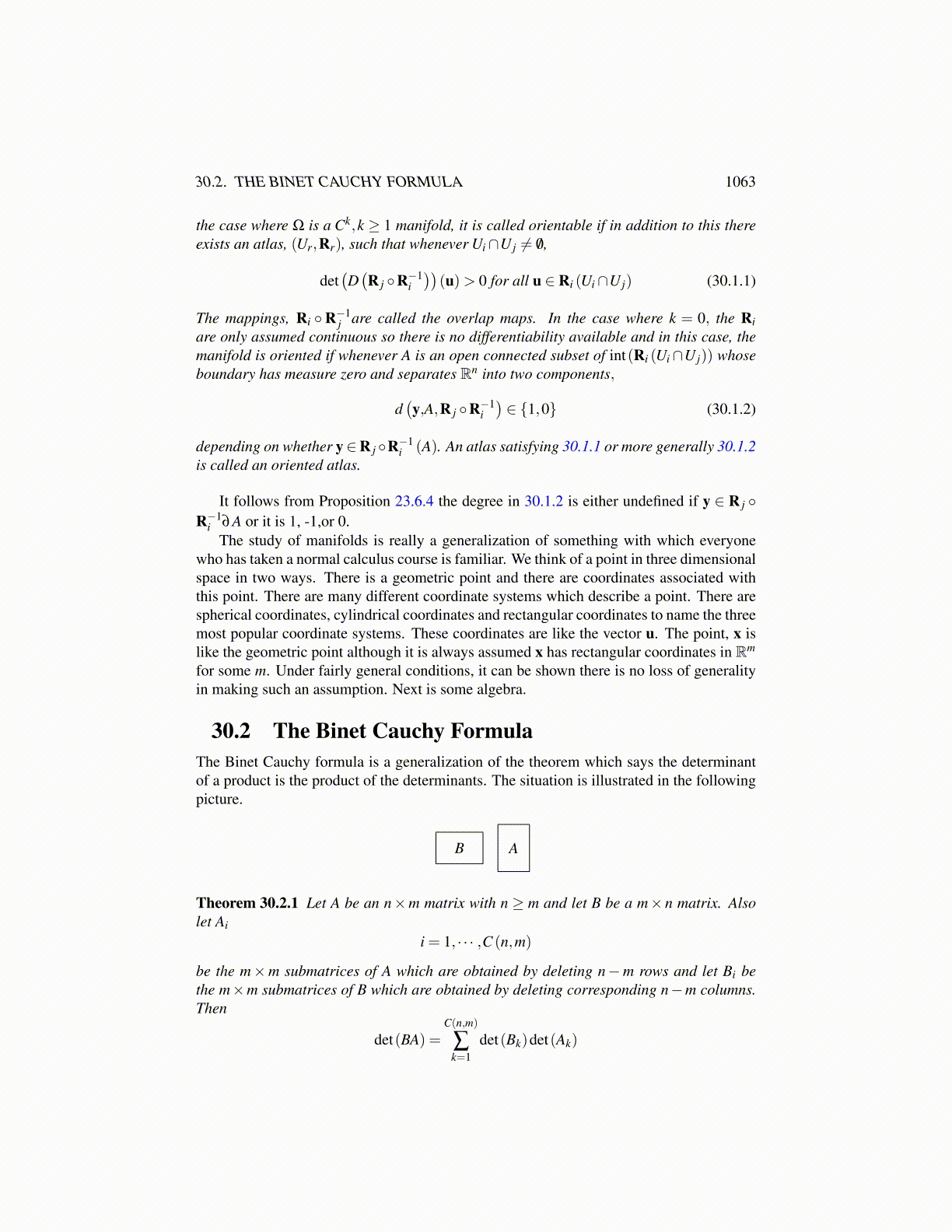
30.2 The Binet Cauchy FormulaThe Binet Cauchy formula is a generalization of the theorem which says the determinantof a product is the product of the determinants. The situation is illustrated in the followingpicture.
B A
Theorem 30.2.1 Let A be an n×m matrix with n ≥ m and let B be a m× n matrix. Alsolet Ai
i = 1, · · · ,C (n,m)
be the m×m submatrices of A which are obtained by deleting n−m rows and let Bi bethe m×m submatrices of B which are obtained by deleting corresponding n−m columns.Then
det(BA) =C(n,m)
∑k=1
det(Bk)det(Ak)