1074 CHAPTER 30. INTEGRATION OF DIFFERENTIAL FORMS
where each aI is in W 1,p (Rm) where p > 1. For{
U j,R j}p
j=0 an oriented atlas for Ω whereR j (U j) is a relatively open set in
{u ∈ Rn : u1 ≤ 0} ,
define an atlas for ∂Ω,{
Vj,S j}
where Vj ≡ ∂Ω∩U j and S j is just the restriction of R j toVj. Then this is an oriented atlas for ∂Ω and∫
∂Ω
ω =∫
Ω
dω
where the two integrals are taken with respect to the given oriented atlass.
30.5 Green’s TheoremGreen’s theorem is a well known result in calculus and it pertains to a region in the plane.I am going to generalize to an open set in Rnwith sufficiently smooth boundary using themethods of differential forms described above.
30.5.1 An Oriented ManifoldA bounded open subset, Ω, of Rn,n≥ 2 has Lipschitz boundary and lies locally on one sideof its boundary if it satisfies the following conditions.
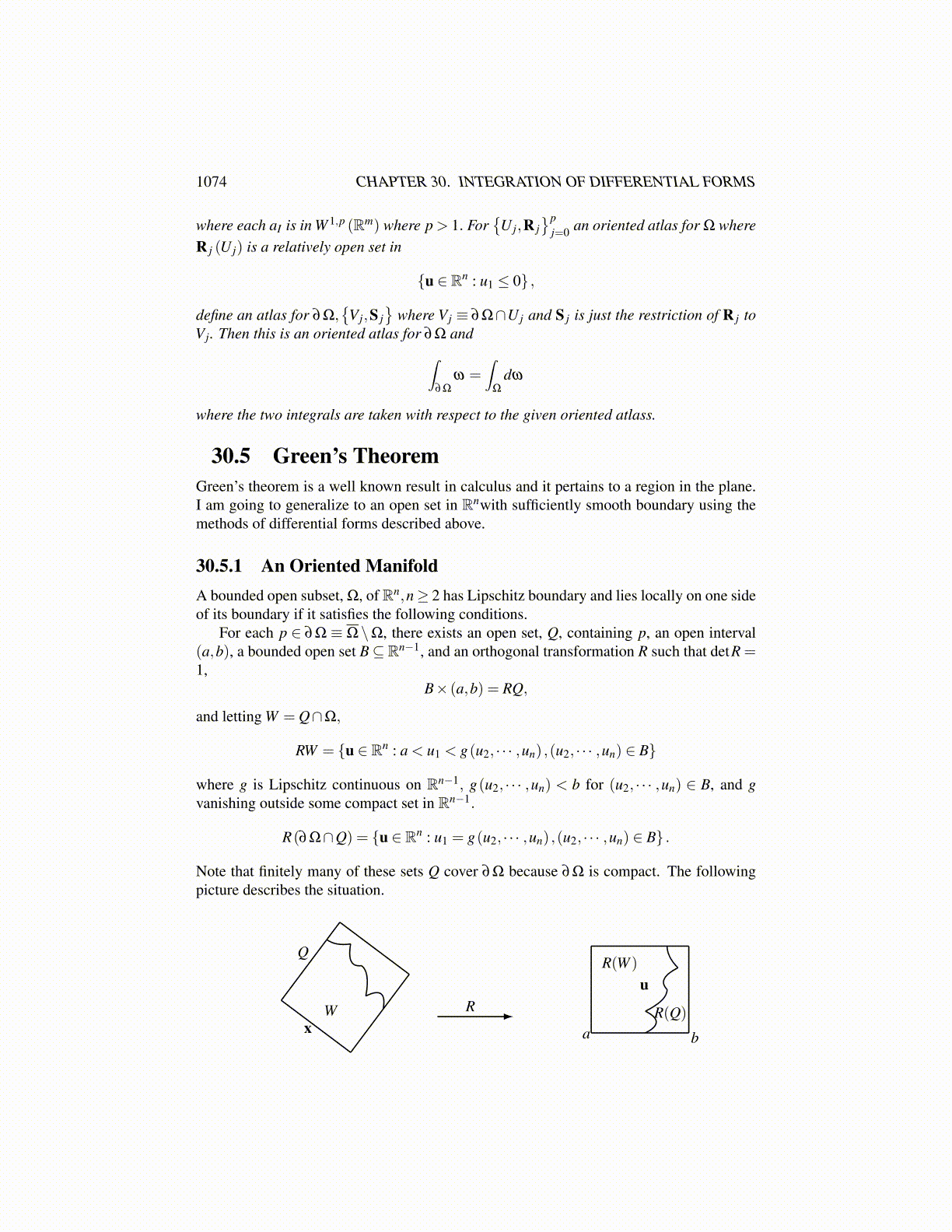
For each p ∈ ∂Ω ≡ Ω \Ω, there exists an open set, Q, containing p, an open interval(a,b), a bounded open set B⊆Rn−1, and an orthogonal transformation R such that detR =1,
B× (a,b) = RQ,
and letting W = Q∩Ω,
RW = {u ∈ Rn : a < u1 < g(u2, · · · ,un) ,(u2, · · · ,un) ∈ B}
where g is Lipschitz continuous on Rn−1, g(u2, · · · ,un) < b for (u2, · · · ,un) ∈ B, and gvanishing outside some compact set in Rn−1.
R(∂Ω∩Q) = {u ∈ Rn : u1 = g(u2, · · · ,un) ,(u2, · · · ,un) ∈ B} .
Note that finitely many of these sets Q cover ∂Ω because ∂Ω is compact. The followingpicture describes the situation.
xW
Q
R
R(W )
a b
R(Q)
u