1104 CHAPTER 32. FOURIER TRANSFORMS
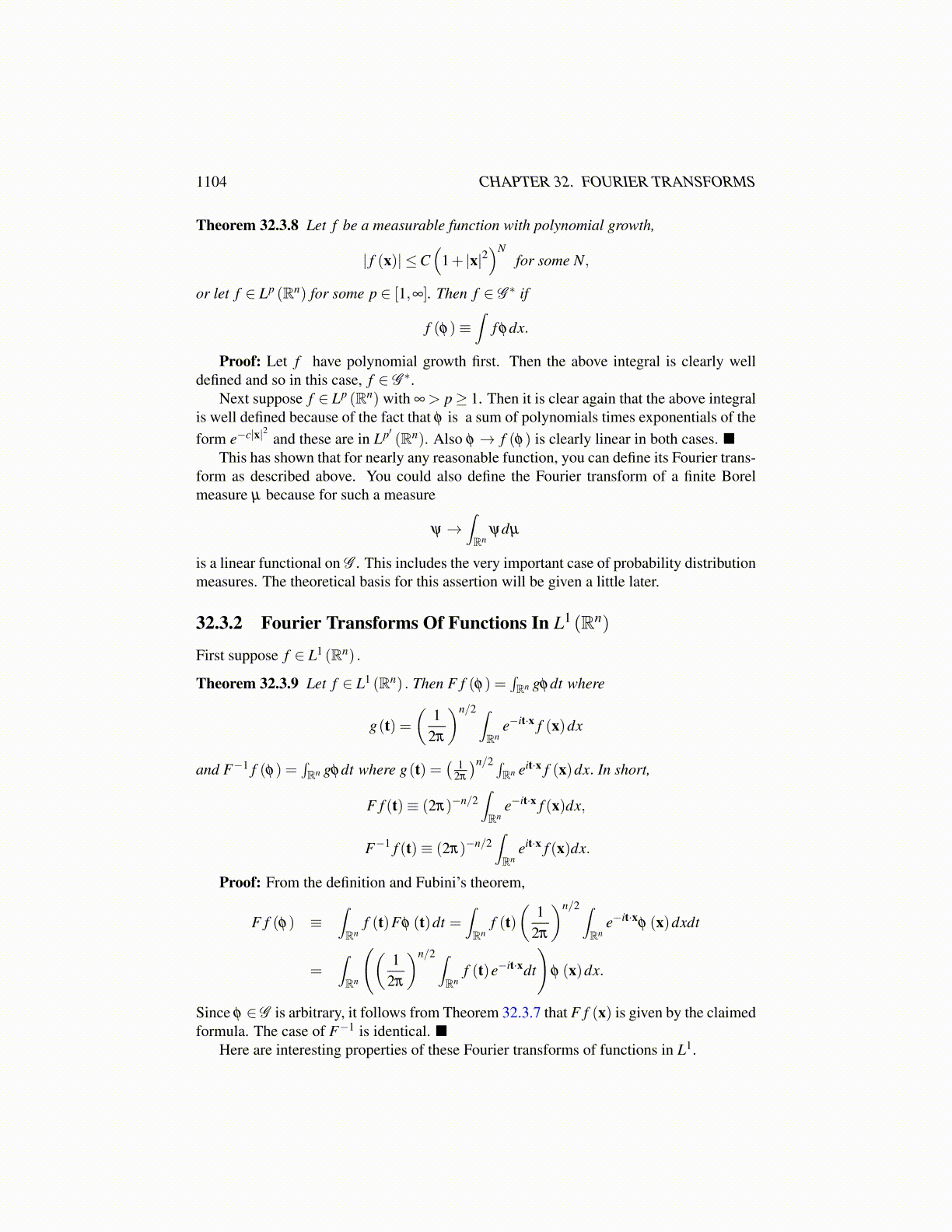
Theorem 32.3.8 Let f be a measurable function with polynomial growth,
| f (x)| ≤C(
1+ |x|2)N
for some N,
or let f ∈ Lp (Rn) for some p ∈ [1,∞]. Then f ∈ G ∗ if
f (φ)≡∫
f φdx.
Proof: Let f have polynomial growth first. Then the above integral is clearly welldefined and so in this case, f ∈ G ∗.
Next suppose f ∈ Lp (Rn) with ∞ > p≥ 1. Then it is clear again that the above integralis well defined because of the fact that φ is a sum of polynomials times exponentials of theform e−c|x|2 and these are in Lp′ (Rn). Also φ → f (φ) is clearly linear in both cases.
This has shown that for nearly any reasonable function, you can define its Fourier trans-form as described above. You could also define the Fourier transform of a finite Borelmeasure µ because for such a measure
ψ →∫Rn
ψdµ
is a linear functional on G . This includes the very important case of probability distributionmeasures. The theoretical basis for this assertion will be given a little later.
32.3.2 Fourier Transforms Of Functions In L1 (Rn)
First suppose f ∈ L1 (Rn) .
Theorem 32.3.9 Let f ∈ L1 (Rn) . Then F f (φ) =∫Rn gφdt where
g(t) =(
12π
)n/2 ∫Rn
e−it·x f (x)dx
and F−1 f (φ) =∫Rn gφdt where g(t) =
( 12π
)n/2 ∫Rn eit·x f (x)dx. In short,
F f (t)≡ (2π)−n/2∫Rn
e−it·x f (x)dx,
F−1 f (t)≡ (2π)−n/2∫Rn
eit·x f (x)dx.
Proof: From the definition and Fubini’s theorem,
F f (φ) ≡∫Rn
f (t)Fφ (t)dt =∫Rn
f (t)(
12π
)n/2 ∫Rn
e−it·xφ (x)dxdt
=∫Rn
((1
2π
)n/2 ∫Rn
f (t)e−it·xdt
)φ (x)dx.
Since φ ∈ G is arbitrary, it follows from Theorem 32.3.7 that F f (x) is given by the claimedformula. The case of F−1 is identical.
Here are interesting properties of these Fourier transforms of functions in L1.