1108 CHAPTER 32. FOURIER TRANSFORMS
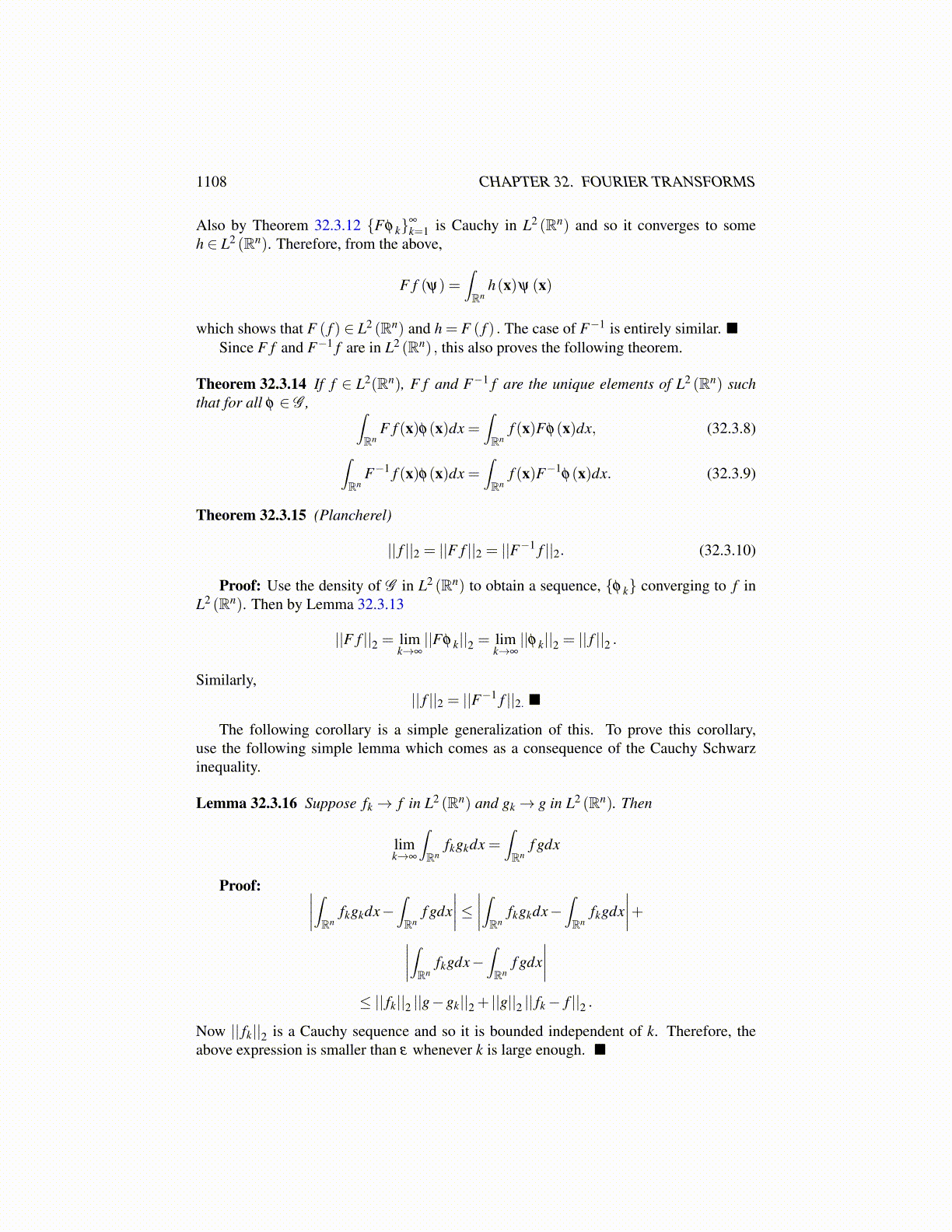
Also by Theorem 32.3.12 {Fφ k}∞
k=1 is Cauchy in L2 (Rn) and so it converges to someh ∈ L2 (Rn). Therefore, from the above,
F f (ψ) =∫Rn
h(x)ψ (x)
which shows that F ( f ) ∈ L2 (Rn) and h = F ( f ) . The case of F−1 is entirely similar.Since F f and F−1 f are in L2 (Rn) , this also proves the following theorem.
Theorem 32.3.14 If f ∈ L2(Rn), F f and F−1 f are the unique elements of L2 (Rn) suchthat for all φ ∈ G , ∫
RnF f (x)φ(x)dx =
∫Rn
f (x)Fφ(x)dx, (32.3.8)∫Rn
F−1 f (x)φ(x)dx =∫Rn
f (x)F−1φ(x)dx. (32.3.9)
Theorem 32.3.15 (Plancherel)
|| f ||2 = ||F f ||2 = ||F−1 f ||2. (32.3.10)
Proof: Use the density of G in L2 (Rn) to obtain a sequence, {φ k} converging to f inL2 (Rn). Then by Lemma 32.3.13
||F f ||2 = limk→∞
||Fφ k||2 = limk→∞
||φ k||2 = || f ||2 .
Similarly,|| f ||2 = ||F−1 f ||2.
The following corollary is a simple generalization of this. To prove this corollary,use the following simple lemma which comes as a consequence of the Cauchy Schwarzinequality.
Lemma 32.3.16 Suppose fk→ f in L2 (Rn) and gk→ g in L2 (Rn). Then
limk→∞
∫Rn
fkgkdx =∫Rn
f gdx
Proof: ∣∣∣∣∫Rnfkgkdx−
∫Rn
f gdx∣∣∣∣≤ ∣∣∣∣∫Rn
fkgkdx−∫Rn
fkgdx∣∣∣∣+∣∣∣∣∫Rn
fkgdx−∫Rn
f gdx∣∣∣∣
≤ || fk||2 ||g−gk||2 + ||g||2 || fk− f ||2 .
Now || fk||2 is a Cauchy sequence and so it is bounded independent of k. Therefore, theabove expression is smaller than ε whenever k is large enough.