1120 CHAPTER 33. FOURIER ANALYSIS IN Rn
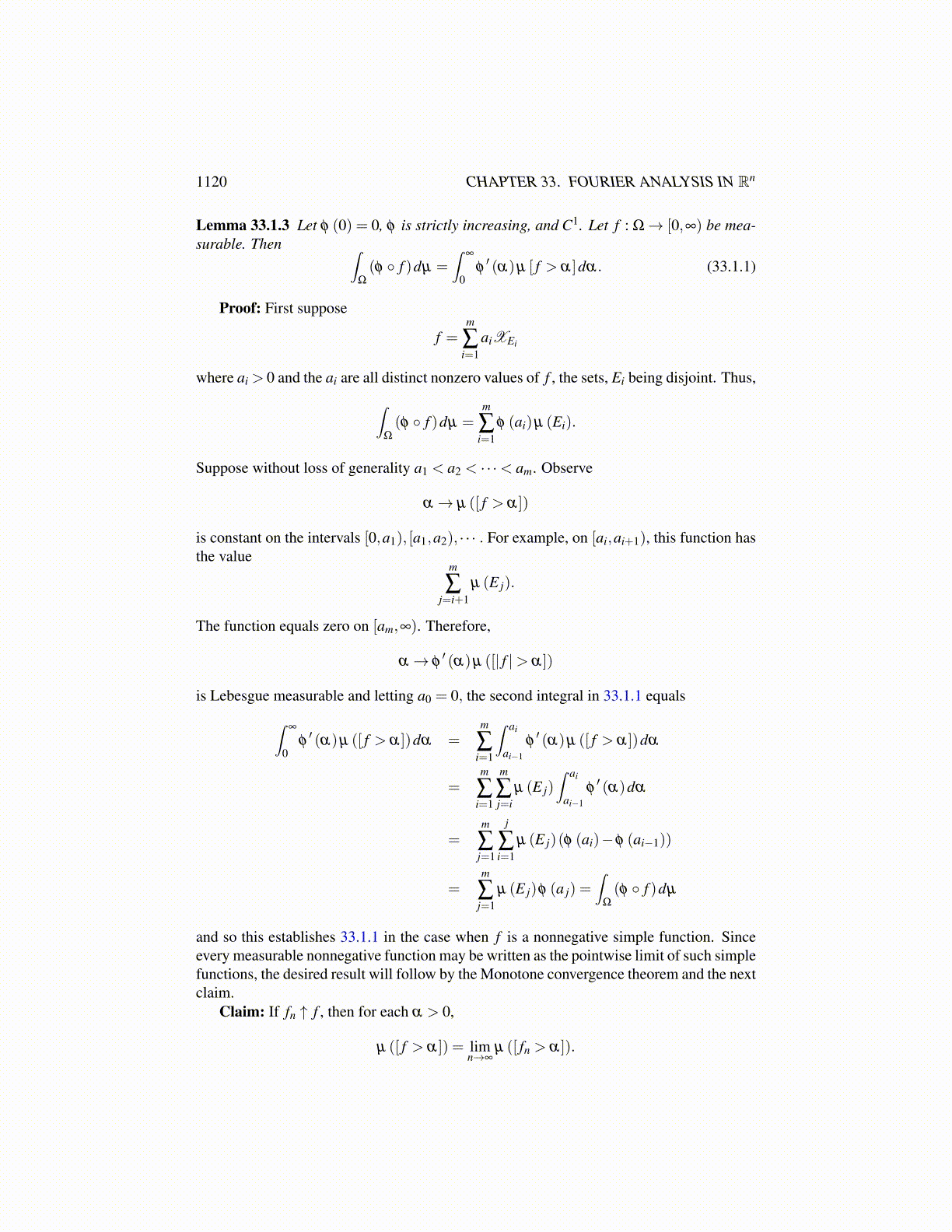
Lemma 33.1.3 Let φ (0) = 0, φ is strictly increasing, and C1. Let f : Ω→ [0,∞) be mea-surable. Then ∫
Ω
(φ ◦ f )dµ =∫
∞
0φ′ (α)µ [ f > α]dα. (33.1.1)
Proof: First suppose
f =m
∑i=1
aiXEi
where ai > 0 and the ai are all distinct nonzero values of f , the sets, Ei being disjoint. Thus,∫Ω
(φ ◦ f )dµ =m
∑i=1
φ (ai)µ (Ei).
Suppose without loss of generality a1 < a2 < · · ·< am. Observe
α → µ ([ f > α])
is constant on the intervals [0,a1), [a1,a2), · · · . For example, on [ai,ai+1), this function hasthe value
m
∑j=i+1
µ (E j).
The function equals zero on [am,∞). Therefore,
α → φ′ (α)µ ([| f |> α])
is Lebesgue measurable and letting a0 = 0, the second integral in 33.1.1 equals∫∞
0φ′ (α)µ ([ f > α])dα =
m
∑i=1
∫ ai
ai−1
φ′ (α)µ ([ f > α])dα
=m
∑i=1
m
∑j=i
µ (E j)∫ ai
ai−1
φ′ (α)dα
=m
∑j=1
j
∑i=1
µ (E j)(φ (ai)−φ (ai−1))
=m
∑j=1
µ (E j)φ (a j) =∫
Ω
(φ ◦ f )dµ
and so this establishes 33.1.1 in the case when f is a nonnegative simple function. Sinceevery measurable nonnegative function may be written as the pointwise limit of such simplefunctions, the desired result will follow by the Monotone convergence theorem and the nextclaim.
Claim: If fn ↑ f , then for each α > 0,
µ ([ f > α]) = limn→∞
µ ([ fn > α]).