1122 CHAPTER 33. FOURIER ANALYSIS IN Rn
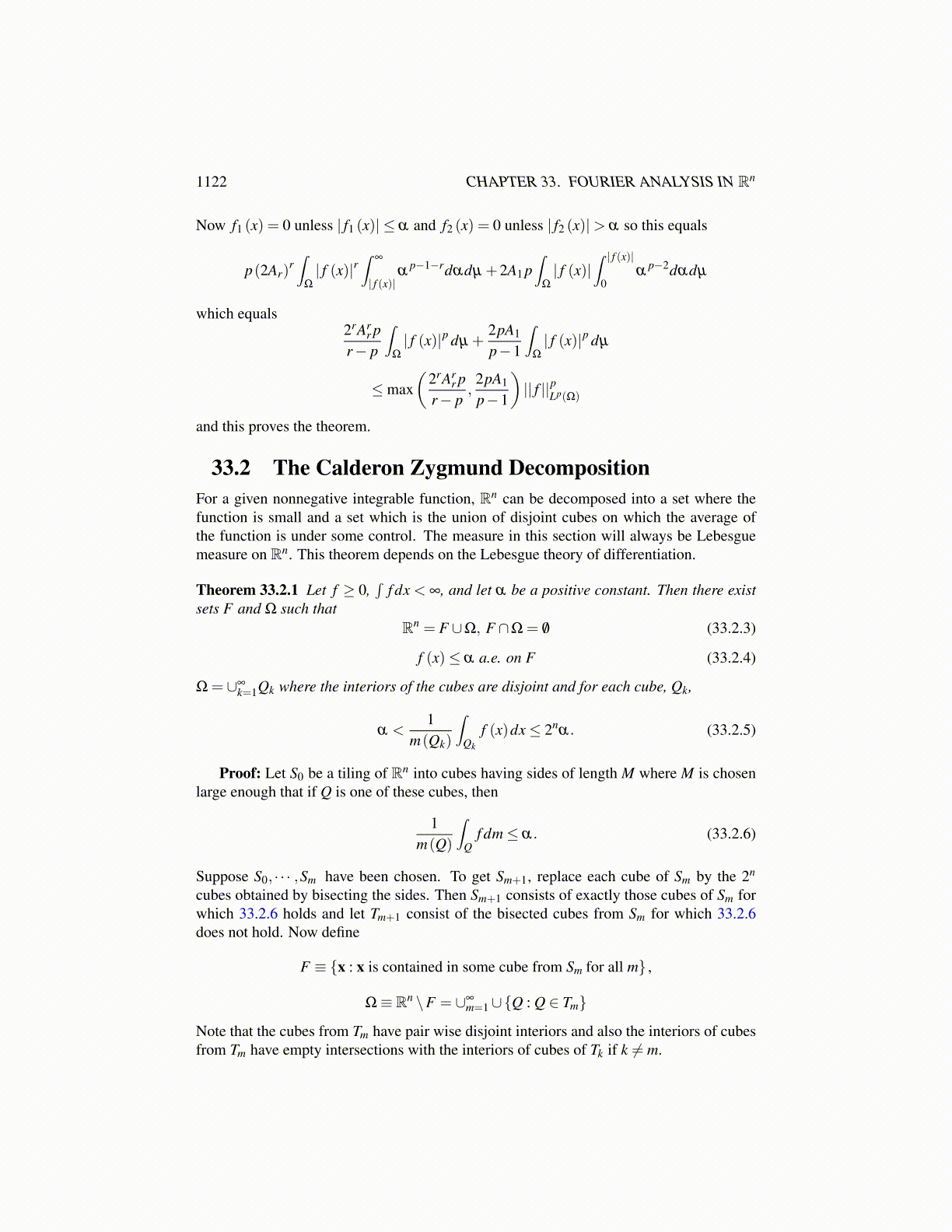
Now f1 (x) = 0 unless | f1 (x)| ≤ α and f2 (x) = 0 unless | f2 (x)|> α so this equals
p(2Ar)r∫
Ω
| f (x)|r∫
∞
| f (x)|α
p−1−rdαdµ +2A1 p∫
Ω
| f (x)|∫ | f (x)|
0α
p−2dαdµ
which equals2rAr
r pr− p
∫Ω
| f (x)|p dµ +2pA1
p−1
∫Ω
| f (x)|p dµ
≤max(
2rArr p
r− p,
2pA1
p−1
)|| f ||pLp(Ω)
and this proves the theorem.
33.2 The Calderon Zygmund DecompositionFor a given nonnegative integrable function, Rn can be decomposed into a set where thefunction is small and a set which is the union of disjoint cubes on which the average ofthe function is under some control. The measure in this section will always be Lebesguemeasure on Rn. This theorem depends on the Lebesgue theory of differentiation.
Theorem 33.2.1 Let f ≥ 0,∫
f dx < ∞, and let α be a positive constant. Then there existsets F and Ω such that
Rn = F ∪Ω, F ∩Ω = /0 (33.2.3)
f (x)≤ α a.e. on F (33.2.4)
Ω = ∪∞k=1Qk where the interiors of the cubes are disjoint and for each cube, Qk,
α <1
m(Qk)
∫Qk
f (x)dx≤ 2nα. (33.2.5)
Proof: Let S0 be a tiling of Rn into cubes having sides of length M where M is chosenlarge enough that if Q is one of these cubes, then
1m(Q)
∫Q
f dm≤ α. (33.2.6)
Suppose S0, · · · ,Sm have been chosen. To get Sm+1, replace each cube of Sm by the 2n
cubes obtained by bisecting the sides. Then Sm+1 consists of exactly those cubes of Sm forwhich 33.2.6 holds and let Tm+1 consist of the bisected cubes from Sm for which 33.2.6does not hold. Now define
F ≡ {x : x is contained in some cube from Sm for all m} ,
Ω≡ Rn \F = ∪∞m=1∪{Q : Q ∈ Tm}
Note that the cubes from Tm have pair wise disjoint interiors and also the interiors of cubesfrom Tm have empty intersections with the interiors of cubes of Tk if k ̸= m.