33.3. MIHLIN’S THEOREM 1125
||g||2L2(E) =∫
E|φ (x)|2 dx≤ α
∫E|φ (x)|dx = α ||φ ||1.
Now consider the second of the inequalities in 33.3.13.
||g||1 =∫
E|g(x)|dx+
∫Ω
|g(x)|dx
=∫
E|φ (x)|dx+∑
i
∫Qi
|g|dx
≤∫
E|φ (x)|dx+∑
i
∫Qi
1m(Qi)
∫Qi
|φ (x)|dm(x)dm
=∫
E|φ (x)|dx+∑
i
∫Qi
|φ (x)|dm(x) = ||φ ||1
This proves the claim. From the claim, it follows that b ∈ L2 (Rn)∩L1 (Rn) .Because of 33.3.13, g ∈ L1 (Rn) and so F−1ρ ∗ g ∈ L2 (Rn). (Since ρ ∈ L2, it follows
F−1ρ ∈ L2 and so this convolution is indeed in L2.) By Plancherel’s theorem,∣∣∣∣F−1ρ ∗g
∣∣∣∣2 =
∣∣∣∣F (F−1ρ ∗g
)∣∣∣∣2.
By Corollary 32.3.19 on Page 1110, the expression on the right equals
(2π)n/2 ||ρFg||2
and so ∣∣∣∣F−1ρ ∗g
∣∣∣∣2 = (2π)n/2 ||ρFg||2 ≤Cn ||ρ||∞ ||g||2.
From this and 33.3.13m([∣∣F−1
ρ ∗g∣∣≥ α/2
])≤ Cn ||ρ||2∞
α2 α (1+4n) ||φ ||1 =Cnα−1 ||φ ||1. (33.3.14)
This is what is wanted so far as g is concerned. Next it is required to estimate
m([∣∣F−1
ρ ∗b∣∣≥ α/2
]).
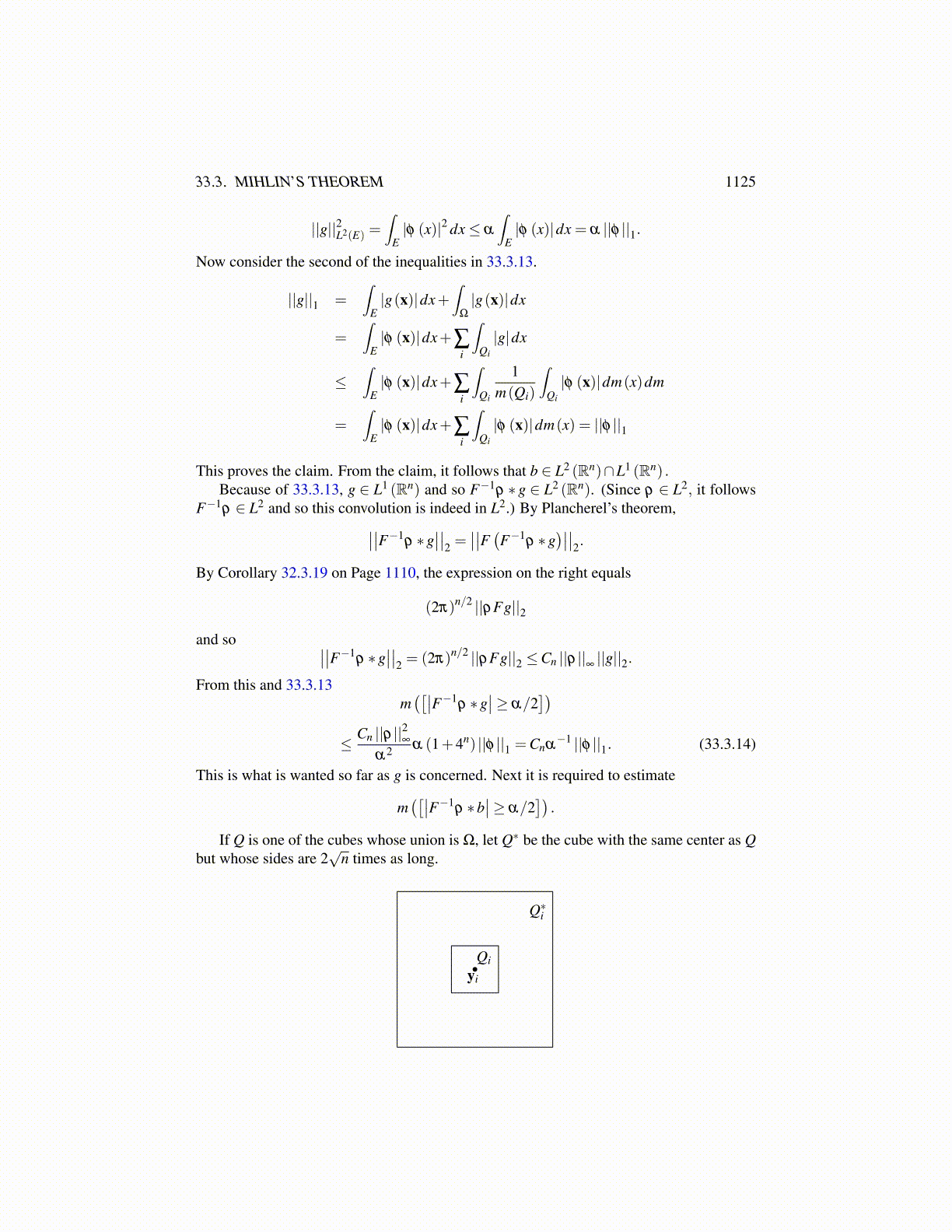
If Q is one of the cubes whose union is Ω, let Q∗ be the cube with the same center as Qbut whose sides are 2
√n times as long.
Qi
Q∗i
yi