1128 CHAPTER 33. FOURIER ANALYSIS IN Rn
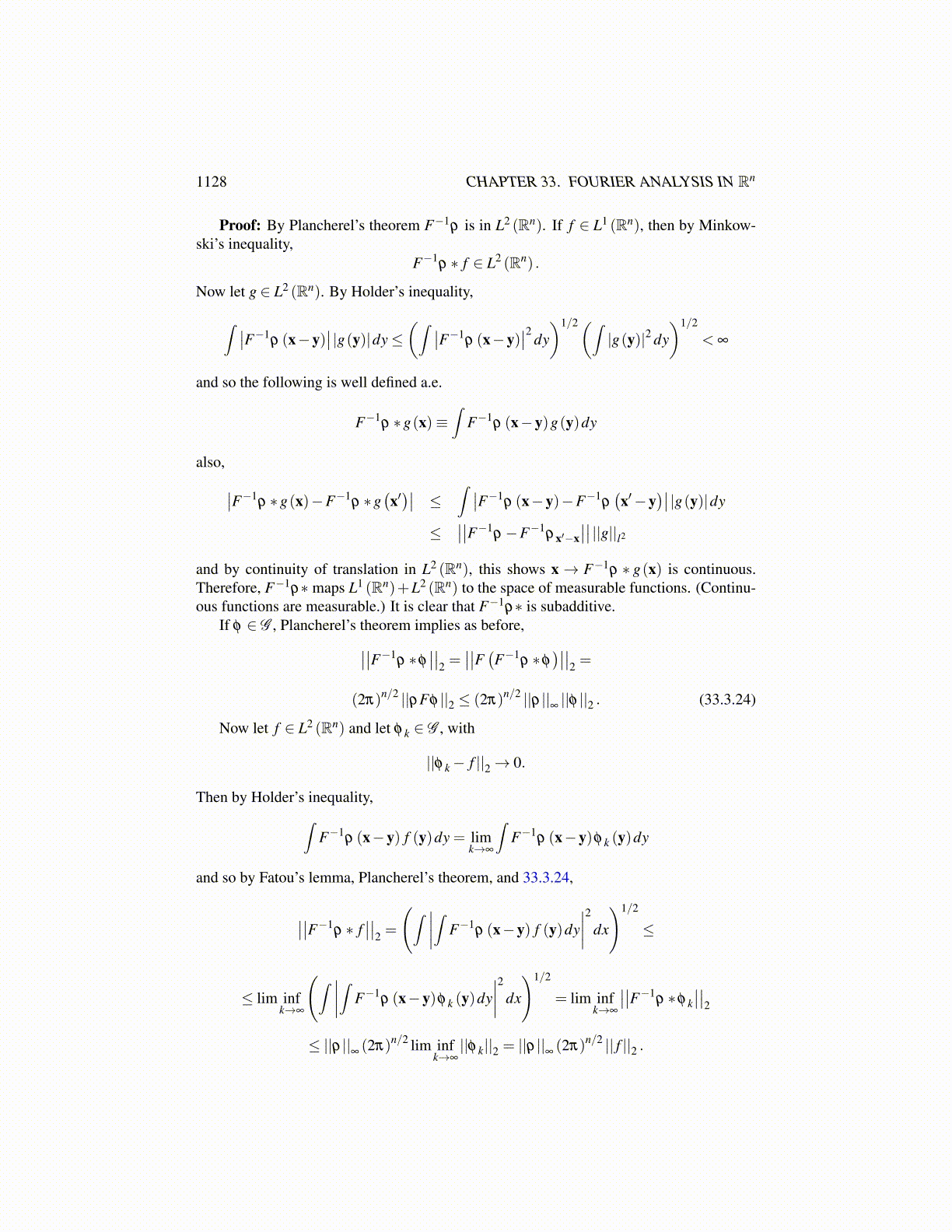
Proof: By Plancherel’s theorem F−1ρ is in L2 (Rn). If f ∈ L1 (Rn), then by Minkow-ski’s inequality,
F−1ρ ∗ f ∈ L2 (Rn) .
Now let g ∈ L2 (Rn). By Holder’s inequality,
∫ ∣∣F−1ρ (x−y)
∣∣ |g(y)|dy≤(∫ ∣∣F−1
ρ (x−y)∣∣2 dy
)1/2(∫|g(y)|2 dy
)1/2
< ∞
and so the following is well defined a.e.
F−1ρ ∗g(x)≡
∫F−1
ρ (x−y)g(y)dy
also, ∣∣F−1ρ ∗g(x)−F−1
ρ ∗g(x′)∣∣ ≤ ∫ ∣∣F−1
ρ (x−y)−F−1ρ(x′−y
)∣∣ |g(y)|dy
≤∣∣∣∣F−1
ρ−F−1ρx′−x
∣∣∣∣ ||g||l2
and by continuity of translation in L2 (Rn), this shows x→ F−1ρ ∗ g(x) is continuous.Therefore, F−1ρ∗ maps L1 (Rn)+L2 (Rn) to the space of measurable functions. (Continu-ous functions are measurable.) It is clear that F−1ρ∗ is subadditive.
If φ ∈ G , Plancherel’s theorem implies as before,∣∣∣∣F−1ρ ∗φ
∣∣∣∣2 =
∣∣∣∣F (F−1ρ ∗φ
)∣∣∣∣2 =
(2π)n/2 ||ρFφ ||2 ≤ (2π)n/2 ||ρ||∞||φ ||2 . (33.3.24)
Now let f ∈ L2 (Rn) and let φ k ∈ G , with
||φ k− f ||2→ 0.
Then by Holder’s inequality,∫F−1
ρ (x−y) f (y)dy = limk→∞
∫F−1
ρ (x−y)φ k (y)dy
and so by Fatou’s lemma, Plancherel’s theorem, and 33.3.24,
∣∣∣∣F−1ρ ∗ f
∣∣∣∣2 =
(∫ ∣∣∣∣∫ F−1ρ (x−y) f (y)dy
∣∣∣∣2 dx
)1/2
≤
≤ lim infk→∞
(∫ ∣∣∣∣∫ F−1ρ (x−y)φ k (y)dy
∣∣∣∣2 dx
)1/2
= lim infk→∞
∣∣∣∣F−1ρ ∗φ k
∣∣∣∣2
≤ ||ρ||∞(2π)n/2 lim inf
k→∞
||φ k||2 = ||ρ||∞ (2π)n/2 || f ||2 .