1146 CHAPTER 33. FOURIER ANALYSIS IN Rn
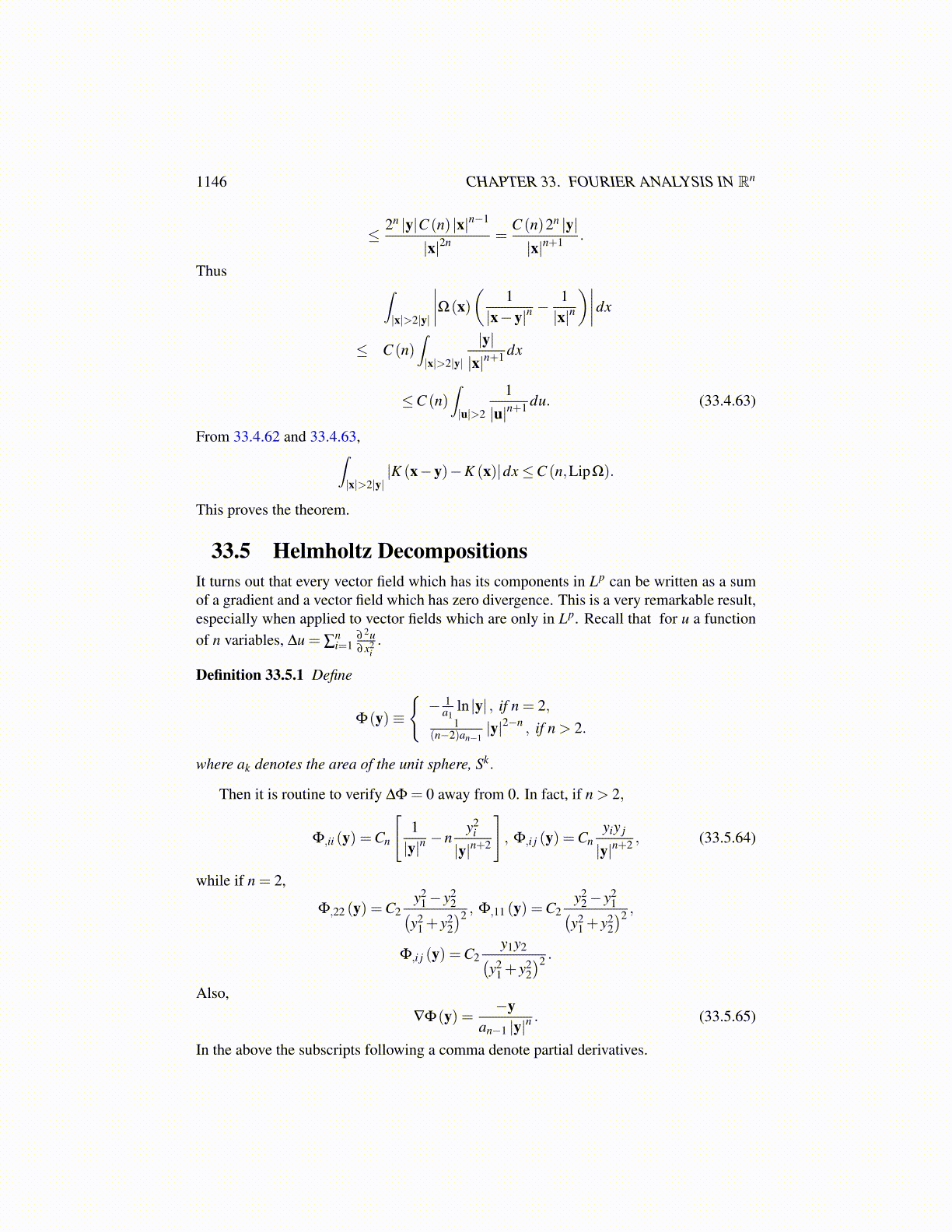
≤ 2n |y|C (n) |x|n−1
|x|2n =C (n)2n |y||x|n+1 .
Thus ∫|x|>2|y|
∣∣∣∣Ω(x)(
1|x−y|n
− 1|x|n
)∣∣∣∣dx
≤ C (n)∫|x|>2|y|
|y||x|n+1 dx
≤C (n)∫|u|>2
1
|u|n+1 du. (33.4.63)
From 33.4.62 and 33.4.63,∫|x|>2|y|
|K (x−y)−K (x)|dx≤C (n,LipΩ).
This proves the theorem.
33.5 Helmholtz DecompositionsIt turns out that every vector field which has its components in Lp can be written as a sumof a gradient and a vector field which has zero divergence. This is a very remarkable result,especially when applied to vector fields which are only in Lp. Recall that for u a functionof n variables, ∆u = ∑
ni=1
∂ 2u∂x2
i.
Definition 33.5.1 Define
Φ(y)≡
{− 1
a1ln |y| , if n = 2,
1(n−2)an−1
|y|2−n , if n > 2.
where ak denotes the area of the unit sphere, Sk.
Then it is routine to verify ∆Φ = 0 away from 0. In fact, if n > 2,
Φ,ii (y) =Cn
[1|y|n−n
y2i
|y|n+2
], Φ,i j (y) =Cn
yiy j
|y|n+2 , (33.5.64)
while if n = 2,
Φ,22 (y) =C2y2
1− y22(
y21 + y2
2
)2 , Φ,11 (y) =C2y2
2− y21(
y21 + y2
2
)2 ,
Φ,i j (y) =C2y1y2(
y21 + y2
2
)2 .
Also,∇Φ(y) =
−yan−1 |y|n
. (33.5.65)
In the above the subscripts following a comma denote partial derivatives.