1166 CHAPTER 34. GELFAND TRIPLES AND RELATED STUFF
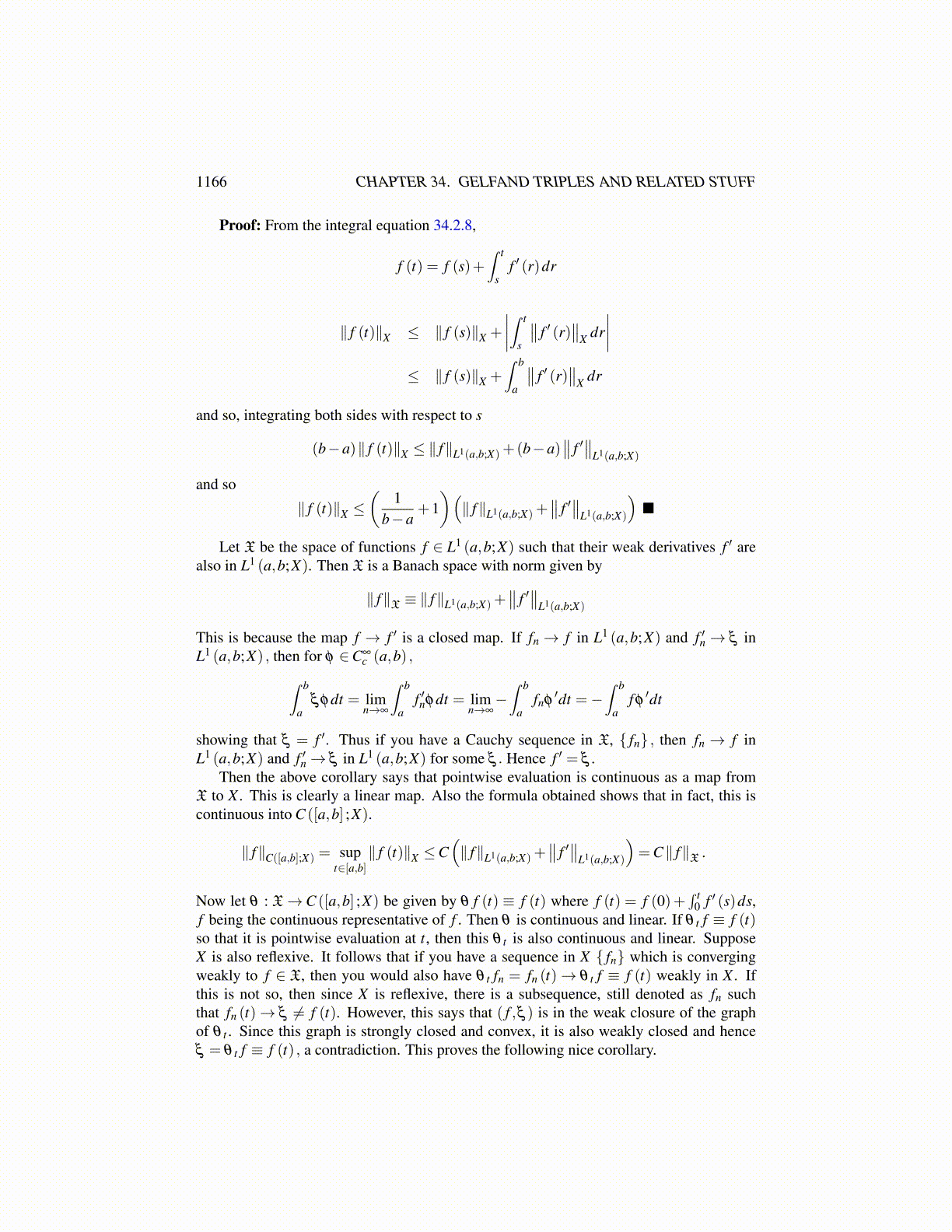
Proof: From the integral equation 34.2.8,
f (t) = f (s)+∫ t
sf ′ (r)dr
∥ f (t)∥X ≤ ∥ f (s)∥X +
∣∣∣∣∫ t
s
∥∥ f ′ (r)∥∥
X dr∣∣∣∣
≤ ∥ f (s)∥X +∫ b
a
∥∥ f ′ (r)∥∥
X dr
and so, integrating both sides with respect to s
(b−a)∥ f (t)∥X ≤ ∥ f∥L1(a,b;X)+(b−a)∥∥ f ′∥∥
L1(a,b;X)
and so
∥ f (t)∥X ≤(
1b−a
+1)(∥ f∥L1(a,b;X)+
∥∥ f ′∥∥
L1(a,b;X)
)Let X be the space of functions f ∈ L1 (a,b;X) such that their weak derivatives f ′ are
also in L1 (a,b;X). Then X is a Banach space with norm given by
∥ f∥X ≡ ∥ f∥L1(a,b;X)+∥∥ f ′∥∥
L1(a,b;X)
This is because the map f → f ′ is a closed map. If fn → f in L1 (a,b;X) and f ′n → ξ inL1 (a,b;X) , then for φ ∈C∞
c (a,b) ,∫ b
aξ φdt = lim
n→∞
∫ b
af ′nφdt = lim
n→∞−∫ b
afnφ′dt =−
∫ b
af φ′dt
showing that ξ = f ′. Thus if you have a Cauchy sequence in X, { fn} , then fn → f inL1 (a,b;X) and f ′n→ ξ in L1 (a,b;X) for some ξ . Hence f ′ = ξ .
Then the above corollary says that pointwise evaluation is continuous as a map fromX to X . This is clearly a linear map. Also the formula obtained shows that in fact, this iscontinuous into C ([a,b] ;X).
∥ f∥C([a,b];X) = supt∈[a,b]
∥ f (t)∥X ≤C(∥ f∥L1(a,b;X)+
∥∥ f ′∥∥
L1(a,b;X)
)=C∥ f∥X .
Now let θ : X→C ([a,b] ;X) be given by θ f (t) ≡ f (t) where f (t) = f (0)+∫ t
0 f ′ (s)ds,f being the continuous representative of f . Then θ is continuous and linear. If θ t f ≡ f (t)so that it is pointwise evaluation at t, then this θ t is also continuous and linear. SupposeX is also reflexive. It follows that if you have a sequence in X { fn} which is convergingweakly to f ∈ X, then you would also have θ t fn = fn (t)→ θ t f ≡ f (t) weakly in X . Ifthis is not so, then since X is reflexive, there is a subsequence, still denoted as fn suchthat fn (t)→ ξ ̸= f (t). However, this says that ( f ,ξ ) is in the weak closure of the graphof θ t . Since this graph is strongly closed and convex, it is also weakly closed and henceξ = θ t f ≡ f (t) , a contradiction. This proves the following nice corollary.