1170 CHAPTER 34. GELFAND TRIPLES AND RELATED STUFF
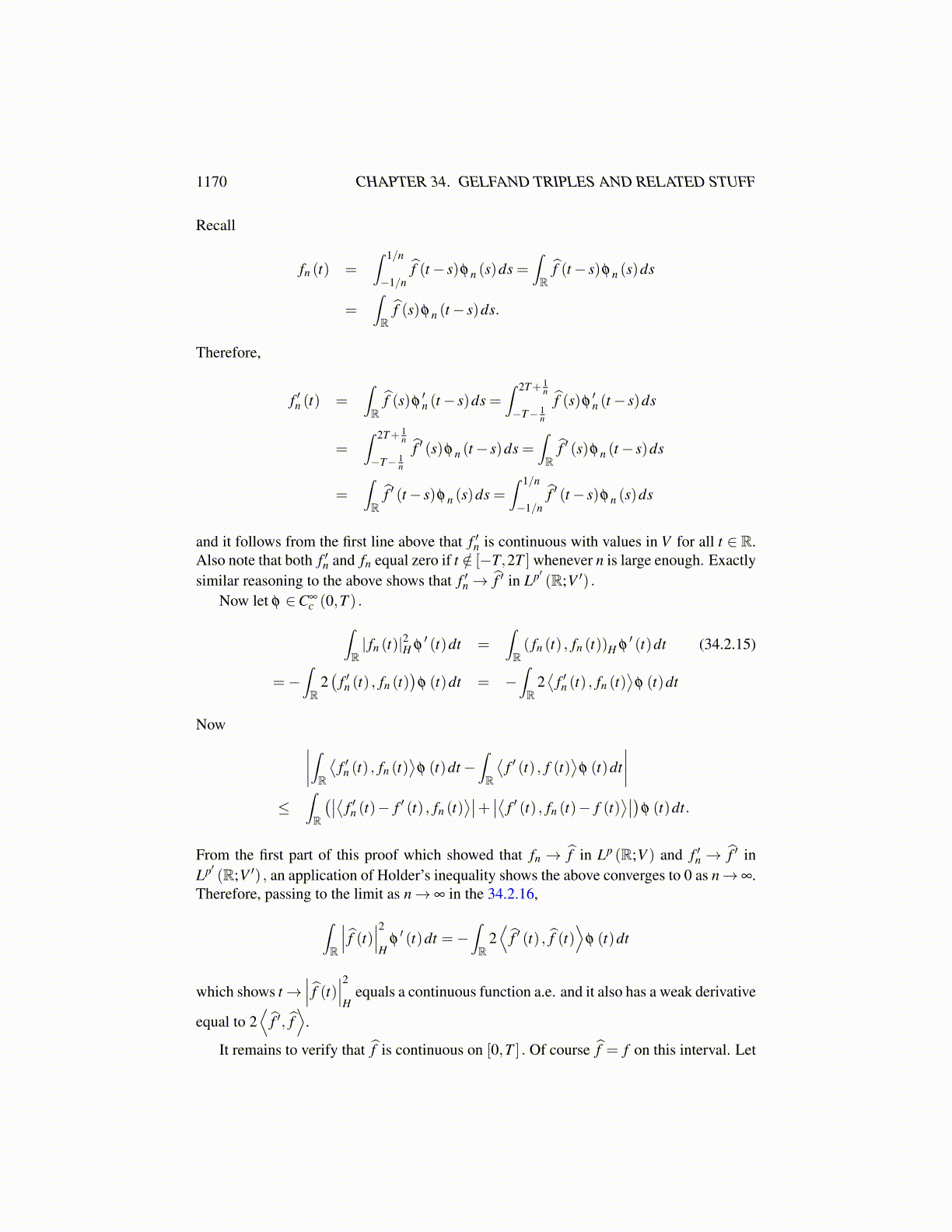
Recall
fn (t) =∫ 1/n
−1/nf̂ (t− s)φ n (s)ds =
∫R
f̂ (t− s)φ n (s)ds
=∫R
f̂ (s)φ n (t− s)ds.
Therefore,
f ′n (t) =∫R
f̂ (s)φ′n (t− s)ds =
∫ 2T+ 1n
−T− 1n
f̂ (s)φ′n (t− s)ds
=∫ 2T+ 1
n
−T− 1n
f̂ ′ (s)φ n (t− s)ds =∫R
f̂ ′ (s)φ n (t− s)ds
=∫R
f̂ ′ (t− s)φ n (s)ds =∫ 1/n
−1/nf̂ ′ (t− s)φ n (s)ds
and it follows from the first line above that f ′n is continuous with values in V for all t ∈ R.Also note that both f ′n and fn equal zero if t /∈ [−T,2T ] whenever n is large enough. Exactlysimilar reasoning to the above shows that f ′n→ f̂ ′ in Lp′ (R;V ′) .
Now let φ ∈C∞c (0,T ) .∫
R| fn (t)|2H φ
′ (t)dt =∫R( fn (t) , fn (t))H φ
′ (t)dt (34.2.15)
=−∫R
2(
f ′n (t) , fn (t))
φ (t)dt = −∫R
2⟨
f ′n (t) , fn (t)⟩
φ (t)dt
Now ∣∣∣∣∫R ⟨ f ′n (t) , fn (t)⟩
φ (t)dt−∫R
⟨f ′ (t) , f (t)
⟩φ (t)dt
∣∣∣∣≤
∫R
(∣∣⟨ f ′n (t)− f ′ (t) , fn (t)⟩∣∣+ ∣∣⟨ f ′ (t) , fn (t)− f (t)
⟩∣∣)φ (t)dt.
From the first part of this proof which showed that fn → f̂ in Lp (R;V ) and f ′n → f̂ ′ inLp′ (R;V ′) , an application of Holder’s inequality shows the above converges to 0 as n→∞.Therefore, passing to the limit as n→ ∞ in the 34.2.16,∫
R
∣∣∣ f̂ (t)∣∣∣2H
φ′ (t)dt =−
∫R
2⟨
f̂ ′ (t) , f̂ (t)⟩
φ (t)dt
which shows t→∣∣∣ f̂ (t)∣∣∣2
Hequals a continuous function a.e. and it also has a weak derivative
equal to 2⟨
f̂ ′, f̂⟩
.
It remains to verify that f̂ is continuous on [0,T ] . Of course f̂ = f on this interval. Let