34.4. THE IMPLICIT CASE 1185
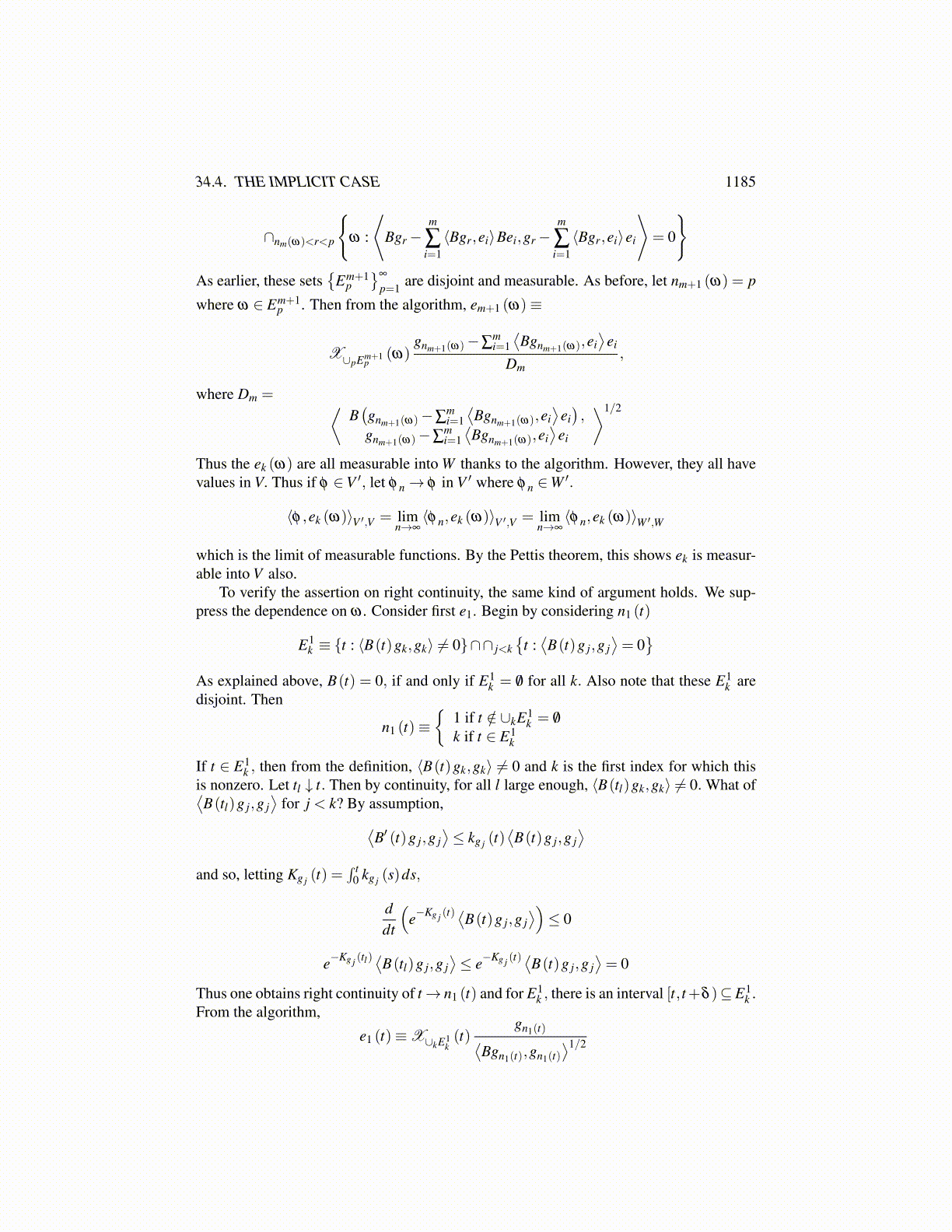
∩nm(ω)<r<p
{ω :
⟨Bgr−
m
∑i=1⟨Bgr,ei⟩Bei,gr−
m
∑i=1⟨Bgr,ei⟩ei
⟩= 0
}As earlier, these sets
{Em+1
p}∞
p=1 are disjoint and measurable. As before, let nm+1 (ω) = p
where ω ∈ Em+1p . Then from the algorithm, em+1 (ω)≡
X∪pEm+1p
(ω)gnm+1(ω)−∑
mi=1⟨Bgnm+1(ω),ei
⟩ei
Dm,
where Dm = ⟨B(gnm+1(ω)−∑
mi=1⟨Bgnm+1(ω),ei
⟩ei),
gnm+1(ω)−∑mi=1⟨Bgnm+1(ω),ei
⟩ei
⟩1/2
Thus the ek (ω) are all measurable into W thanks to the algorithm. However, they all havevalues in V. Thus if φ ∈V ′, let φ n→ φ in V ′ where φ n ∈W ′.
⟨φ ,ek (ω)⟩V ′,V = limn→∞⟨φ n,ek (ω)⟩V ′,V = lim
n→∞⟨φ n,ek (ω)⟩W ′,W
which is the limit of measurable functions. By the Pettis theorem, this shows ek is measur-able into V also.
To verify the assertion on right continuity, the same kind of argument holds. We sup-press the dependence on ω . Consider first e1. Begin by considering n1 (t)
E1k ≡ {t : ⟨B(t)gk,gk⟩ ̸= 0}∩∩ j<k
{t :⟨B(t)g j,g j
⟩= 0}
As explained above, B(t) = 0, if and only if E1k = /0 for all k. Also note that these E1
k aredisjoint. Then
n1 (t)≡{
1 if t /∈ ∪kE1k = /0
k if t ∈ E1k
If t ∈ E1k , then from the definition, ⟨B(t)gk,gk⟩ ̸= 0 and k is the first index for which this
is nonzero. Let tl ↓ t. Then by continuity, for all l large enough, ⟨B(tl)gk,gk⟩ ̸= 0. What of⟨B(tl)g j,g j
⟩for j < k? By assumption,⟨
B′ (t)g j,g j⟩≤ kg j (t)
⟨B(t)g j,g j
⟩and so, letting Kg j (t) =
∫ t0 kg j (s)ds,
ddt
(e−Kg j (t)
⟨B(t)g j,g j
⟩)≤ 0
e−Kg j (tl)⟨B(tl)g j,g j
⟩≤ e−Kg j (t)
⟨B(t)g j,g j
⟩= 0
Thus one obtains right continuity of t→ n1 (t) and for E1k , there is an interval [t, t+δ )⊆E1
k .From the algorithm,
e1 (t)≡X∪kE1k(t)
gn1(t)⟨Bgn1(t),gn1(t)
⟩1/2