1226 CHAPTER 34. GELFAND TRIPLES AND RELATED STUFF
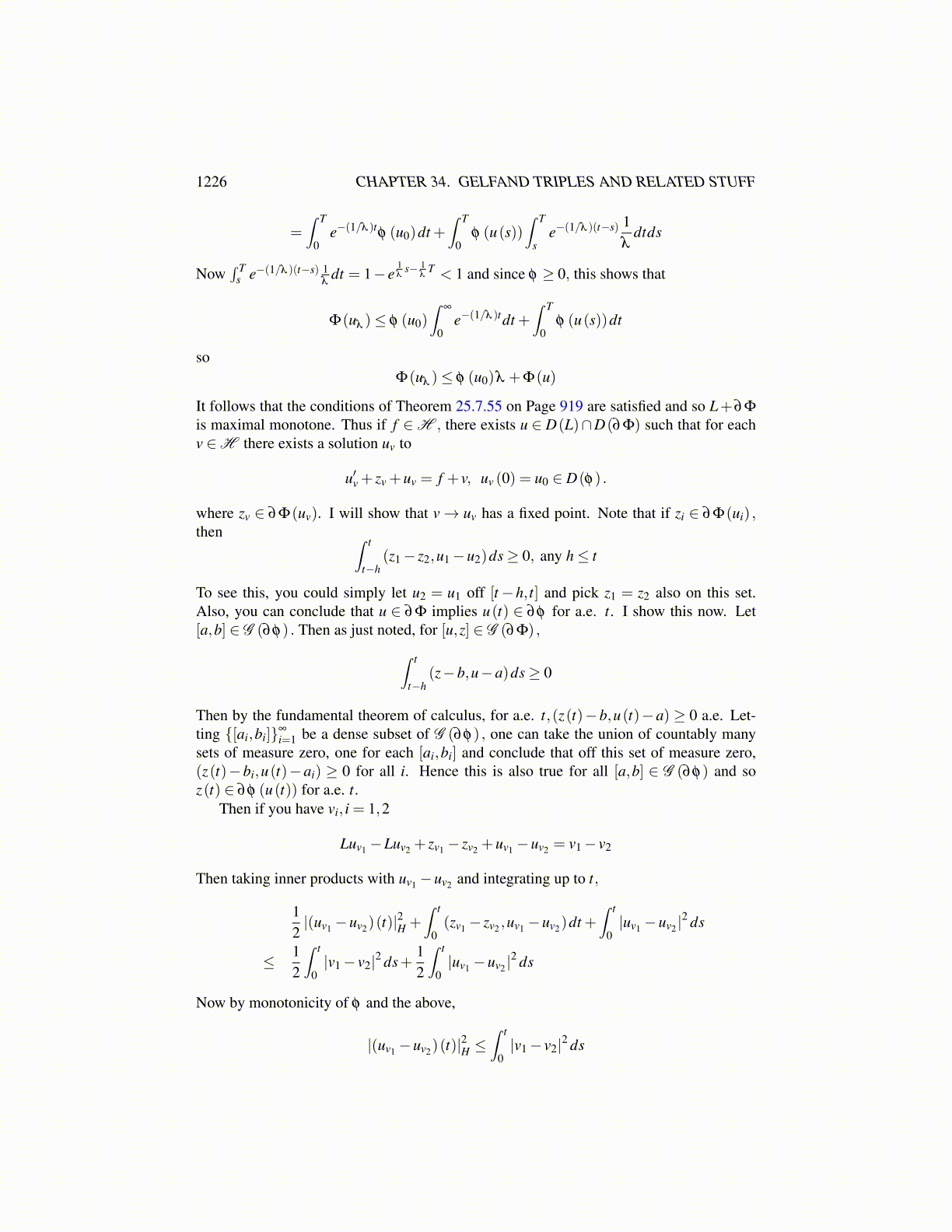
=∫ T
0e−(1/λ )t
φ (u0)dt +∫ T
0φ (u(s))
∫ T
se−(1/λ )(t−s) 1
λdtds
Now∫ T
s e−(1/λ )(t−s) 1λ
dt = 1− e1λ
s− 1λ
T < 1 and since φ ≥ 0, this shows that
Φ(uλ )≤ φ (u0)∫
∞
0e−(1/λ )tdt +
∫ T
0φ (u(s))dt
soΦ(uλ )≤ φ (u0)λ +Φ(u)
It follows that the conditions of Theorem 25.7.55 on Page 919 are satisfied and so L+∂Φ
is maximal monotone. Thus if f ∈H , there exists u ∈ D(L)∩D(∂Φ) such that for eachv ∈H there exists a solution uv to
u′v + zv +uv = f + v, uv (0) = u0 ∈ D(φ) .
where zv ∈ ∂Φ(uv). I will show that v→ uv has a fixed point. Note that if zi ∈ ∂Φ(ui) ,then ∫ t
t−h(z1− z2,u1−u2)ds≥ 0, any h≤ t
To see this, you could simply let u2 = u1 off [t−h, t] and pick z1 = z2 also on this set.Also, you can conclude that u ∈ ∂Φ implies u(t) ∈ ∂φ for a.e. t. I show this now. Let[a,b] ∈ G (∂φ) . Then as just noted, for [u,z] ∈ G (∂Φ) ,∫ t
t−h(z−b,u−a)ds≥ 0
Then by the fundamental theorem of calculus, for a.e. t,(z(t)−b,u(t)−a) ≥ 0 a.e. Let-ting {[ai,bi]}∞
i=1 be a dense subset of G (∂φ) , one can take the union of countably manysets of measure zero, one for each [ai,bi] and conclude that off this set of measure zero,(z(t)−bi,u(t)−ai) ≥ 0 for all i. Hence this is also true for all [a,b] ∈ G (∂φ) and soz(t) ∈ ∂φ (u(t)) for a.e. t.
Then if you have vi, i = 1,2
Luv1 −Luv2 + zv1 − zv2 +uv1 −uv2 = v1− v2
Then taking inner products with uv1 −uv2 and integrating up to t,
12|(uv1 −uv2)(t)|
2H +
∫ t
0(zv1 − zv2 ,uv1 −uv2)dt +
∫ t
0|uv1 −uv2 |
2 ds
≤ 12
∫ t
0|v1− v2|2 ds+
12
∫ t
0|uv1 −uv2 |
2 ds
Now by monotonicity of φ and the above,
|(uv1 −uv2)(t)|2H ≤
∫ t
0|v1− v2|2 ds