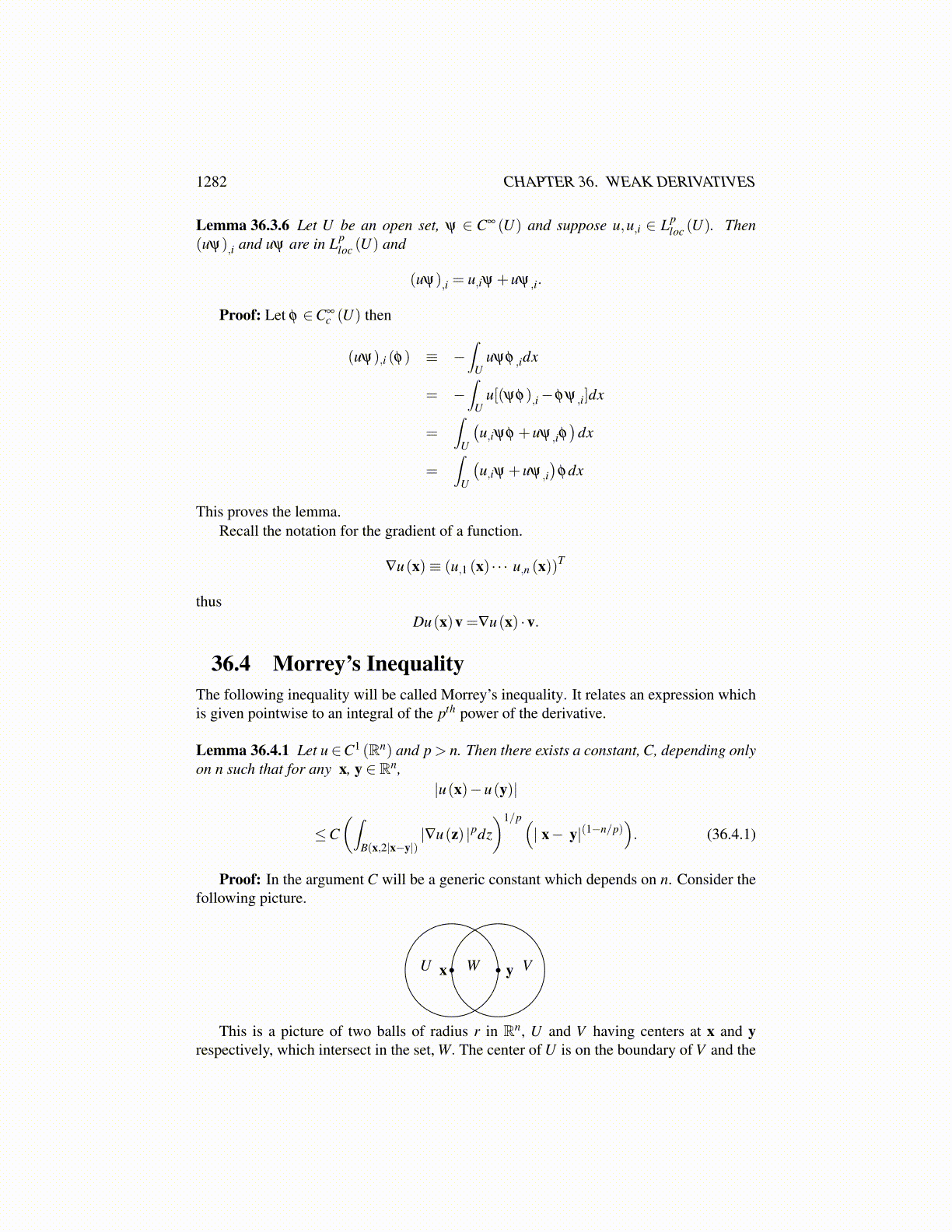
1282 CHAPTER 37. BASIC THEORY OF SOBOLEV SPACES
First of all, for u ∈ K and x ∈ Rn,
|u∗φ k (x)|p ≤
(∫|u(x−y)φ k (y)|dy
)p
=
(∫|u(y)φ k (x−y)|dy
)p
≤∫|u(y)|p φ k (x−y)dy
≤(
supz∈Rn
φ k (z))∫|u(y)|dy≤M
(supz∈Rn
φ k (z))
showing the functions in Kk are uniformly bounded.Next suppose x,x1 ∈ Kk and consider
|u∗φ k (x)−u∗φ k (x1)|
≤∫|u(x−y)−u(x1−y)|φ k (y)dy
≤(∫|u(x−y)−u(x1−y)|p dy
)1/p(∫φ k (y)
q dy)q
which by assumption 37.1.17 is small independent of the choice of u whenever |x−x1| issmall enough. Note that k is fixed in the above. Therefore, the set, Kk is precompact inC(G)
thanks to the Ascoli Arzela theorem. Next consider how well u ∈ K is approximatedby u∗φ k in Lp (Rn) . By Minkowski’s inequality,(∫
|u(x)−u∗φ k (x)|p dx)1/p
≤(∫ (∫
|u(x)−u(x−y)|φ k (y)dy)p
dx)1/p
≤∫
B(0, 1k )
φ k (y)(∫|u(x)−u(x−y)|p dx
)1/p
dy.
Now let η > 0 be given. From 37.1.17 there exists k large enough that for all u ∈ K,∫B(0, 1
k )φ k (y)
(∫|u(x)−u(x−y)|p dx
)1/p
dy≤∫
B(0, 1k )
φ k (y)η dy = η .
Now let ε > 0 be given and let δ and G correspond to ε as given in the hypotheses andlet 1/k < δ and also k is large enough that for all u ∈ K,
||u−u∗φ k||p < ε
as in the above inequality. By the Ascoli Arzela theorem there exists an(ε
m(G+B(0,1)
))1/p