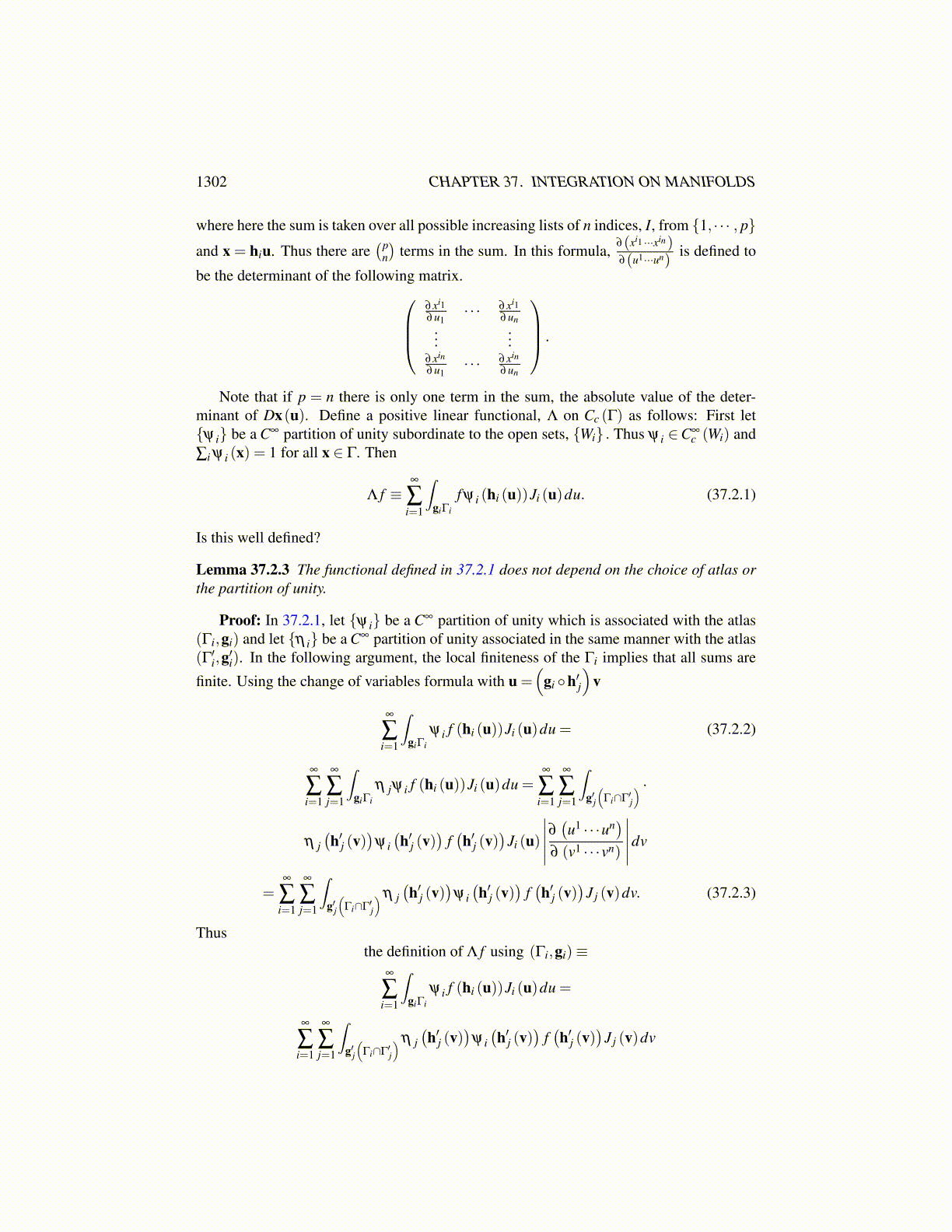
1302 CHAPTER 38. SOBOLEV SPACES BASED ON L2
Lemma 38.1.3 The Schwartz class, S, is dense in W m,p (Rn) .
Proof: The set, Rn satisfies the segment condition, so C∞c (Rn) is dense in W m,p (Rn) .
However, C∞c (Rn)⊆S. This proves the lemma.
Recall now Plancherel’s theorem which states that || f ||0,2,Rn = ||F f ||0,2,Rn wheneverf ∈ L2 (Rn) . Also it is routine to verify from the definition of the Fourier transform that foru ∈S,
F∂ku = ixkFu.
From this it follows that||Dα u||0,2,Rn = ||xα Fu||0,2,Rn .
Here xα denotes the function x→ xα . Therefore,
||u||m,2,Rn =
(∫Rn
∑|α|≤m
x2α11 · · ·x2αn
n |Fu(x)|2 dx
)1/2
.
Also, it is not hard to verify that
∑|α|≤m
x2α11 · · ·x2αn
n ≤
(1+
n
∑j=1
x2j
)m
≤C (n,m) ∑|α|≤m
x2α11 · · ·x2αn
n
where C (n,m) is the largest of the multinomial coefficients obtained in the expansion,(1+
n
∑j=1
x2j
)m
.
Therefore, for all u ∈S,
||u||m,2,Rn ≤(∫
Rn
(1+ |x|2
)m|Fu(x)|2 dx
)1/2
≤C (n,m) ||u||m,2,Rn . (38.1.2)
This motivates the following definition.
Definition 38.1.4 Let Hm (Rn)≡{u ∈ L2 (Rn) : ||u||Hm(Rn) ≡
(∫Rn
(1+ |x|2
)m|Fu(x)|2 dx
)1/2
< ∞
}. (38.1.3)
Lemma 38.1.5 S is dense in Hm (Rn) and Hm (Rn) =W 2,m (Rn). Furthermore, the normsare equivalent.
Proof: First it is shown that S is dense in Hm (Rn) . Let u ∈ Hm (Rn) . Let µ (E) ≡∫E
(1+ |x|2
)mdx. Thus µ is a regular measure and u ∈ Hm (Rn) just means that Fu ∈
L2 (µ) , the space of functions which are in L2 (Rn) with respect to this measure, µ. There-fore, from the regularity of the measure, µ, there exists uk ∈Cc (Rn) such that
||uk−Fu||L2(µ)→ 0.