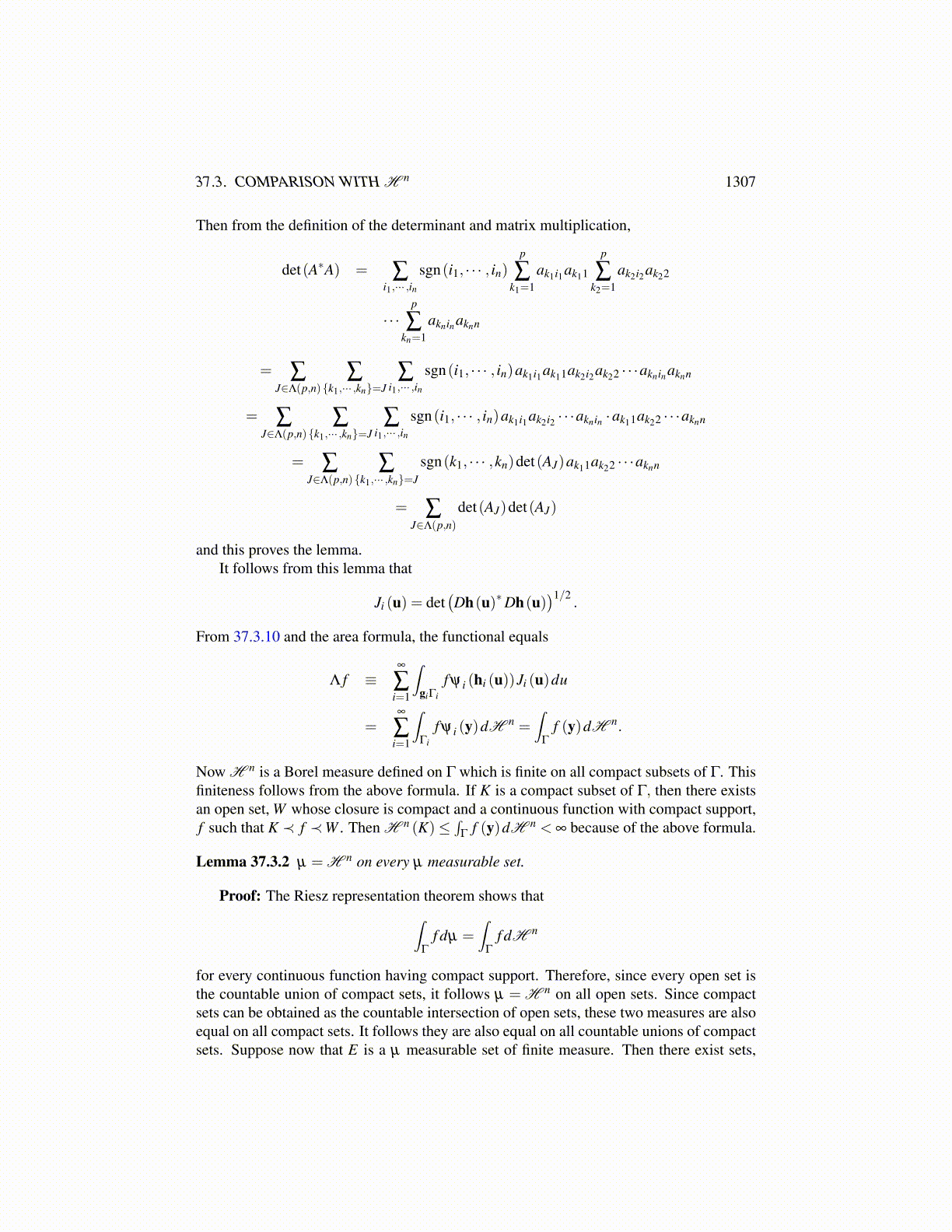
38.3. AN INTRINSIC NORM 1307
Proof: This follows from Holder’s inequality applied to the measure µ given by
µ (E) =∫
E|Fu|2 dx
Thus ∫ (1+ |x|2
)s|Fu|2 dx
=∫ (
1+ |x|2)rθ (
1+ |x|2)(1−θ)t
|Fu|2 dx
≤(∫ (
1+ |x|2)r|Fu|2 dx
)θ (∫ (1+ |x|2
)(1−θ)t|Fu|2 dx
)1−θ
= ||u||2θ
Hr(Rn) ||u||2(1−θ)Ht (Rn)
.
Taking square roots yields the desired inequality.
Corollary 38.2.6 Let U be an open set satisfying Assumption 38.1.2 and let p < q wherep,q are two nonnegative integers. Also let t ∈ (p,q) . Then exists a constant, C independentof u ∈ Hq (U) such that for all u ∈ Hq (U) ,
||u||Ht (U) ≤C ||u||θH p(U) ||u||1−θ
Hq(U)
where θ is such that t = θ p+(1−θ)q.
Proof: Let E ∈L (Hq (U) ,Hq (Rn)) such that for all positive integers, l less than orequal to q, E ∈ L
(H l (U) ,H l (Rn)
). Then Eu|U = u and Eu ∈ Ht (Rn) . Therefore, by
Lemma 38.2.5,
||u||Ht (U) ≤ ||Eu||Ht (Rn) ≤ ||Eu||θH p(Rn) ||Eu||1−θ
Hq(Rn)
≤ C ||u||θH p(U) ||u||1−θ
Hq(U) .
Now recall the very important Theorem 37.0.14 on Page 1272 which is listed here forconvenience.
Theorem 38.2.7 Let h : U →V be one to one and onto where U and V are two open sets.Also suppose that Dα h and Dα
(h−1)
exist and are Lipschitz continuous if |α| ≤ m−1 form a positive integer. Then
h∗ : W m,p (V )→W m,p (U)
is continuous, linear, one to one, and has an inverse with the same properties, the inversebeing
(h−1)∗.
38.3 An Intrinsic NormIs there something like this for the fractional order spaces? Yes there is. However, in orderto prove it, it is convenient to use an equivalent norm for Hm+s (Rn) which does not dependexplicitly on the Fourier transform. The following theorem is similar to one in [68]. Itdescribes the norm in Hm+s (Rn) in terms which are free of the Fourier transform. This isalso called an intrinsic norm [1].