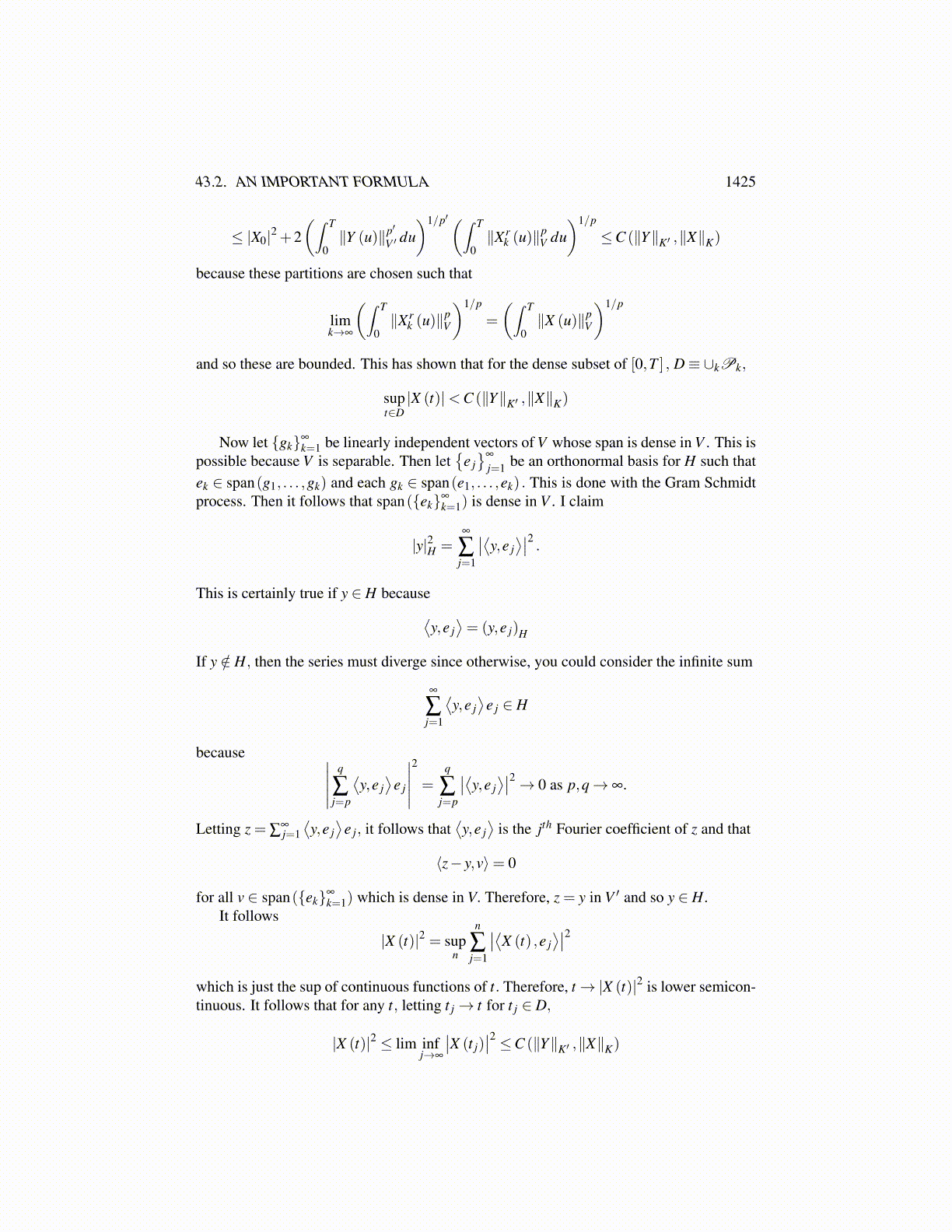
43.2. AN IMPORTANT FORMULA 1425
Hence by the Borel Cantelli lemma, there exists a set of measure zero N such that for s /∈N,
mnk (s)≤ 1/k
for all k sufficiently large. Picking sk /∈ N,
Y lk (t)≡ Y
((γnk
(t− sk)+ sk
)+)
Then t→Y((
γnk(t− sk)+ sk
)+)is a step function of the sort described above. Of course
you can always simply define Y lk (0) ≡ 0. This is because the interval affected has length
which converges to 0 as k→ ∞. The jumps in t → γnk(t− sk) determine the mesh points
of the partition. By picking sk appropriately, you can have each of these mesh points missa given set of measure zero except for the first and last point. This is because when youslide sk it just moves the mesh points of Pk except for the first point and last point. Let N1be a set of measure zero and let (a,b) ⊆ [0,T ] . Now let s move through (a,b) and denoteby A j the corresponding set of points obtained by the jth mesh point. Thus A j has positivemeasure and so it is not contained in N1. Let S j be the points of (a,b) which correspond toA j ∩N1. Thus S j has measure 0. Just pick sk ∈ (a,b)\∪ jS j. You can also choose sk suchthat
T − sk− γnk(T − sk)> 2−(nk+1)
which will cause the last condition mentioned above to hold.To get the other sequence of step functions, just use a similar argument with δ n in place
of γn.
Theorem 43.2.2 Let V ⊆H =H ′⊆V ′ be a Gelfand triple and suppose Y ∈ Lp′ (0,T ;V ′)≡K′ and
X (t) = X0 +∫ t
0Y (s)ds in V ′ (43.2.8)
where X0 ∈ H, and it is known that X ∈ Lp (0,T,V ) ≡ K for p > 1. Then t → X (t) is inC ([0,T ] ,H) and also
12|X (t)|2H =
12|X0|2H +
∫ t
0⟨Y (s) ,X (s)⟩ds
Proof: By Lemma 43.2.1, there exists a sequence of uniform partitions{
tnk
}mnk=0 =
Pn,Pn ⊆Pn+1, of [0,T ] such that the step functions
mn−1
∑k=0
X (tnk )X(tn
k ,tnk+1]
(t) ≡ X l (t)
mn−1
∑k=0
X(tnk+1)X(tn
k ,tnk+1]
(t) ≡ X r (t)
converge to X in K and in L2 ([0,T ] ,H).