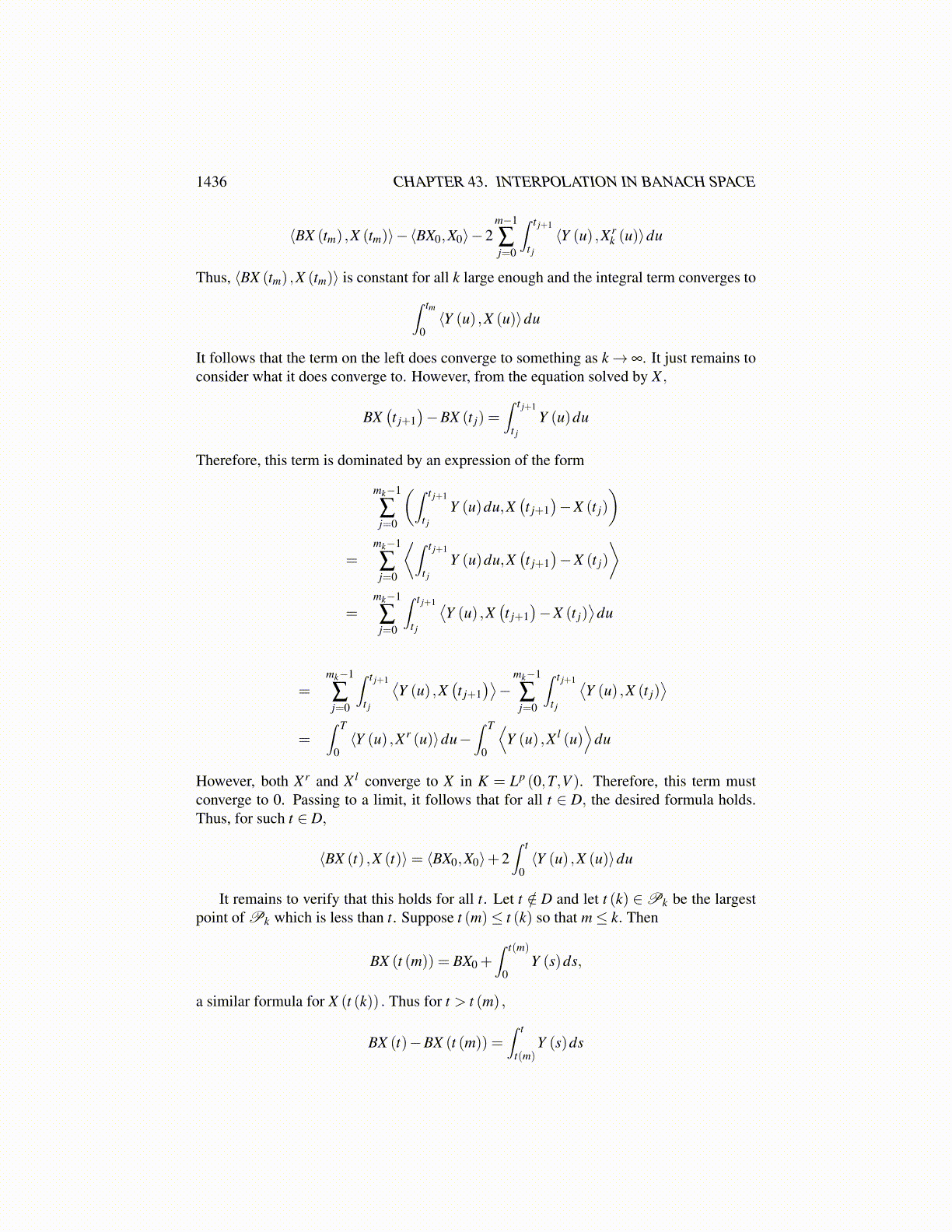
1436 CHAPTER 43. INTERPOLATION IN BANACH SPACE
Proof: It follows from the following computations
B(X (t)−X (s)) =∫ t
sY (u)du
and so
2∫ t
s⟨Y (u) ,X (t)⟩du−⟨B(X (t)−X (s)) ,(X (t)−X (s))⟩
= 2⟨B(X (t)−X (s)) ,X (t)⟩−⟨B(X (t)−X (s)) ,(X (t)−X (s))⟩
= 2⟨BX (t) ,X (t)⟩−2⟨BX (s) ,X (t)⟩−⟨BX (t) ,X (t)⟩+2⟨BX (s) ,X (t)⟩−⟨BX (s) ,X (s)⟩
= ⟨BX (t) ,X (t)⟩−⟨BX (s) ,X (s)⟩
Thus⟨BX (t) ,X (t)⟩−⟨BX (s) ,X (s)⟩
= 2∫ t
s⟨Y (u) ,X (t)⟩du−⟨B(X (t)−X (s)) ,(X (t)−X (s))⟩
Lemma 43.3.4 In the above situation,
supt∈[0,T ]
⟨BX (t) ,X (t)⟩ ≤C (∥Y∥K′ ,∥X∥K)
Also, t→ BX (t) is weakly continuous with values in W ′.
Proof: From the above formula applied to the kth partition of [0,T ] described above,
⟨BX (tm) ,X (tm)⟩−⟨BX0,X0⟩=m−1
∑j=0
⟨BX(t j+1
),X(t j+1
)⟩−⟨BX (t j) ,X (t j)
⟩
=m−1
∑j=0
2∫ t j+1
t j
⟨Y (u) ,X
(t j+1
)⟩du−
⟨B(X(t j+1
)−X (t j)
),X(t j+1
)−X (t j)
⟩=
m−1
∑j=0
2∫ t j+1
t j
⟨Y (u) ,X rk (u)⟩du−
⟨B(X(t j+1
)−X (t j)
),X(t j+1
)−X (t j)
⟩Thus, discarding the negative terms and denoting by Pk the kth of these partitions,
supt j∈Pk
⟨BX (t j) ,X (t j)
⟩≤ ⟨BX0,X0⟩+2
∫ T
0|⟨Y (u) ,X r
k (u)⟩|du
≤ ⟨BX0,X0⟩+2∫ T
0∥Y (u)∥V ′ ∥X
rk (u)∥V du