1710 CHAPTER 54. FUNCTIONAL ANALYSIS APPLICATIONS
Now consider one of the straight lines. On either of these λ = a+wy where |w| = 1and y≥ 1/ |t|. Then the contour integral is
eat
2πi
∫∞
1/|t|eywt
(−I +(a+wy)((a+wy) I−A)−1
)wdy
As earlier, the norm of this is dominated by |eat |
2π
∫∞
1/|t| e−y|t|c(r)
(1+M |a+wy|
|wy|
)dy =
=|eat |2π
∫∞
1e−xc(r)
(1+M
|a+w(x/ |t|)||w(x/ |t|)|
)1|t|
dx
=|eat |2π
∫∞
1e−xc(r)
(1+M
|a |t|+wx||x|
)1|t|
dx≤ |eat |
2π
(Mr
1|t|
)+Nr |a|
|eat |2π
Combining this with 54.3.15 and adjusting constants,
∥AS (t)∥ ≤Mr∣∣eat ∣∣ 1|t|
+Nr∣∣eat ∣∣ |a|
Also note that if the contour is shifted to the right slightly, the integral over the shiftedcontour, γ ′
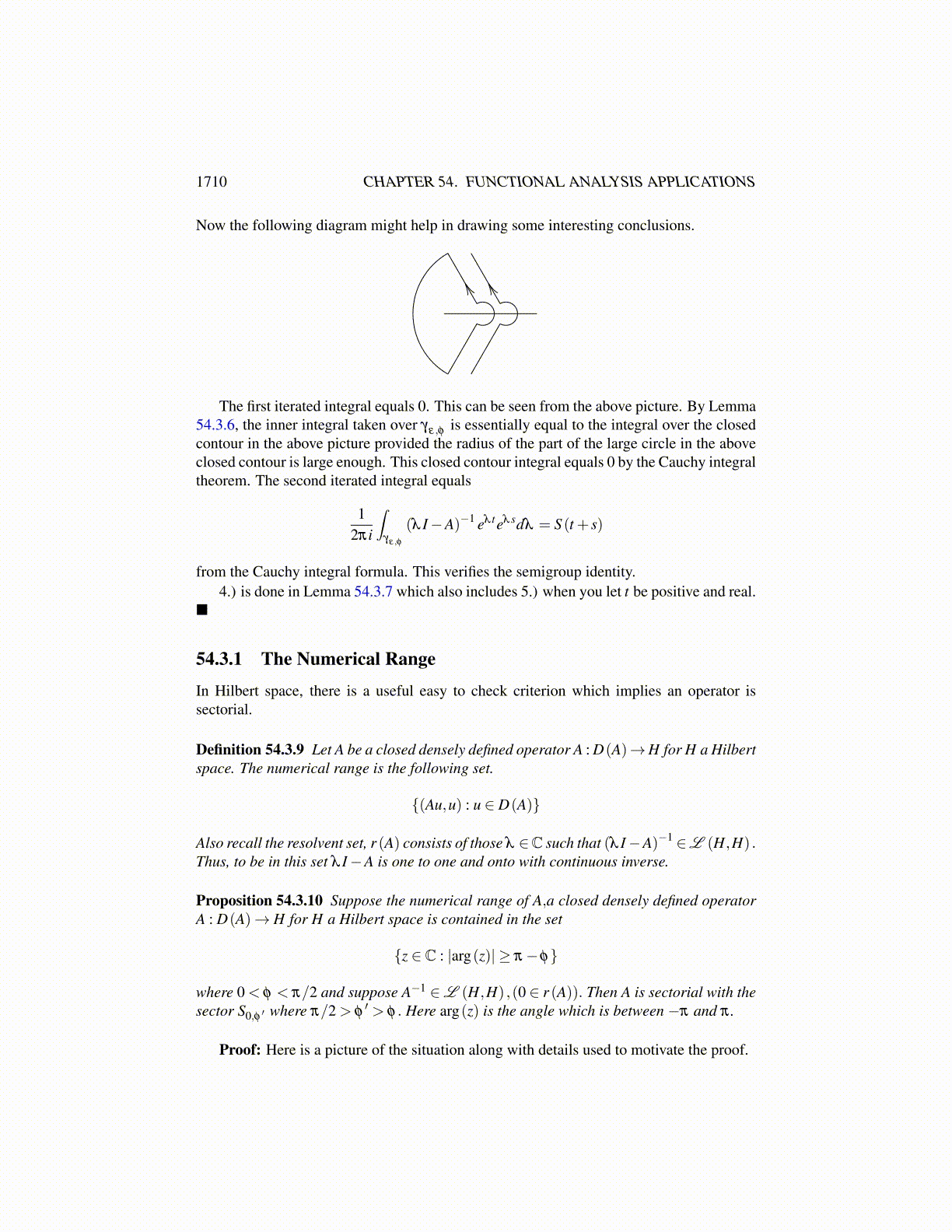
ε,φ coincides with the integral over γε,φ thanks to the Cauchy integral formulaand Lemma 54.3.6 which allows the approximation of the above integrals with one on aclosed contour. The following is the main result.
Theorem 54.3.8 Let A be a sectorial operator as defined in Definition 54.3.1 for the sectorSa,φ . Then there exists a semigroup S (t) for t ∈ |argz| ≤ r <
(π
2 −φ)
which satisfies thefollowing conditions.
1. Then S (t) given above in 54.3.11 is analytic for t ∈ S00,(φ+π/2).
2. For any x ∈ H and t ∈ S00,(φ+π/2), then for n a positive integer, S(n) (t)x = AnS (t)x
3. S is a semigroup on the open sector, S00,(φ+π/2). That is, for all t,s ∈ S0
0(φ+π/2),
S (t + s) = S (t)S (s)
4. limt→0,t∈Sr S (t)x = x for all x ∈ H where |arg t| ≤ r <(
π
2 −φ)
5. For some constants M,N, if t is positive and real,∥S (t)∥ ≤Meat , then
∥AS (t)∥ ≤Meat 1|t|
+N∣∣eat ∣∣ |a|
Proof: Consider the first claim. This follows right away from the formula: S (t) ≡1
2πi∫
γε,φeλ t (λ I−A)−1 dλ . One can differentiate under the integral sign using the domi-
nated convergence theorem to obtain
S′ (t)≡ 12πi
∫γε,φ
λeλ t (λ I−A)−1 dλ =1
2πi
∫γε,φ
eλ t(
I +A(λ I−A)−1)
dλ