54.3. SECTORIAL OPERATORS AND ANALYTIC SEMIGROUPS 1717
Obviously you could follow identical reasoning to include many other examples ofmore complexity. What does it mean for u ∈ D(A)? It means that in a weak sense
−au+∇ · (a(x)∇u) ∈ H.
Since A is sectorial for S−a,φ for any 0 < φ < π/2, this has shown the existence of a weaksolution to the partial differential equation along with appropriate boundary conditions,
−au+∇ · (a(x)∇u) = f , u ∈V.
What are these appropriate boundary conditions? u = 0 on Γ is one. the other would bea variational boundary condition which comes from integration by parts. Letting v ∈ V,formally do the following using the divergence theorem.
( f ,v)H =∫
Ω
(−au+∇ · (a(x)∇u))vdx
=∫
Ω
−auvdx+∫
∂Ω
(a(x)∇uv) ·nds−∫
Ω
a(x)∇u(x) ·∇v(x)dx
= ( f ,v)H +∫
∂Ω\Γ(a(x)∇u) ·nvds
and so the other boundary condition is
a(x)∂u∂n
= 0 on ∂Ω\Γ.
To what extent this weak solution is really a classical solution depends on more technicalconsiderations.
54.3.3 Fractional Powers Of Sectorial OperatorsIt will always be assumed in this section that A is sectorial for the sector S−a,φ wherea > 0. To begin with, here is a useful lemma which will be used in the presentation of thesefractional powers.
Lemma 54.3.15 The following holds for α ∈ (0,1) and σ < t.∫ t
σ
(t− s)α−1 (s−σ)−α ds =π
sin(πα)
In particular, ∫ 1
0(1− s)α−1 s−α ds =
π
sin(πα).
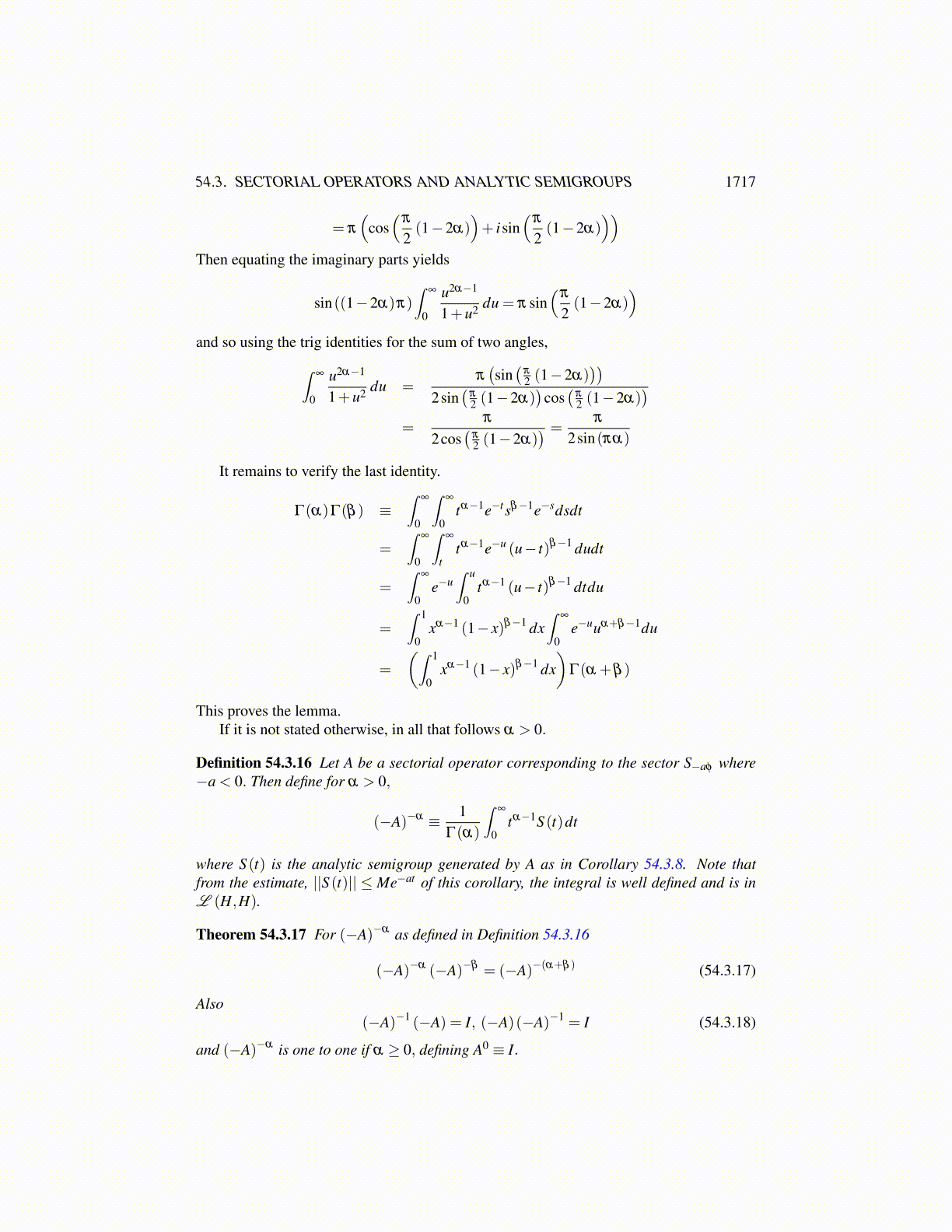
Also for α,β > 0
Γ(α)Γ(β ) =
(∫ 1
0xα−1 (1− x)β−1 dx
)Γ(α +β ) .