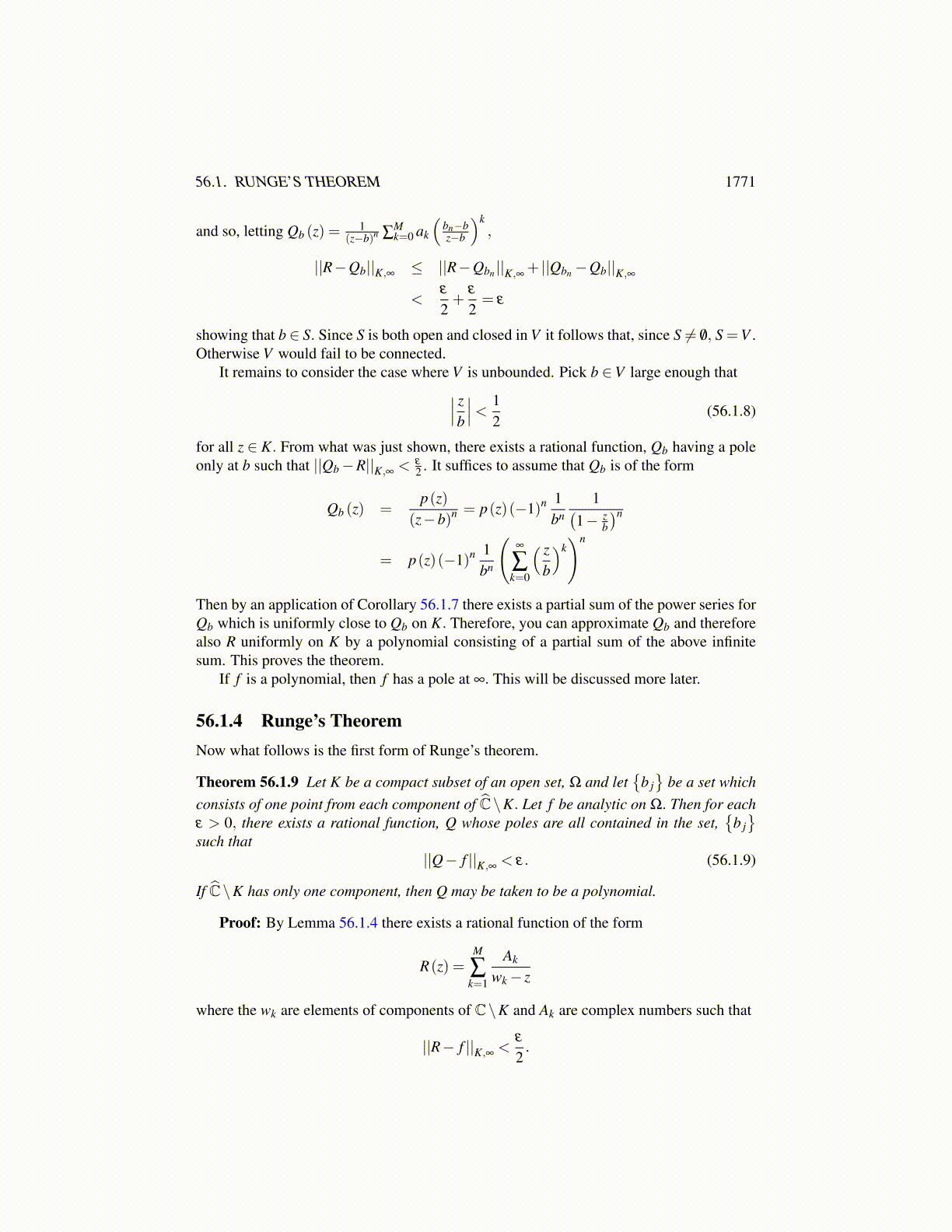
56.1. RUNGE’S THEOREM 1771
Lemma 56.1.8 Let R be a rational function which has a pole only at a ∈ V, a componentof C \K where K is a compact set. Suppose b ∈ V. Then for ε > 0 given, there exists arational function Q, having a pole only at b such that
||R−Q||K,∞ < ε. (56.1.4)
If it happens that V is unbounded, then there exists a polynomial, P such that
||R−P||K,∞ < ε. (56.1.5)
Proof: Say that b ∈ V satisfies P if for all ε > 0 there exists a rational function, Qb,having a pole only at b such that
||R−Qb||K,∞ < ε
Now define a set,S≡ {b ∈V : b satisfies P } .
Observe that S ̸= /0 because a ∈ S.I claim S is open. Suppose b1 ∈ S. Then there exists a δ > 0 such that∣∣∣∣b1−b
z−b
∣∣∣∣< 12
(56.1.6)
for all z ∈ K whenever b ∈ B(b1,δ ) . In fact, it suffices to take |b−b1| < dist(b1,K)/4because then ∣∣∣∣b1−b
z−b
∣∣∣∣ <
∣∣∣∣dist(b1,K)/4z−b
∣∣∣∣≤ dist(b1,K)/4|z−b1|− |b1−b|
≤ dist(b1,K)/4dist(b1,K)−dist(b1,K)/4
≤ 13<
12.
Since b1 satisfies P, there exists a rational function Qb1 with the desired properties. Itis shown next that you can approximate Qb1 with Qb thus yielding an approximation to Rby the use of the triangle inequality,∣∣∣∣R−Qb1
∣∣∣∣K,∞
+∣∣∣∣Qb1 −Qb
∣∣∣∣K,∞≥ ||R−Qb||K,∞ .
Since Qb1 has poles only at b1, it follows it is a sum of functions of the form αn(z−b1)
n .
Therefore, it suffices to consider the terms of Qb1 or that Qb1 is of the special form
Qb1 (z) =1
(z−b1)n .
However,1
(z−b1)n =
1
(z−b)n(
1− b1−bz−b
)n