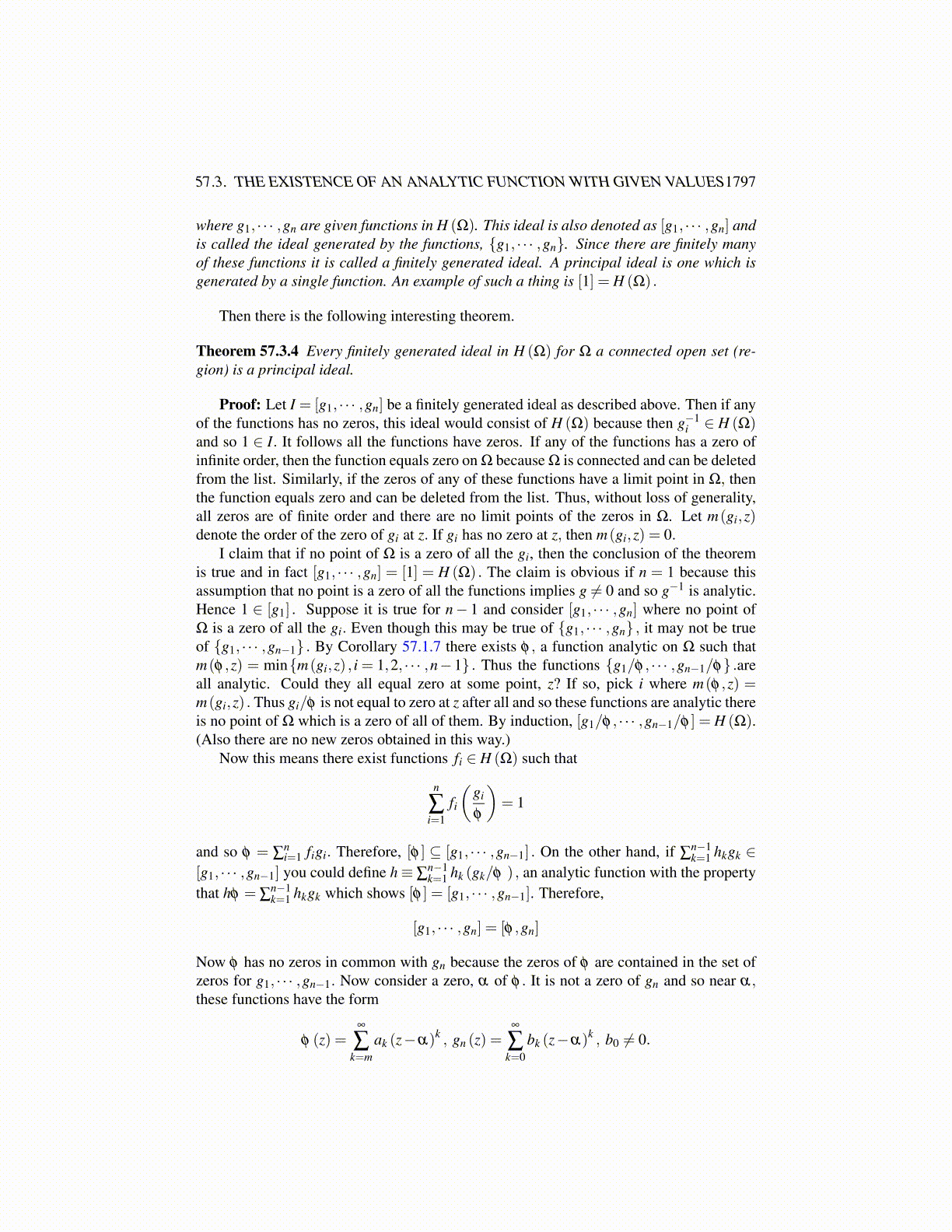
57.3. THE EXISTENCE OF AN ANALYTIC FUNCTION WITH GIVEN VALUES1797
and it only remains to find c. Divide both sides by πz and take a limit as z→ 0. Using thepower series of sin(πz) , this yields
1 =ec
π
and so c = lnπ . Therefore,
sin(πz) = zπ
∞
∏n=1
(1−( z
n
)2). (57.2.17)
Example 57.2.4 Find an interesting formula for tan(πz) .
This is easy to obtain from the formula for cot(πz) .
cot(
π
(z+
12
))=− tanπz
for z real and therefore, this formula holds for z complex also. Therefore, for z+ 12 not an
integer
π cot(
π
(z+
12
))=
22z+1
+∞
∑n=1
2z+1( 2z+12
)2−n2
57.3 The Existence Of An Analytic Function With GivenValues
The Weierstrass product formula, Theorem 57.1.4, along with the Mittag-Leffler theorem,Theorem 56.2.1 can be used to obtain an analytic function which has given values on acountable set of points, having no limit point. This is clearly an amazing result and indi-cates how potent these theorems are. In fact, you can show that it isn’t just the values ofthe function which may be specified at the points in this countable set of points but thederivatives up to any finite order.
Theorem 57.3.1 Let P≡{zk}∞
k=1 be a set of points in C,which has no limit point. For eachzk, consider
mk
∑j=0
akj (z− zk)
j . (57.3.18)
Then there exists an analytic function defined on C such that the Taylor series of f at zkhas the first mk terms given by 57.3.18.1
Proof: By the Weierstrass product theorem, Theorem 57.1.4, there exists an analyticfunction, f defined on all of Ω such that f has a zero of order mk +1 at zk. Consider this zkThus for z near zk,
f (z) =∞
∑j=mk+1
c j (z− zk)j
1This says you can specify the first mk derivatives of the function at the point zk .