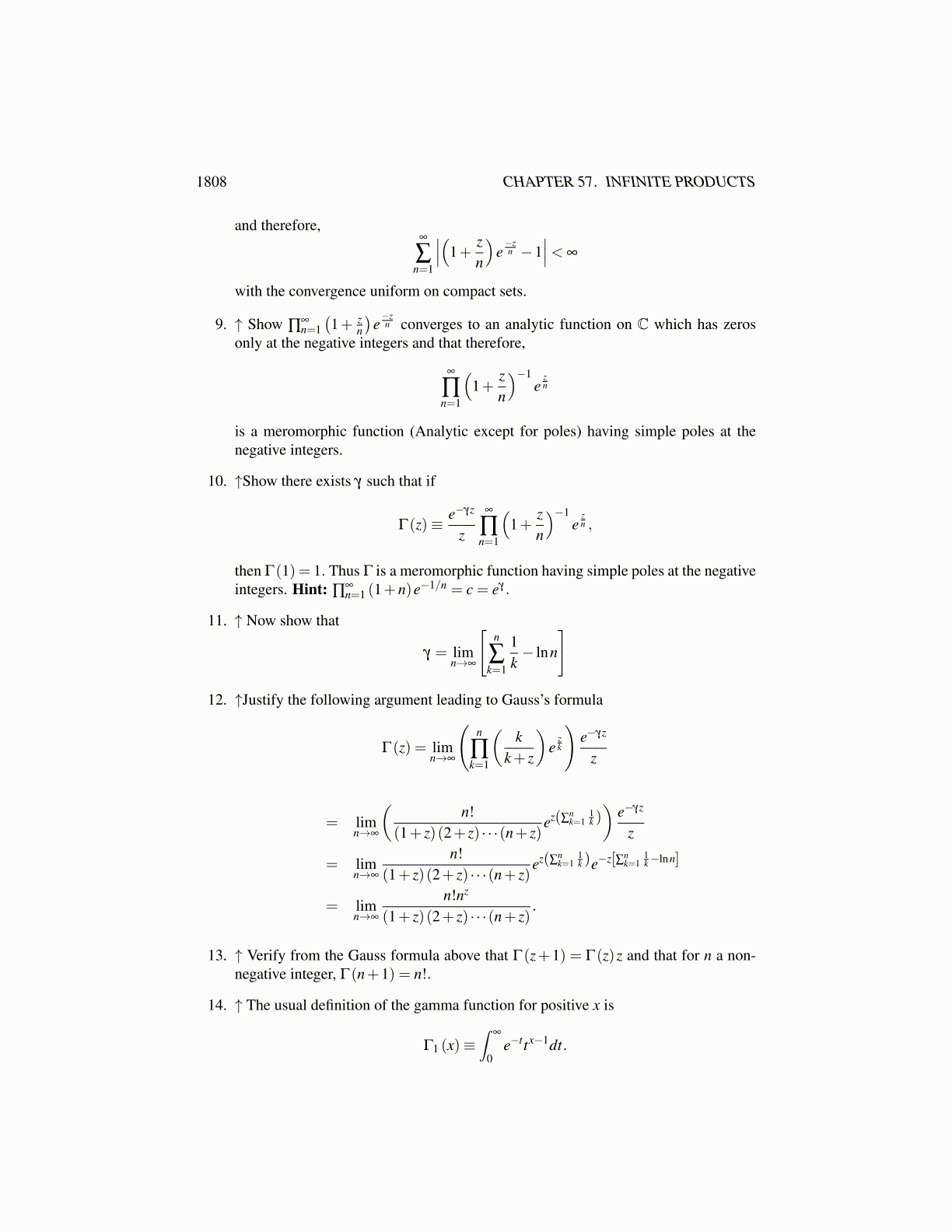
1808 CHAPTER 57. INFINITE PRODUCTS
The function tz = exp(z ln(t)) is analytic. I claim that F (z) is also analytic for Rez > 0.Apply Morera’s theorem. Let T be a triangle in Rez > 0. Then∫
∂TF (z)dz =
∫∂T
∫(0,b]
e(z ln(t))ξ d |µ|dz
Now∫
∂T can be split into three integrals over intervals ofR and so this integral is essentiallya Lebesgue integral taken with respect to Lebesgue measure. Furthermore, e(z ln(t)) is acontinuous function of the two variables and ξ is a function of only the one variable, t.Thus the integrand is product measurable. The iterated integral is also absolutely integrablebecause
∣∣∣e(z ln(t))∣∣∣ ≤ ex ln t ≤ ex lnb where x+ iy = z and x is given to be positive. Thus the
integrand is actually bounded. Therefore, you can apply Fubini’s theorem and write∫∂T
F (z)dz =∫
∂T
∫(0,b]
e(z ln(t))ξ d |µ|dz
=∫(0,b]
ξ
∫∂T
e(z ln(t))dzd |µ|= 0.
By Morera’s theorem, F is analytic on Rez > 0 which is given to have zeros at the λ k.Now let φ (z) = 1+z
1−z . Then φ maps B(0,1) one to one onto Rez > 0. To see this let0 < r < 1.
φ
(reiθ)=
1+ reiθ
1− reiθ =1− r2 + i2r sinθ
1+ r2−2r cosθ
and so Reφ(reiθ)> 0. Now the inverse of φ is φ
−1 (z) = z−1z+1 . For Rez > 0,
∣∣φ−1 (z)∣∣2 = z−1
z+1· z−1
z+1=|z|2−2Rez+1
|z|2 +2Rez+1< 1.
Consider F ◦φ , an analytic function defined on B(0,1). This function is given to have zerosat zn where φ (zn) =
1+zn1−zn
= λ n. This reduces to zn =−1+λ n1+λ n
. Now
1−|zn| ≥c
1+λ n
for a positive constant, c. It is given that ∑1
λ n= ∞. so it follows ∑(1−|zn|) = ∞ also.
Therefore, by Corollary 57.5.4, F ◦φ = 0. It follows F = 0 also. In particular, F (k) for k apositive integer equals zero. This has shown that if Λ ∈C ([0,b])′ and Λ sends 1 and all thetλ n to 0, then Λ sends 1 and all tk for k a positive integer to zero. As explained above, X isdense in C ((0,b]) .
The converse of this theorem is also true and is proved in Rudin [113].
57.6 Exercises1. Suppose f is an entire function with f (0) = 1. Let
M (r) = max{| f (z)| : |z|= r} .