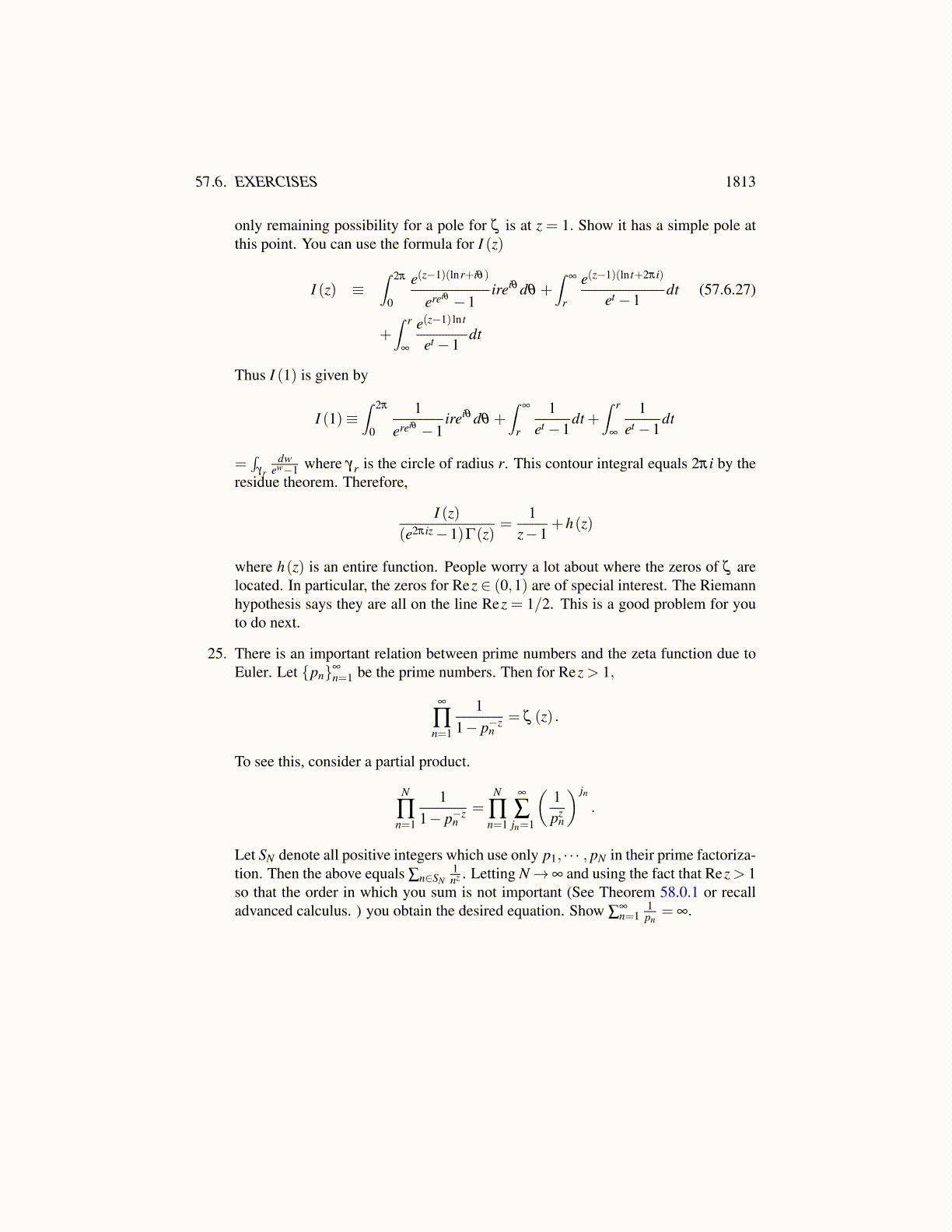
57.6. EXERCISES 1813
where the oriented contour is shown below.
γr,r1,δ
In this contour integral, wz−1 denotes e(z−1) log(w) where log(w) = ln |w|+ iarg(w)for arg(w) ∈ (0,2π) . Explain why this integral equals zero. From Problem 20 itfollows that Ir = Ir1 . Therefore, you can define an entire function, I (z)≡ Ir (z) for allr positive but sufficiently small. Hint: Remember the Cauchy integral formula foranalytic functions defined on simply connected regions. You could argue there is asimply connected region containing γr,r1,δ
.
22. ↑ In case Rez > 1, you can get an interesting formula for I (z) by taking the limit asr→ 0. Recall that
Ir (z) ≡∫ 2π
0
e(z−1)(lnr+iθ)
ereiθ −1ireiθ dθ +
∫∞
r
e(z−1)(ln t+2πi)
et −1dt (57.6.25)
+∫ r
∞
e(z−1) ln t
et −1dt
and now it is desired to take a limit in the case where Rez > 1. Show the first integralabove converges to 0 as r→ 0. Next argue the sum of the two last integrals convergesto (
e(z−1)2πi−1)∫ ∞
0
e(z−1) ln(t)
et −1dt.
Thus
I (z) =(ez2πi−1
)∫ ∞
0
e(z−1) ln(t)
et −1dt (57.6.26)
when Rez > 1.
23. ↑ So what does all this have to do with the zeta function and the gamma function?The zeta function is defined for Rez > 1 by
∞
∑n=1
1nz ≡ ζ (z) .
By Problem 15, whenever Rez > 0,
Γ(z) =∫
∞
0e−ttz−1dt.