57.6. EXERCISES 1815
only remaining possibility for a pole for ζ is at z = 1. Show it has a simple pole atthis point. You can use the formula for I (z)
I (z) ≡∫ 2π
0
e(z−1)(lnr+iθ)
ereiθ −1ireiθ dθ +
∫∞
r
e(z−1)(ln t+2πi)
et −1dt (57.6.27)
+∫ r
∞
e(z−1) ln t
et −1dt
Thus I (1) is given by
I (1)≡∫ 2π
0
1ereiθ −1
ireiθ dθ +∫
∞
r
1et −1
dt +∫ r
∞
1et −1
dt
=∫
γrdw
ew−1 where γr is the circle of radius r. This contour integral equals 2πi by theresidue theorem. Therefore,
I (z)(e2πiz−1)Γ(z)
=1
z−1+h(z)
where h(z) is an entire function. People worry a lot about where the zeros of ζ arelocated. In particular, the zeros for Rez ∈ (0,1) are of special interest. The Riemannhypothesis says they are all on the line Rez = 1/2. This is a good problem for youto do next.
25. There is an important relation between prime numbers and the zeta function due toEuler. Let {pn}∞
n=1 be the prime numbers. Then for Rez > 1,
∞
∏n=1
11− p−z
n= ζ (z) .
To see this, consider a partial product.
N
∏n=1
11− p−z
n=
N
∏n=1
∞
∑jn=1
(1pz
n
) jn.
Let SN denote all positive integers which use only p1, · · · , pN in their prime factoriza-tion. Then the above equals ∑n∈SN
1nz . Letting N→∞ and using the fact that Rez > 1
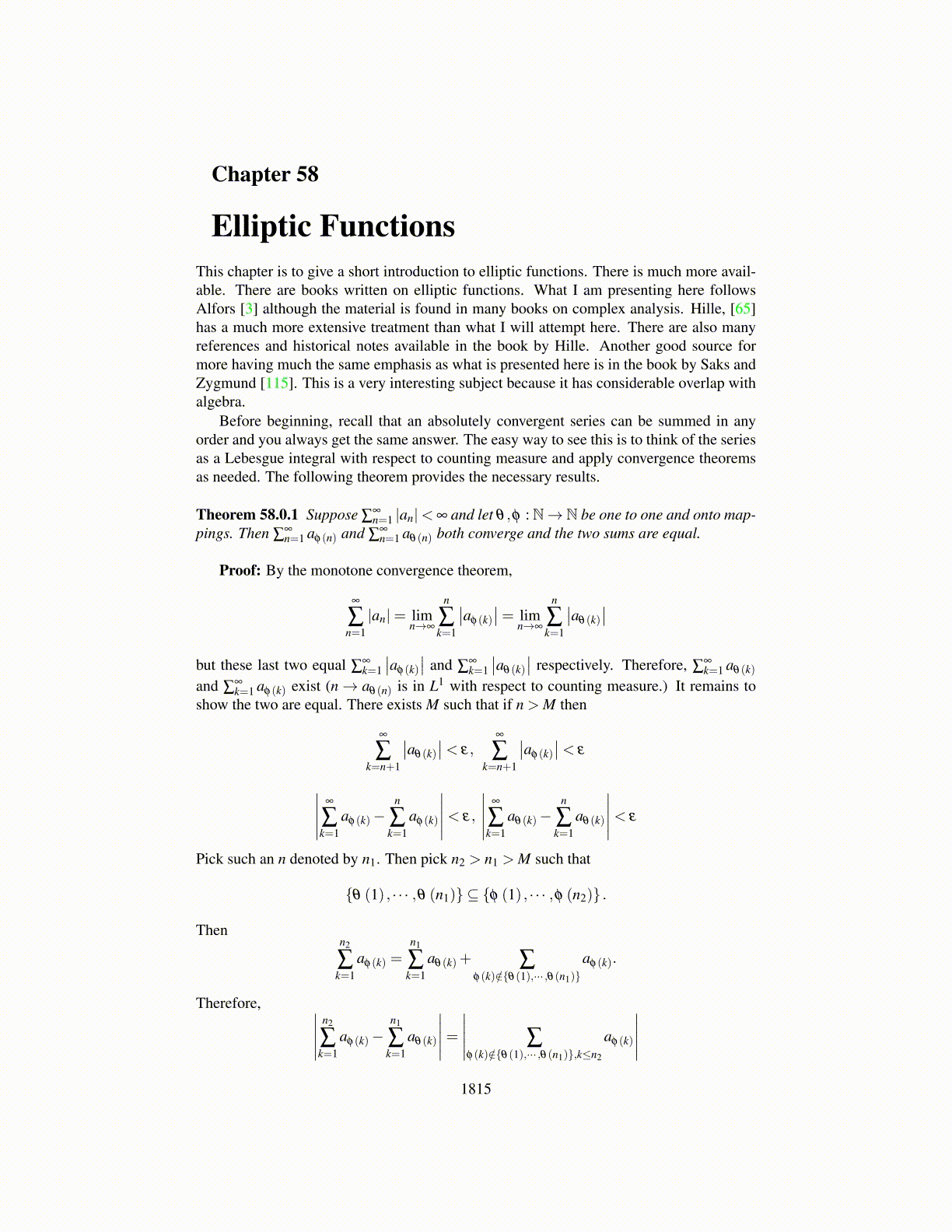
so that the order in which you sum is not important (See Theorem 58.0.1 or recalladvanced calculus. ) you obtain the desired equation. Show ∑
∞n=1
1pn
= ∞.