1832 CHAPTER 58. ELLIPTIC FUNCTIONS

Observation 58.1.15 The function, λ (τ) is analytic for τ in the upper half plane and neverassumes the values 0 and 1.

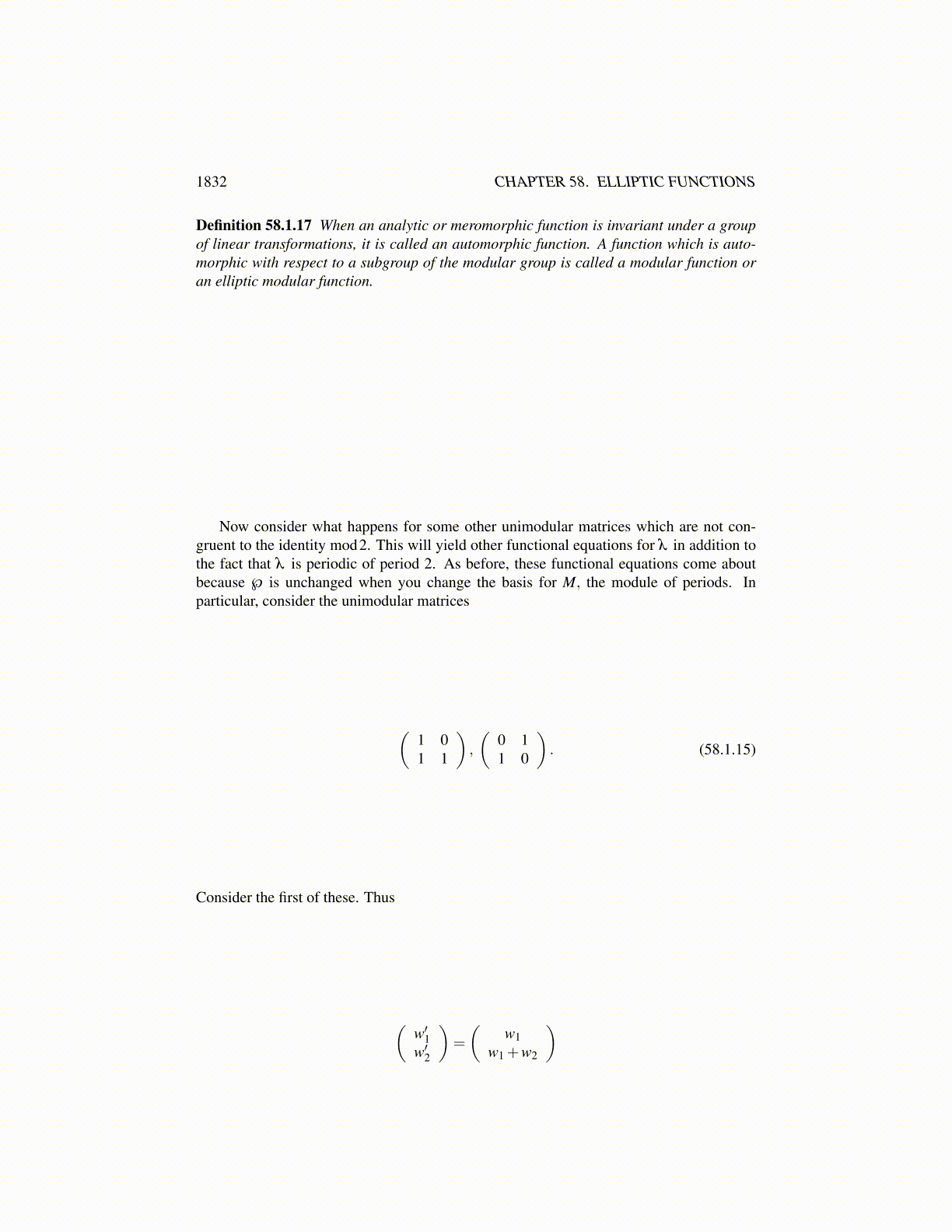
This is a very interesting function. Consider what happens when(w′1w′2

)=

(a bc d

)(w1w2

)and the matrix is unimodular. By Theorem 58.1.12 on Page 1823 {w′1,w′2} is just anotherbasis for the same module of periods. Therefore, ℘(z,w1,w2) =℘(z,w′1,w

′2) because both

are defined as sums over the same values of w, just in different order which does not matterbecause of the absolute convergence of the sums on compact subsets of C. Since ℘ isunchanged, it follows ℘′ (z) is also unchanged and so the numbers, ei are also the same.However, they might be permuted in which case the function λ (τ) defined above wouldchange. What would it take for λ (τ) to not change? In other words, for which unimodulartransformations will λ be left unchanged? This happens if and only if no permuting takesplace for the ei. This occurs if ℘

(w12

)=℘

(w′12

)and ℘

(w22

)=℘

(w′22

). If

w′12− w1

2∈M,

w′22− w2

2∈M

then℘(w1

2

)=℘

(w′12

)and so e1 will be unchanged and similarly for e2 and e3. This occurs

exactly when12((a−1)w1 +bw2) ∈M,

12(cw1 +(d−1)w2) ∈M.

This happens if a and d are odd and if b and c are even. Of course the stylish way to saythis is

a≡ 1mod2, d ≡ 1mod2, b≡ 0mod2, c≡ 0mod2. (58.1.11)

This has shown that for unimodular transformations satisfying 58.1.11 λ is unchanged.Letting τ be defined as above,

τ′ =

w′2w′1≡ cw1 +dw2

aw1 +bw2=

c+dτ

a+bτ.

Thus for unimodular transformations,(

a bc d

)satisfying 58.1.11, or more succinctly,

(a bc d

)∼(

1 00 1

)mod2 (58.1.12)

it follows that

λ

(c+dτ

a+bτ

)= λ (τ) . (58.1.13)

Furthermore, this is the only way this can happen.

1832 CHAPTER 58. ELLIPTIC FUNCTIONSObservation 58.1.15 The function, A (7) is analytic for t in the upper half plane and neverassumes the values 0 and 1.This is a very interesting function. Consider what happens whenw, \_ [a b WICi )=Co a) Ga)and the matrix is unimodular. By Theorem 58.1.12 on Page 1823 {w,w4} is just anotherbasis for the same module of periods. Therefore, 2(z,w1,w2) = (9(z,w},,w5) because bothare defined as sums over the same values of w, just in different order which does not matterbecause of the absolute convergence of the sums on compact subsets of C. Since g isunchanged, it follows 7 (z) is also unchanged and so the numbers, e; are also the same.However, they might be permuted in which case the function A (t) defined above wouldchange. What would it take for A (7) to not change? In other words, for which unimodulartransformations will A be left unchanged? This happens if and only if no permuting takesplace for the e;. This occurs if s(4!) = (5) and y9(*2) = e() If/ /wy Ww W w2—-—.— EM, ~-—~—eEmM2 2 2 2then (5) = (3) and so e; will be unchanged and similarly for e2 and e3. This occursexactly when1 13 ((a—Dwi +bw2) eM, 5 (ow +(d—1)w2) EM.This happens if a and d are odd and if b and c are even. Of course the stylish way to saythis isa= 1mod2, d=1mod2, b=0mod2, c=0mod2. (58.1.11)This has shown that for unimodular transformations satisfying 58.1.11 A is unchanged.Letting tT be defined as above,7a” _ cwr+dwy — c+dt~ wi aw; +bwe ~~ a+tbtThus for unimodular transformations, ( \ , ) satisfying 58.1.11, or more succinctly,a b 1 0( cd ) ~ ( 01 ) moa2 (58.1.12)it follows thatc+dtXr =A(t). 58.1.13(Se) (7) ( )Furthermore, this is the only way this can happen.