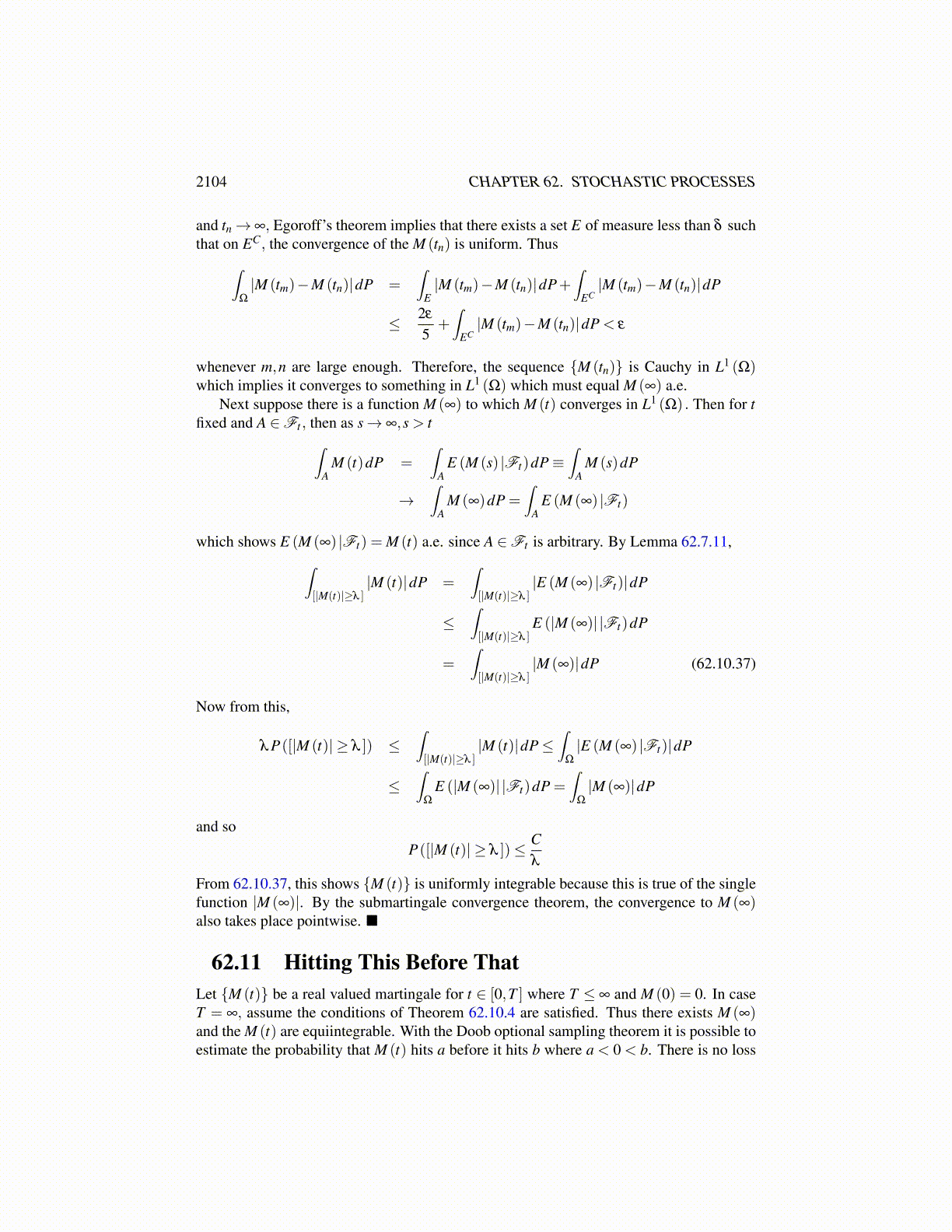
2104 CHAPTER 62. STOCHASTIC PROCESSES
≤ 1b−a
(E (X (τ2n+1))−E (X (τ0)))+1
≤ 1b−a
(E (X (M))−a)+1
which does not depend on n. The last inequality follows because 0≤ τ2n+1 ≤M and X (t)is a submartingale. Let n→ ∞ to obtain
E(
UM[a,b]
)≤ 1
b−a(E (X (M))−a)+1
where UM[a,b] is an upper bound to the number of upcrossings of {X (t)} on [0,M] . This
proves the following interesting upcrossing estimate.
Lemma 62.10.2 Let {Y (t)} be a continuous submartingale adapted to a normal filtrationFt for t ∈ [0,M] . Then if UM
[a,b] is defined as the above upper bound to the number ofupcrossings of {Y (t)} for t ∈ [0,M] , then this is a random variable and
E(
UM[a,b]
)≤ 1
b−a
(E (Y (M)−a)++a−a
)+1
=1
b−aE |Y (M)|+ 1
b−a|a|+1
With this it is easy to prove a continuous submartingale convergence theorem.
Theorem 62.10.3 Let {X (t)} be a continuous submartingale adapted to a normal filtra-tion such that
supt{E (|X (t)|)}=C < ∞.
Then there exists X∞ ∈ L1 (Ω) such that
limt→∞
X (t)(ω) = X∞ (ω) a.e. ω.
Proof: Let U[a,b] be defined by
U[a,b] = limM→∞
UM[a,b].
Thus the random variable U[a,b] is an upper bound for the number of upcrossings. FromLemma 62.10.2 and the assumption of this theorem, there exists a constant C independentof M such that
E(
UM[a,b]
)≤ C
b−a+1.
Letting M→ ∞, it follows from monotone convergence theorem that
E(U[a,b]
)≤ C
b−a+1