2200 CHAPTER 64. WIENER PROCESSES
and in general,
E((h,(W (t)−W (s)))2m
U
)=Cm (Qh,h)m (t− s)m .
Now it follows from Minkowsky’s inequality applied to the two integrals ∑∞i=1 and
∫Ω
that
[E(|W (t)−W (s)|2m
)]1/m=
[E
((∞
∑k=1
(ek,W (t)−W (s))2
)m)]1/m
≤∞
∑k=1
[E((ek,W (t)−W (s))2m
)]1/m
=∞
∑k=1
[Cm (Qek,ek)m (t− s)m]
1/m
= C1/mm |t− s|
(∞
∑k=1
(Qek,ek)
)≡C′m |t− s| .
Hence there exists a constant Cm such that
E(|W (t)−W (s)|2m
)≤Cm |t− s|m
By the Kolmogorov Čentsov Theorem, Theorem 62.2.2, it follows that off a set ofmeasure 0, t→W (t,ω) is Holder continuous with exponent γ such that
γ <m−1
2m, m > 2.
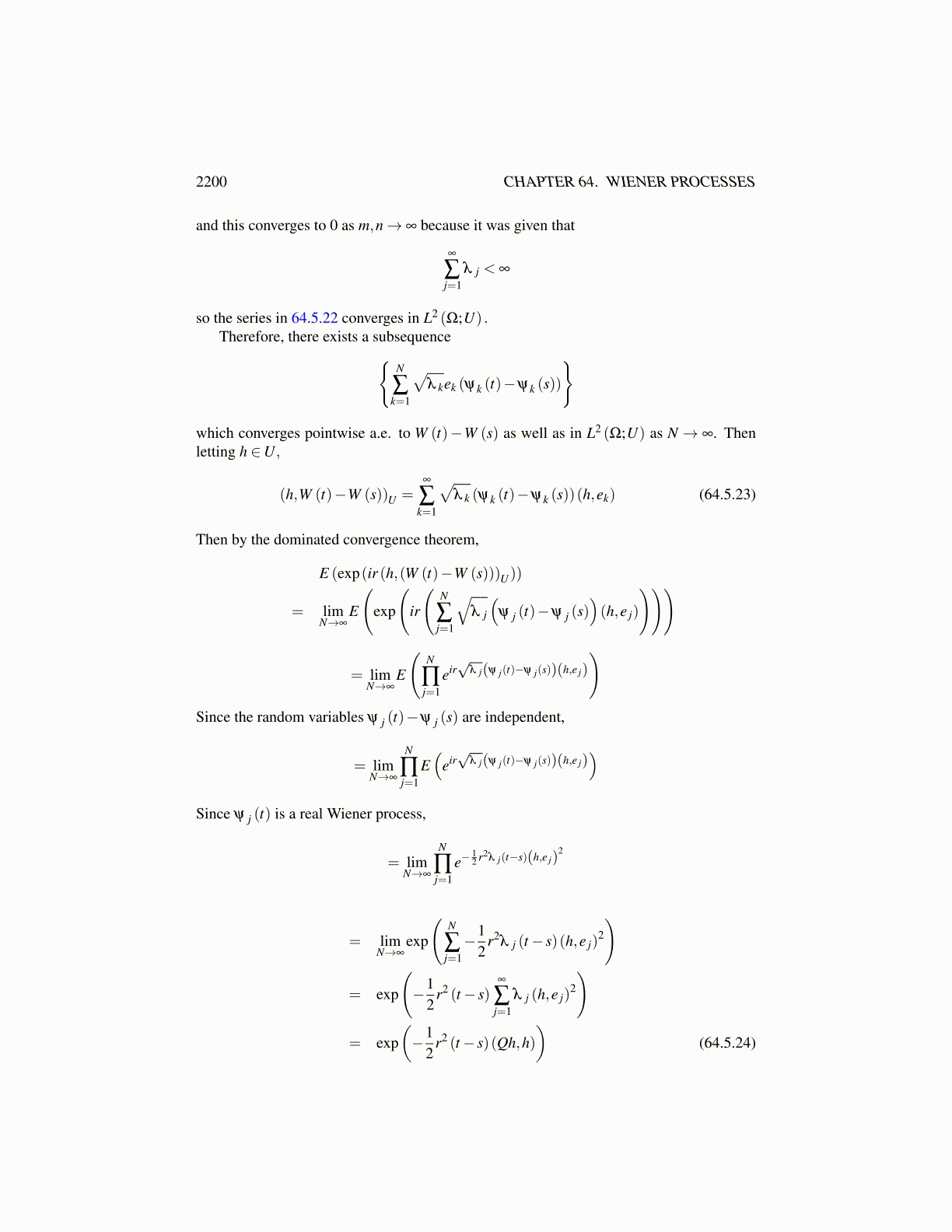
Finally, from 64.5.19 with r = 1,
E (exp i(h,W (t)−W (s))U ) = exp(−1
2(t− s)(Qh,h)
)which is the same as E (exp i(h,W (t− s))U ) due to the fact W (0) = 0.
The above has shown that W (t) satisfies the conditions of Lemma 64.4.2 and so it is amartingale with respect to the filtration given there. What is its quadratic variation?
E(||W (t)||2
)=
∞
∑k=1
E ((W (t) ,ek)(W (t) ,ek)) =∞
∑k=1
(Qek,ek) t = trace(Q) t
Is it the case that [W ] (t) = trace(Q) t? Let the filtration be as in Lemma 64.4.2 and letA ∈Fs. Then using the result of that lemma,∫
A
(||W (t)||2− t trace(Q) |Fs
)dP
=∫
A
(||W (t)−W (s)||2 +2(W (t) ,W (s))−||W (s)||2
−(t− s) traceQ− traceQs|Fs)dP