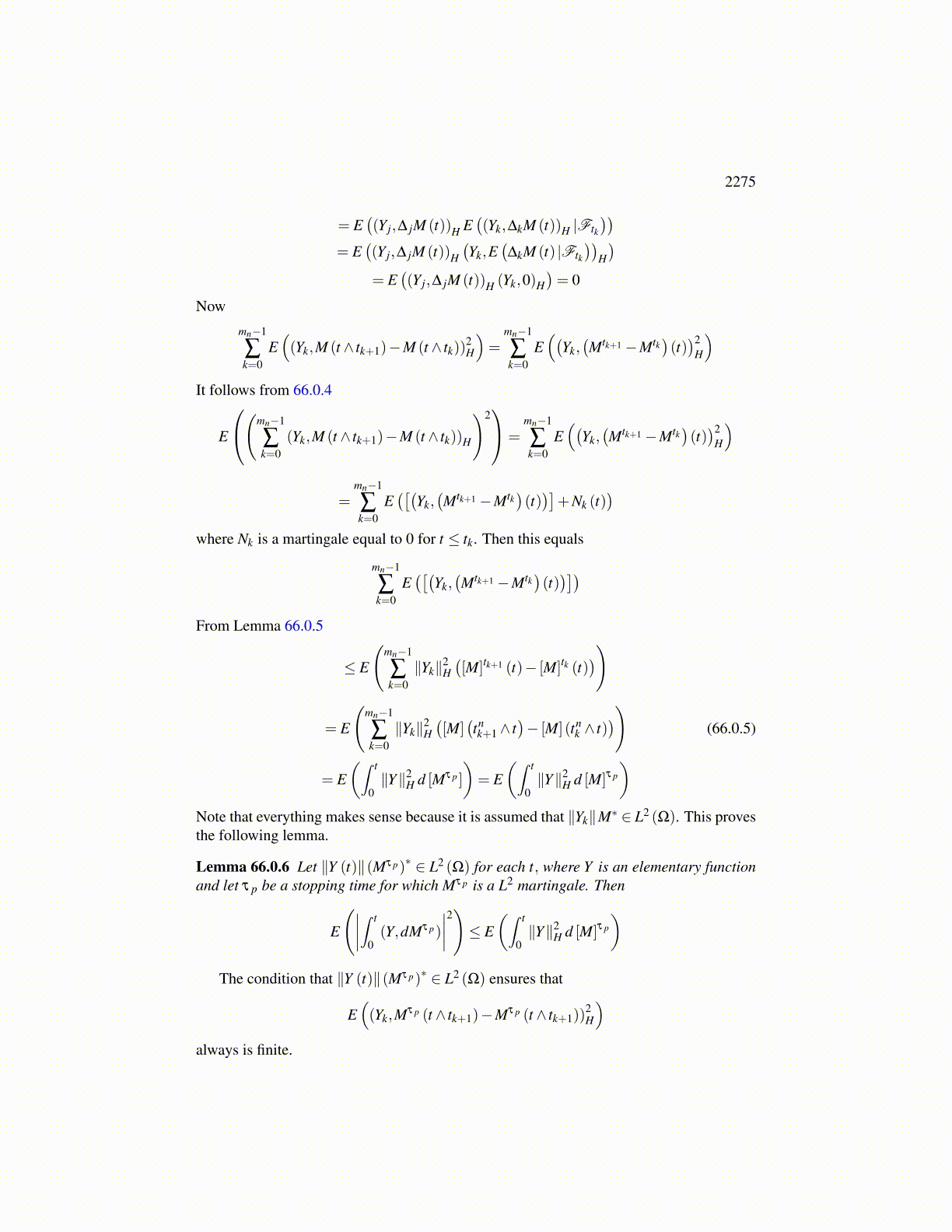
2275
Lemma 66.0.5 Let M be a local martingale on [0,T ] where M (0)= 0 and M is continuous.Let 0 < r < s < T and consider (Y,(Mτ ps−Mτ pr)(t)) where Y (Mτ p)∗ ∈ L2 (Ω) and Y isFr measurable and τ p is a localizing sequence of stopping times for which Mτ p is a L2
martingale. Then this is a martingale on [0,T ] which equals 0 at t = 0 and
[(Y,(Mτ ps−Mτ pr))] (t) ≤ ∥Y∥2 [Mτ ps−Mτ pr] (t)
= ∥Y∥2 ([Mτ p ]s (t)− [Mτ p ]r (t))
= ∥Y∥2 ([Mτ p ] (t ∧ s)− [Mτ p ] (t ∧ r))
It follows that for Y an elementary function where each Yi (Mτ p)∗ is in L2 (Ω),∫ t
0(Y,dM)
is a local martingale.
Proof: To save notation, M is written in place of Mτ p . It is clear that
(Y,(Ms−Mr)(t)) = 0
if t ≤ r. Is it a martingale?
E ((Y,(Ms−Mr)(t))) = E (E ((Y,(Ms−Mr)(t)) |Fr))
= E ((Y,E ((M (s∧ t)−M (r∧ t)) |Fr))) = 0
because M is a martingale. Now let σ be a bounded stopping time with two values. Thenusing the optional sampling theorem where needed,
E ((Y,(Ms−Mr)(σ))) = E (E ((Y,(Ms−Mr)(σ)) |Fr))
= E ((Y,E ((M (s∧σ)−M (r∧σ)) |Fr)))
= E ((Y,M (s∧σ ∧ r)−M (r∧σ)))
= E ((Y,M (σ ∧ r)−M (r∧σ))) = 0
It follows that this is indeed a martingale as claimed.By the definition of the quadratic variation,
|(Y,(Ms−Mr)(t))|2 ≤ ∥Y∥2 ∥(Ms−Mr)(t)∥2
= ∥Y∥2 [(Ms−Mr)] (t)+∥Y∥2 N̂ (t)
where N̂ (t) is a martingale. It equals 0 if t ≤ r. By similar reasoning to the above,∥Y∥2 N̂ (t) is a martingale. To see this,
E(∥Y∥2 N̂ (σ)
)= E
(E(∥Y∥2 N̂ (σ) |Fr
))= E
(∥Y∥2 E
(N̂ (σ) |Fr
))= E
(∥Y∥2 N (σ ∧ r)
)= 0