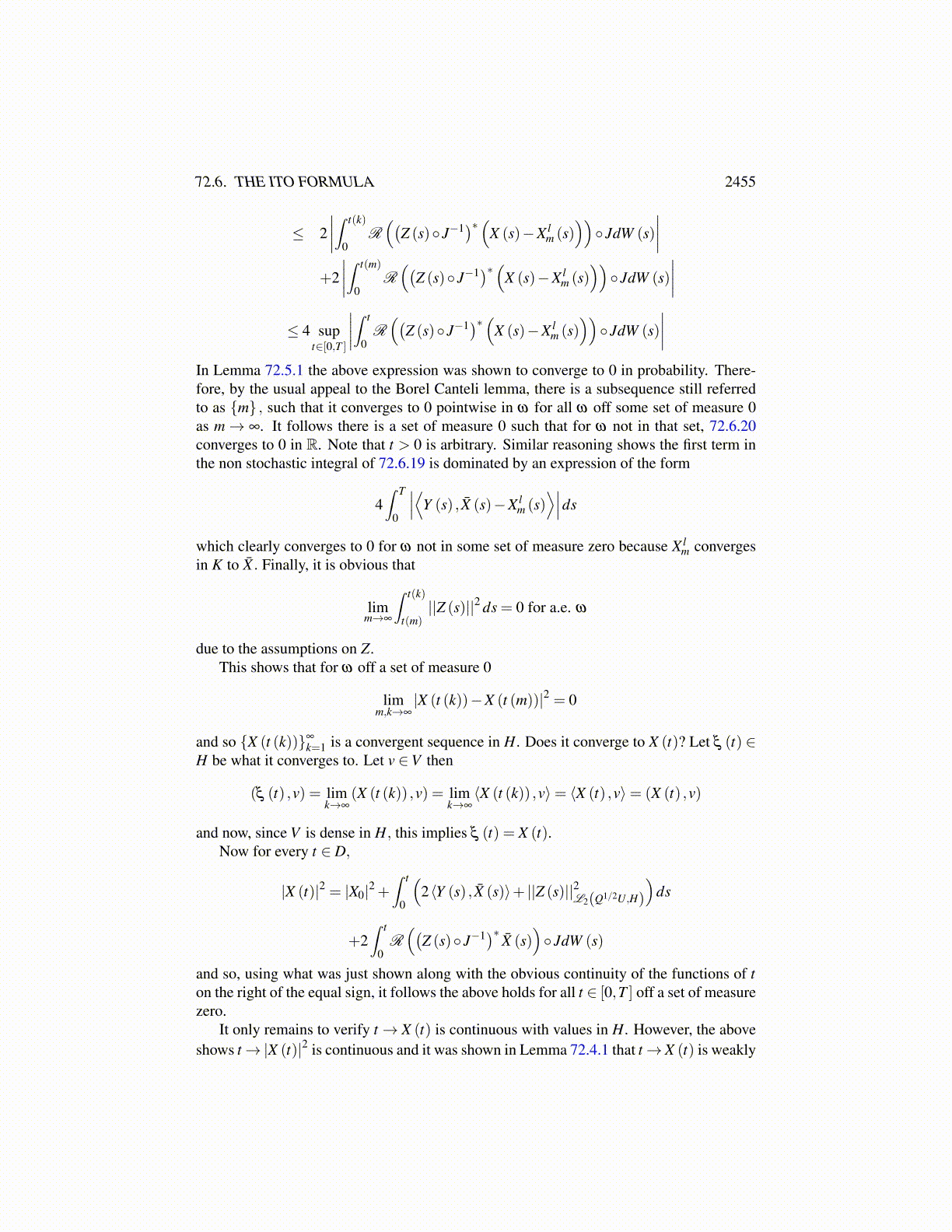
72.6. THE ITO FORMULA 2455
Now consider the other term, 72.6.14 using the n just determined. This term is of theform
qk−1
∑j=1
∫ t j+1
t j
⟨Y (s) ,X r
k (s)−X lk (s)−Pn
(Mr
k (s)−Mlk (s)
)⟩ds
=∫ t
t1
⟨Y (s) ,X r
k (s)−X lk (s)−Pn
(Mr
k (s)−Mlk (s)
)⟩ds
where Mrk denotes the step function
Mrk (t) =
mk−1
∑i=0
M (ti+1)X(ti,ti+1] (t)
and Mlk is defined similarly. The term∫ t
t1
⟨Y (s) ,Pn
(Mr
k (s)−Mlk (s)
)⟩ds
converges to 0 for a.e. ω as k→ ∞.This is because the integrand converges to 0 thanks tothe continuity of M (t) and also since this is a projection onto a finite dimensional subspaceof V, Therefore, for each ω off a set of measure zero,∫ t
t1
⟨Y (s) ,Pn
(Mr
k (s)−Mlk (s)
)⟩ds
≤∫ t
t1∥Y (s)∥V ′
∥∥∥Pn
(Mr
k (s)−Mlk (s)
)∥∥∥V
ds
and this last integral converges to 0 as k→ ∞ because Pn (M (s)) is uniformly boundedin V so there is no problem getting a dominating function for the dominated convergencetheorem. Let
Ak ≡[∣∣∣∣∫ t
t1∥Y (s)∥V ′
∥∥∥Pn
(Mr
k (s)−Mlk (s)
)∥∥∥V
ds∣∣∣∣> ε
]Then since the partitions are increasing, these sets are decreasing as k increases and theirintersection has measure zero. Hence P(Ak)→ 0. It follows that
limk→∞
P([∣∣∣∣∫ t
t1
⟨Y (s) ,Pn
(Mr
k (s)−Mlk (s)
)⟩ds∣∣∣∣> ε
])≤
limk→∞
P([∣∣∣∣∫ t
t1∥Y (s)∥V ′
∥∥∥Pn
(Mr
k (s)−Mlk (s)
)∥∥∥V
ds∣∣∣∣> ε
])= 0
Now consider ∫ t
t1
⟨Y (s) ,X r
k (s)−X lk (s)
⟩ds
This converges to 0 in L1 (Ω) because it is of the form∫ t
t1⟨Y (s) ,X r
k (s)⟩ds−∫ t
t1
⟨Y (s) ,X l
k (s)⟩
ds